New
New
The inheritance of biological sex in humans
I can explain how the inheritance of chromosomes determines biological sex in humans.
Lesson 5 of 4
New
New
- Year 10
- AQA
The inheritance of biological sex in humans
I can explain how the inheritance of chromosomes determines biological sex in humans.
Lesson details
Key learning points
- During sexual reproduction, an individual’s biological sex is determined by the chromosomes they inherit.
- In humans, the 23rd pair of chromosomes are sex chromosomes; XX in females and XY in males.
- A gene on the Y chromosome triggers the development of testes, which make male sex hormones (androgens).
- Interpreting, completing and constructing Punnett squares showing the inheritance of human sex chromosomes.
Keywords
Sexual reproduction - The process of producing offspring where a male and a female provide half the genetic material via gametes.
Biological sex - Male or female as determined by the combination of sex chromosomes inherited (i.e. XX female, XY male).
Sex chromosome - The chromosomes that determine the reproductive and secondary sexual characteristics (i.e. X and Y).
Sex hormone - Chemical messengers, secreted by glands, that help to control the reproductive and secondary sexual characteristics.
Common misconception
Males only have Y chromosomes.
Males have one Y and one X chromosome.
Emphasise that mothers can only pass on X chromosomes, to both males and females, it is the sex chromosme of the sperm that will determine the biological sex of the offspring.
Teacher tip
Equipment
None required.
Licence
This content is © Oak National Academy Limited (2026), licensed on Open Government Licence version 3.0 except where otherwise stated. See Oak's terms & conditions (Collection 2).
Prior knowledge starter quiz
6 Questions
Q1.Which is the best definition of genotype?
Which is the best definition of genotype?
An individual’s genetic make-up.
All of an individual’s genes.
An individual’s physical characteristics.
An individual’s combination of genes.
Q2.Horses can breed with donkeys to produce offspring called mules. Horse body cells have 64 chromosomes and those of a donkey have 62. How many chromosomes will the zygote that grows into a mule have?
Horses can breed with donkeys to produce offspring called mules. Horse body cells have 64 chromosomes and those of a donkey have 62. How many chromosomes will the zygote that grows into a mule have?
126
64
62
2
Q3.Tay-Sachs is a single gene disorder caused by a recessive allele. Here is a family tree. It shows three generations. The shaded male has Tay-Sachs. Which statement is true?
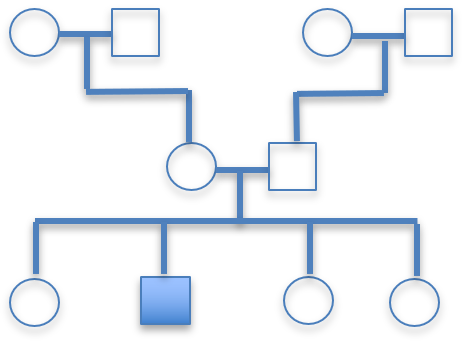
Tay-Sachs is a single gene disorder caused by a recessive allele. Here is a family tree. It shows three generations. The shaded male has Tay-Sachs. Which statement is true?

All the grandparents must be carriers of Tay-Sachs.
One grandparent is a carrier of Tay-Sachs.
One parent is a carrier of Tay-Sachs
All the females are carriers of Tay-Sachs.
Q4.Albinism is caused by a recessive allele. The Punnett square shows the possible genotypes resulting from two carriers having a child. What is the probability that a child will be a carrier?
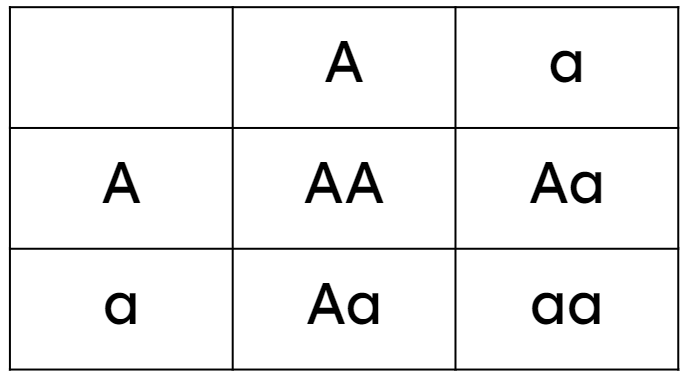
Albinism is caused by a recessive allele. The Punnett square shows the possible genotypes resulting from two carriers having a child. What is the probability that a child will be a carrier?

0.00
0.25
0.75
1.00
Q5.A student thinks you can tell the genotype of an individual by looking at its phenotype. When is this statement true?
A student thinks you can tell the genotype of an individual by looking at its phenotype. When is this statement true?
Always.
Only if the individual is heterozygous.
Only if the individual is homozygous dominant.
Never.
Q6.Although it wasn’t recognised at the time, Mendel made a significant contribution to our modern understanding of inheritance. What was this contribution?
Although it wasn’t recognised at the time, Mendel made a significant contribution to our modern understanding of inheritance. What was this contribution?
He worked out that proteins are made from amino acids.
He isolated DNA from a nucleus.
He worked out that three DNA bases code for each amino acid.
He discovered the double helix structure of DNA.
Assessment exit quiz
6 Questions
Q1.Match each term to its correct meaning.
Match each term to its correct meaning.
Q2.What percentage of the chromosomes in the nucleus of a zygote comes from the father?
What percentage of the chromosomes in the nucleus of a zygote comes from the father?
0%
25%
75%
100%
Q3.In humans, biological sex is determined by ...
In humans, biological sex is determined by ...
all 46 chromosomes.
only the Y chromosome.
only the X chromosome.
Q4.Put the statements in order to describe how sex chromosomes cause the development of male biological sex.
Put the statements in order to describe how sex chromosomes cause the development of male biological sex.
Q5.The incomplete Punnett square show the inheritance of biological sex in humans. What combination of sex chromosomes cannot be produced in a fertilised egg cell?
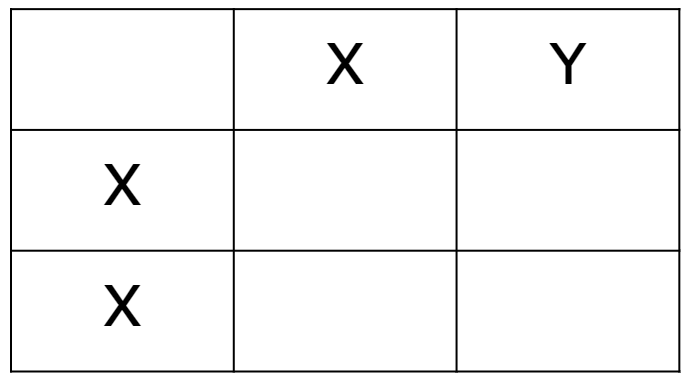
The incomplete Punnett square show the inheritance of biological sex in humans. What combination of sex chromosomes cannot be produced in a fertilised egg cell?

Q6.Henry the VIII had his second wife Anne Boleyn executed partly because she failed to give him a male child. Why wasn’t the absence of a male child her fault?
Henry the VIII had his second wife Anne Boleyn executed partly because she failed to give him a male child. Why wasn’t the absence of a male child her fault?
Only one of their children, later Queen Elizabeth I, survived childhood.
If more children had been conceived, eventually one would have been a boy.
Only half her eggs would contain a Y chromosome, so it was just chance.