


The intercept point
I can calculate the intercept point from a graph and from two coordinate pairs.


- Year 8
The intercept point
I can calculate the intercept point from a graph and from two coordinate pairs.
Lesson details
Key learning points
- The y-intercept can be found by considering the graph.
- The y-intercept occurs when the x value is zero.
- The gradient can be found from two points.
- The y-intercept can be found using the gradient and one of the points.
- It is useful to check using the second point while understanding the limitations of this check.
Keywords
Gradient - The gradient is a measure of how steep a line is.
Intercept - An intercept is the coordinate where a line or curve meets a given axis.
Linear - The relationship between two variables is linear if, when plotted on a pair of axes, a straight line is formed.
Common misconception
Writing the y intercept as a single value or getting the x and y coordinates the wrong way around.
Encourage writing the y intercept as a coordinate. Stating 'lines cross the y axis when x=0' can help pupils write the coordinate correctly.


Licence
Lesson video
Loading...
Prior knowledge starter quiz
6 Questions
Q1.Which of these sequences are linear?

Q2.Which of these best describes an intercept point?
Q3.The tables shown have been labeled A,B,C,D,E. Match the table with the correct gradient.
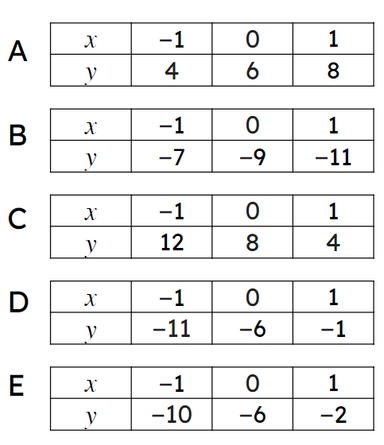
A - 2
B - -2
C - -4
D - 5
E - 4
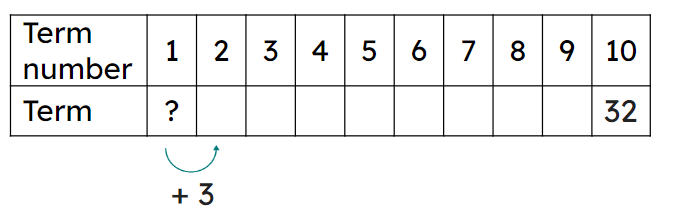
Q4.In a linear sequence the common difference is 3 and the tenth term is 32. What is the first term?
Q5.What is the gradient of the line which passes through the coordinates (4, 7) and (6,11) ?
Q6.What is the gradient of the line which passes through the coordinates (2, -6) and (0,-1) ?
Assessment exit quiz
6 Questions
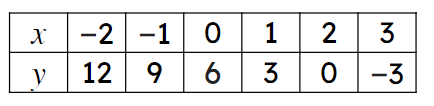
Q1.What is the $$y$$-intercept for the line formed when this table of values is plotted?
Q2.Which of these coordinates could be a $$y$$-intercept?
Q3.The graph shows 5 lines labelled A, B, C, D, E. Match the line to its corresponding $$y$$ intercept.
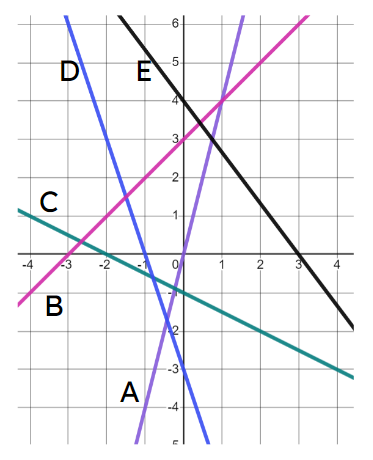
A (purple) - (0,0)
B (pink) - (0,3)
C (green) - (0,-1)
D (blue) - (0,-3)
E (black) - (0,4)
Q4.What is the $$y$$ intercept for the line belonging to this table of values?
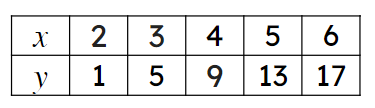
Q5.What is the $$y$$ intercept for the line belonging to this table of values?
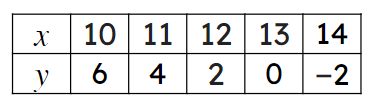
Q6.Match up the $$y$$-intercepts with the corresponding lines.
(0,-3) - The line through (4,5) and (5,7)
(0,0) - The line through (1,3) and (3,9)
(0,15) - The line through (10,5) and (13,2)
(0,-15) - The line through (4,-3) and (8,9)
