Choose exam board for KS4 Computer Science (GCSE)
Choose exam board for KS4 English
Choose exam board for KS4 French
Choose exam board for KS4 Geography
Choose exam board for KS4 German
Choose exam board for KS4 History
Choose tier for KS4 Maths
Choose exam board for KS4 Music
Choose exam board for KS4 Physical education (GCSE)
Choose exam board for KS4 Religious education (GCSE)
Choose exam board for KS4 Spanish
      New
      New

      The perpendicular from the centre of a circle to a chord bisects the chord

      I can derive and use the theorem: the perpendicular from the centre of a circle to a chord bisects the chord.

      Lesson 4 of 11
      New
      New
      • Year 10

      The perpendicular from the centre of a circle to a chord bisects the chord

      I can derive and use the theorem: the perpendicular from the centre of a circle to a chord bisects the chord.

      Lesson details

      Key learning points

      1. A theorem is a statement that can be demonstrated to be true by accepted mathematical operations and arguments
      2. Theorems can be thought of as puzzles to solve, you are showing how to find a result
      3. In order to use this theorem, you may need to draw a diagram or add more information to an existing one

      Keywords

      • Bisect - To bisect means to cut or divide an object into two equal parts.

      • Chord - A chord is any line segment joining two points on the circumference of a circle.

      Common misconception

      Pupils may assume that a radius which intersects a chord always bisects the chord.

      A radius only bisects a chord if they are perpendicular.

      The lesson demonstrates how this circle theorem could be explored practically by using a pair of compasses, using a circular geoboard and using dynamic geometry software. Pupils may wish to explore these further for themselves.
      Teacher tip

      Equipment

      Ruler, protractor, pair of compasses, pencil

      Licence

      This content is © Oak National Academy Limited (2025), licensed on Open Government Licence version 3.0 except where otherwise stated. See Oak's terms & conditions (Collection 2).

      Lesson video

      Loading...

      Prior knowledge starter quiz

      6 Questions

      Q1.
      Which of these statements are correct?

      A chord can be a radius.
      Correct answer: A chord can be a diameter.
      A chord can be a tangent.
      Correct answer: A segment can be a sector.
      A minor sector can be a segment.

      Q2.
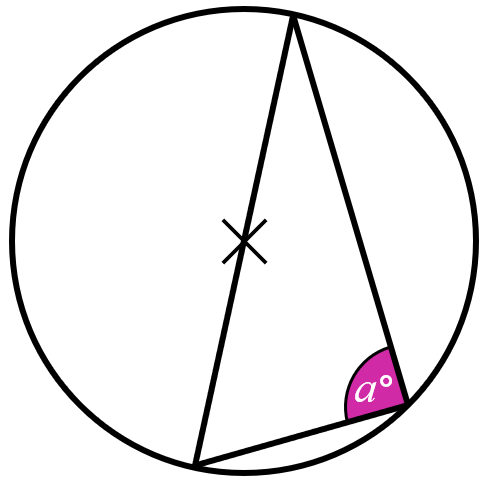
      Find the size of angle $$a$$°.

      An image in a quiz
      30°
      60°
      Correct answer: 90°
      120°
      Not enough information.

      Q3.
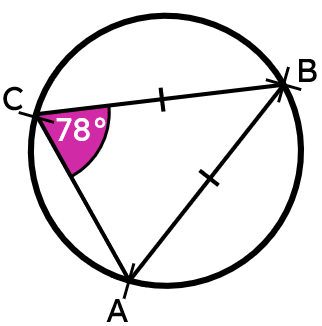
      The size of the angle subtended by the chord AC is °?

      An image in a quiz
      Correct Answer: 24, 24°, 24 degrees, 24degrees

      Q4.
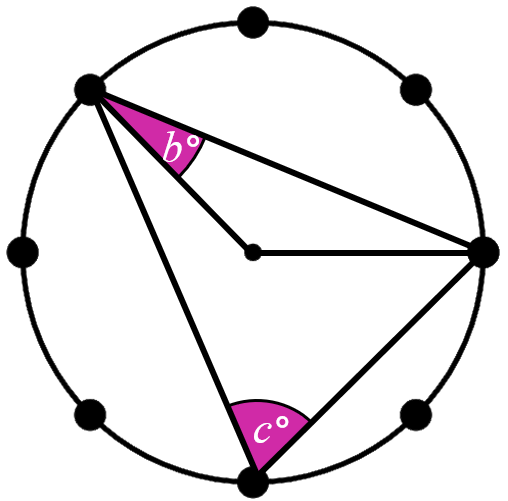
      The image shows an 8-point geoboard. The size of angle $$b$$° is °.

      An image in a quiz
      Correct Answer: 22.5, 22.5°, 22.5 degrees

      Q5.
      On this 8-point geoboard the size of the angle labelled $$c$$° is °.

      An image in a quiz
      Correct Answer: 67.5, 67.5°, 67.5 degrees, 67.5degrees

      Q6.
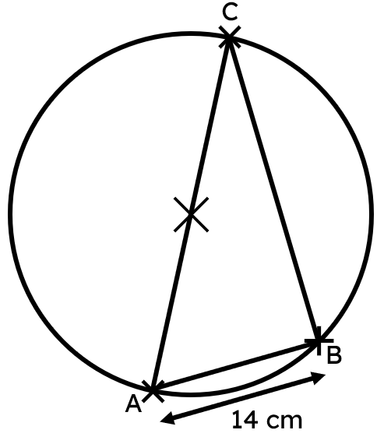
      The area of triangle ABC is 336 cm². Find the area of the circle, in cm² (3 s.f.)

      An image in a quiz
      25
      48
      50
      625
      Correct answer: 1960

      Assessment exit quiz

      6 Questions

      Q1.
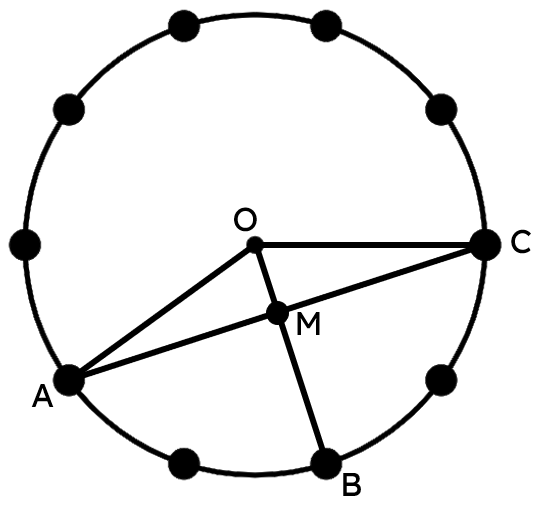
      On this 10-point geoboard ∠AOM is °.

      An image in a quiz
      Correct Answer: 72, 72°, 72 degrees

      Q2.
      On this 10-point geoboard ∠OAM is °.

      An image in a quiz
      Correct Answer: 18, 18°, 18 degrees

      Q3.
      Find ∠OMA on this 10-point geoboard (in degrees).

      An image in a quiz
      Correct Answer: 90, 90°, 90 degrees

      Q4.
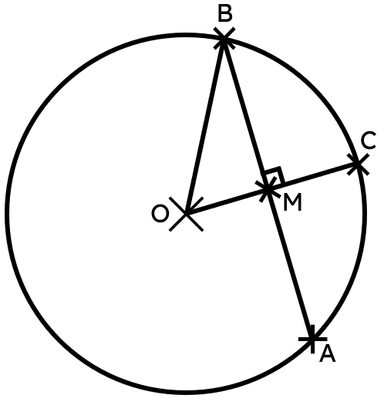
      BMA and OMC are straight line segments. AM = 10 cm Which of these are also 10 cm long?

      An image in a quiz
      Line segment OB
      Line segment OC
      Line segment OM
      Correct answer: Line segment BM
      Line segment CM

      Q5.
      BMA and OMC are straight line segments. AM = 10 cm. Radius OB has length 14 cm. Find the length of OM (in cm, to 2 d.p.).

      An image in a quiz
      Correct Answer: 9.80, 9.80 cm

      Q6.
      BMA and OMC are straight line segments. AM = 10 cm. Radius OB has length 14 cm. The size of ∠MOB is ° (1.d.p.).

      An image in a quiz
      Correct Answer: 45.6, 45.6°, 45.6 degrees, 45.6degrees

      Lesson appears in

      UnitMaths / Circle theorems