The structure of DNA: including nucleotides
I can describe the structure of DNA and how DNA is copied during mitosis.


- Year 10
- AQA
The structure of DNA: including nucleotides
I can describe the structure of DNA and how DNA is copied during mitosis.
Lesson details
Key learning points
- DNA is made of two strands, each a long polymer of nucleotides, wound together in a double helix shape.
- DNA is a polymer of four different nucleotides (A, C, G and T).
- Nucleotides in each strand of DNA pair up in a complementary way; A pairs with T, and C pairs with G.
- The DNA in chromosomes is unwound & copied during interphase, then the copies separate and the cell divides by mitosis.
- Complementary base pairing allows an exact copy of each ‘unzipped’ DNA strand to be made from free nucleotides.
Keywords
DNA - A polymer with a double helix structure that carries the genetic information.
Mitosis - A type of cell division that produces genetically identical cells.
Nucleotides - Individual subunits that make up DNA.
Polymer - A long chain of repeating subunits.
Complementary base pairing - Bases form pairs with one other base: A pairs with T, and C pairs with G.
Common misconception
Students may think that each strand of DNA is the same without recognising one strand is inverted.
The slides specifically mention the second strand is inverted and this is also reinforced using diagrams of inverted nucleotides wherever possible.


Licence
Lesson video
Loading...
Prior knowledge starter quiz
6 Questions
Q1.This image shows a model of ...

Q2.Which of the following is the definition of a polymer?
Q3.Match each structure to its correct definition.

Q4.What happens during interphase in the cell cycle?
Q5.Which type of cell division creates two genetically identical cells?
Q6.Which term describes a cell with a membrane bound nucleus?
Assessment exit quiz
6 Questions
Q1.Which words describe the structure of DNA?
Q2.DNA is made from single repeating subunits called ...
Q3.Which of these statements about DNA are true?
Q4.What is complementary base pairing?
Q5.Which of the following statements about copying DNA are true?
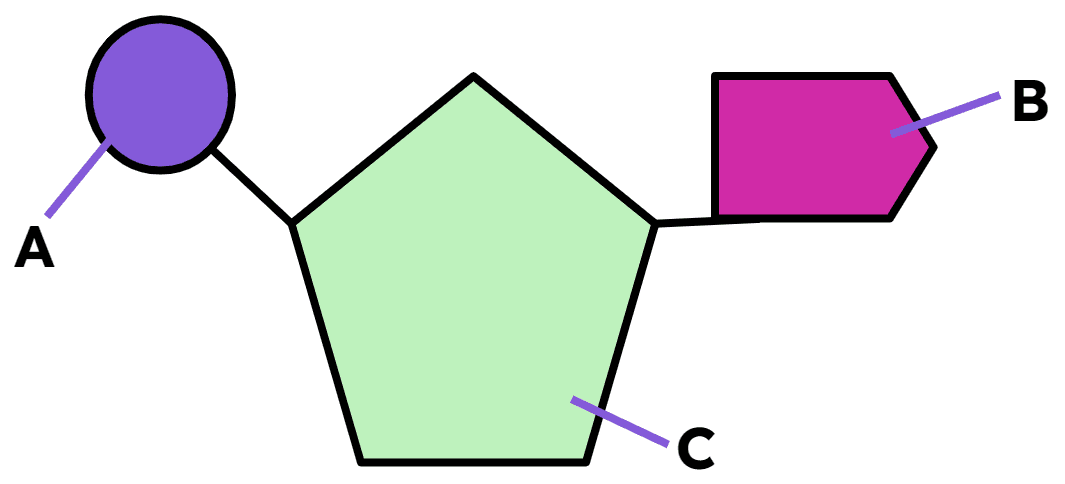
Q6.Use the diagram to match the letter to the correct part of the nucleotide.