


Transforming graphs: combinations of transformations
I can recognise the effect of applying a combination of transformations to a function.


- Year 11
Transforming graphs: combinations of transformations
I can recognise the effect of applying a combination of transformations to a function.
Lesson details
Key learning points
- Desmos is an effective tool for showing the effects of this transformation
- The actual function itself does not need to be known
- The order of transformations is defined by the priority of operations
Keywords
Transformation - A transformation is a process that may change the size, orientation or position of a shape or graph.
Common misconception
For the combined transformation $$3$$f$$(x-2)$$ order does not matter so pupils may assume that order never matters.
For $$3$$f$$(x-2)$$ the $$3$$ affects the output, the $$y$$ value, and the $$-2$$ affects the input, the $$x$$ value. Model to show that these can happen in either order. Then point out that $$3$$f$$(x)-2$$ is two effects on the output.


Licence
Lesson video
Loading...
Prior knowledge starter quiz
6 Questions
Q1.$$y=\text{f}(x)+a$$, $$y=\text{f}(x+a)$$, $$y={a}\text{f}(x)$$, and $$y=\text{f}(ax)$$ are all of $$y=\text{f}(x)$$.

Q2.Match the notation to its transformation.
$$y=\text{f}(x)+a$$ - Translation by $$a$$ in the $$y$$-direction.
$$y=\text{f}(x+a)$$ - Translation by $$-a$$ in the $$x$$-direction.
$$y=-\text{f}(x)$$ - Reflection in the $$x$$-axis.
$$y=\text{f}(-x)$$ - Reflection in the $$y$$-axis.
$$y={a}\text{f}(x)$$ - Stretch by scale factor $$a$$ in the $$y$$-direction.
$$y=\text{f}(ax)$$ - Stretch by scale factor $$1\over{a}$$ in the $$x$$-direction.
Q3.Match each piece of function notation to a description.
$$2\text{f}(x)+3$$ - Output of $$\text{f}(x)$$ is multiplied by $$2$$ then $$3$$ is added.
$$3\text{f}(x)+2$$ - Output of $$\text{f}(x)$$ is multiplied by $$3$$ then $$2$$ is added.
$$3\text{f}(x+2)$$ - Input has $$2$$ added before output is multiplied by $$3$$
$$2\text{f}(x+3)$$ - Input has $$3$$ added before output is multiplied by $$2$$
$$2\text{f}(3x)$$ - Input is multiplied by $$3$$ before output is multiplied by $$2$$
$$-2\text{f}(x)$$ - Output of $$\text{f}(x)$$ is multiplied by $$-2$$
Q4.$$y=\text{f}(x)$$ is graphed. Which of these images shows the transformation $$y=2\text{f}(x)$$?
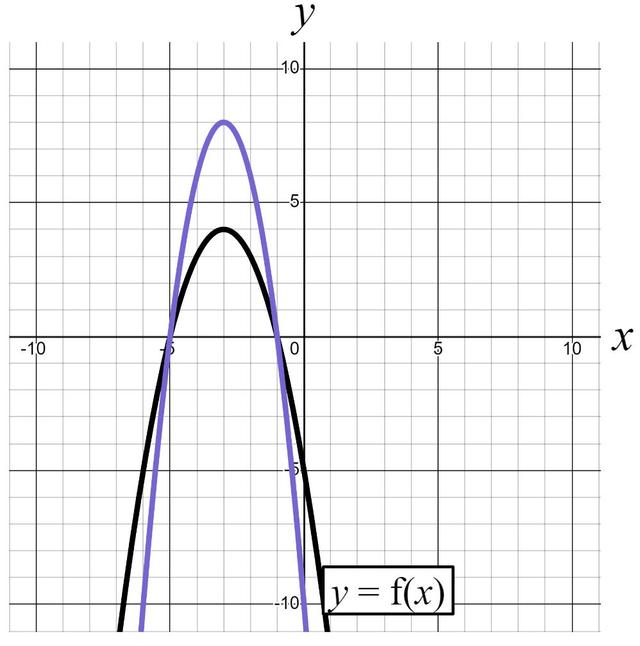
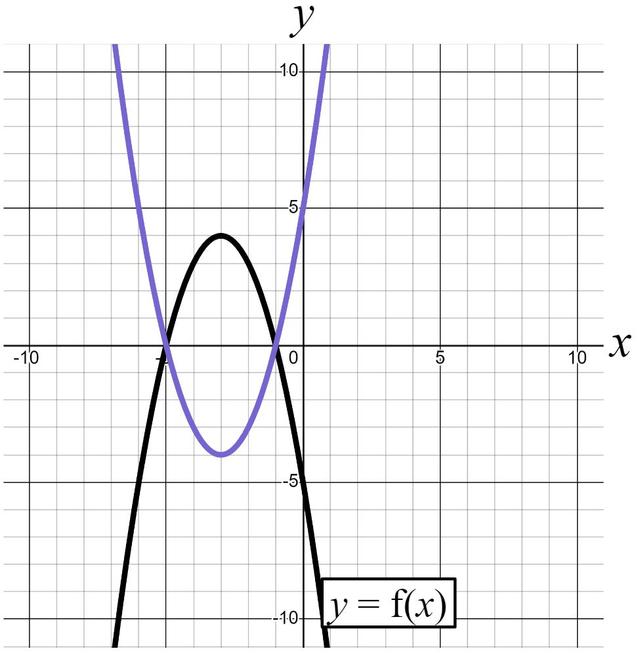
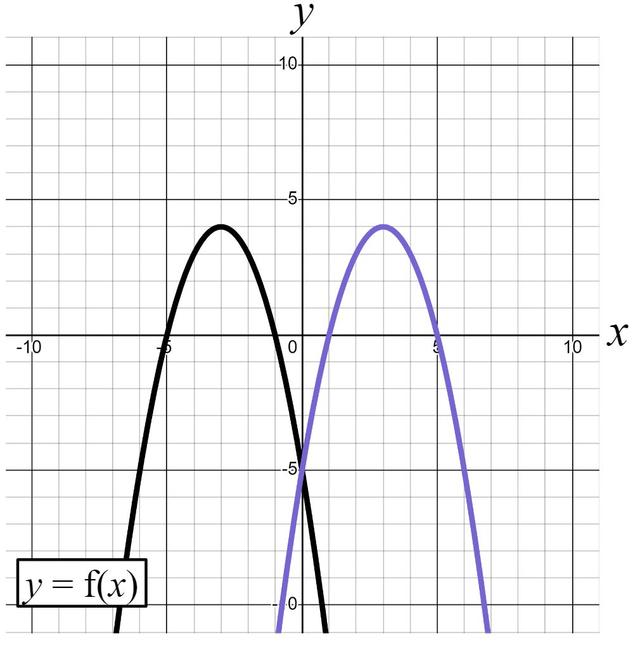
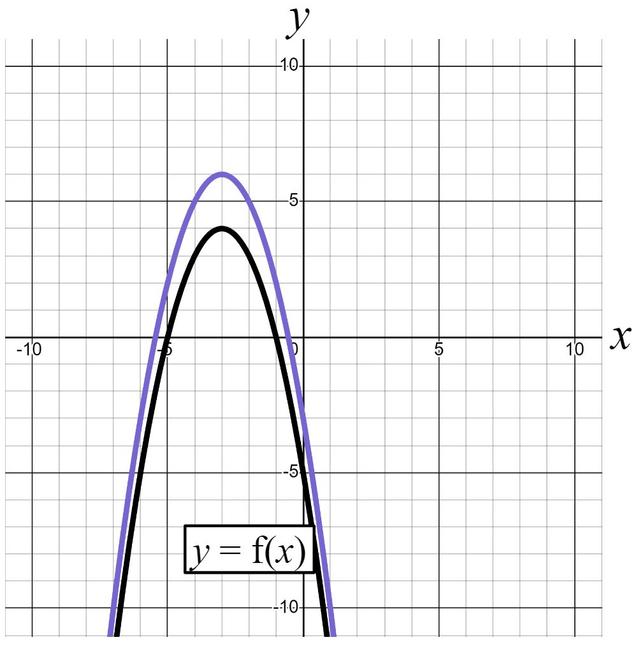
Q5.$$y=\text{f}(x)$$ is graphed. Which of these images shows the transformation $$y=\text{f}(x-6)$$?
Q6.$$y=\text{f}(x)$$ is graphed. Which of these images shows the transformation $$y=-\text{f}(x)$$?
Assessment exit quiz
6 Questions
Q1.$$-\text{f}(-x)$$ will transform $$\text{f}(x)$$ by two __________.
Q2.$$y=\text{f}(x)$$ is graphed. Which of these images shows the transformation $$y=-2\text{f}(x)$$?
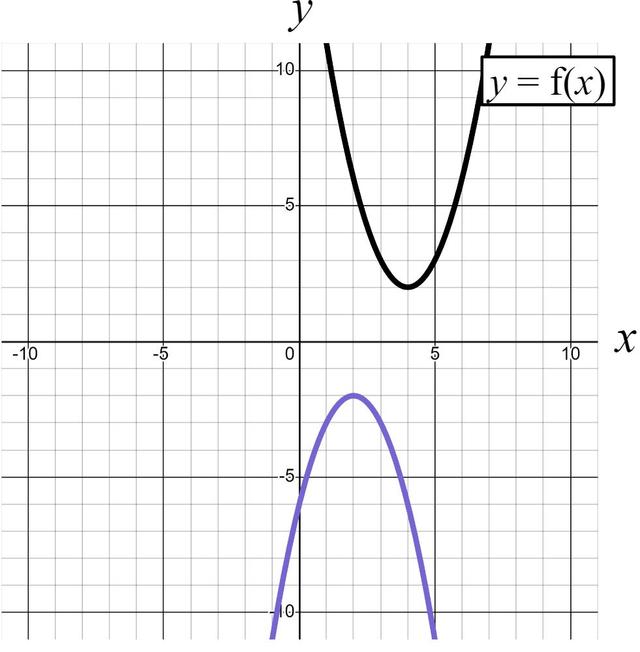
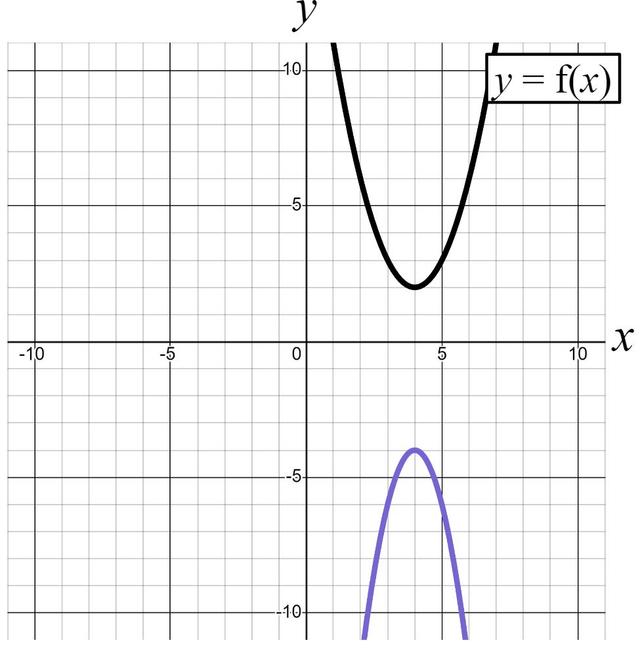
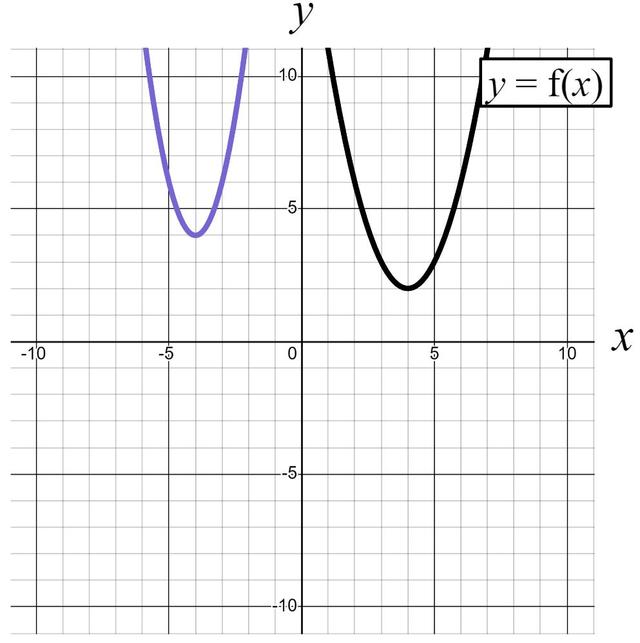
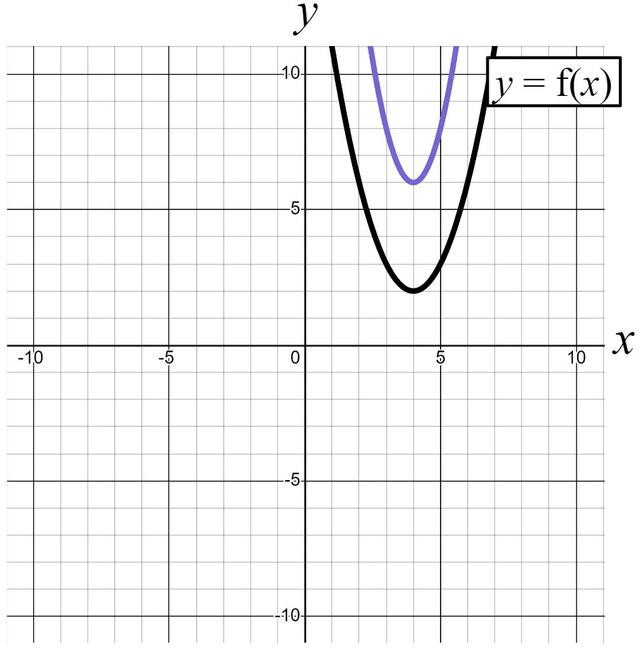
Q3.$$y=\text{f}(x)$$ is graphed. Which of these images shows the transformation $$y=2\text{f}(x)+2$$?
Q4.$$y=\text{f}(x)$$ is graphed. Which of these images shows the transformation $$y=-\text{f}(x+2)$$?
Q5.$$\text{f}(x)=\text{cos}(x)$$. Where will the marked point be after the transformation $$y=3\text{f}(2x)$$?
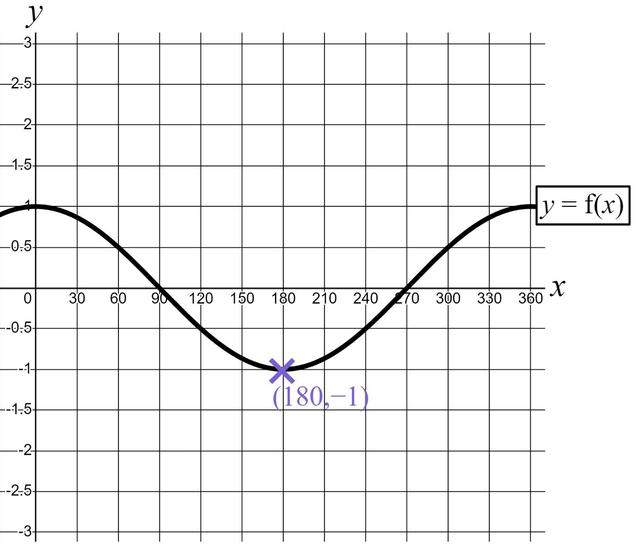
Q6.$$\text{f}(x)=\text{cos}(x)$$. Where will the marked point be after the transformation $$y=-\text{f}\left({1\over2}x\right)+1$$? Give your answer in the form $$(x,y)$$
