


New
New


Lesson 7 of 10
New
New
- Year 9
Turning forces
I can investigate and calculate the size of turning forces.
Lesson details
Key learning points
- A moment causes turning.
- Moment = force × (perpendicular) distance from the pivot.
- Moments are measured in Newton-metres (Nm).
Keywords
Balanced - A beam is balanced if it is not starting to rotate about its pivot.
Newton-metre - One unit for the turning effect of a force is the newton-metre (N m).
Newton-centimetre - Another unit for the turning effect of a force is the newton-centimetre (N cm).
Moment - The turning effect of a force is called a moment.
Common misconception
The turning effect is a force (it is often wrongly called a turning force).
Correct any use of the erroneous term ‘turning force’ and use examples of the turning effect caused by force with a lever.
Balance beams are much better than using masses on rules with pivots as they allow a little leeway with positioning. If rulers are used then distances to the nearest centimetre are good enough.

Teacher tip

Content guidance
- Risk assessment required - equipment

Supervision
Adult supervision required

Licence
This content is © Oak National Academy Limited (2026), licensed on Open Government Licence version 3.0 except where otherwise stated. See Oak's terms & conditions (Collection 2).
Lesson video
Loading...
Prior knowledge starter quiz
6 Questions
Q1.Which of these is not the result of there being a resultant force acting on an object?
Which of these is not the result of there being a resultant force acting on an object?
A stationary object starts to move.
The shape of an object changes.
A moving object changes direction.
A moving object speeds up or slows down.
Q2.Which of these objects do not make use of levers?
Which of these objects do not make use of levers?
see-saw
screwdriver
door
Q3.What name is given to the force that is applied to make a lever move?
What name is given to the force that is applied to make a lever move?
load
pulling force
pushing force
Q4.What name is given to the force that is exerted by a lever?
What name is given to the force that is exerted by a lever?
effort
pushing force
pivot
Q5.Levers are often used as force __________ as they produce larger load forces than the effort force used to move them.
Levers are often used as force __________ as they produce larger load forces than the effort force used to move them.
expanders
boosters
accelerators
Q6.Which of these units can the size of the load force be measured in?
Which of these units can the size of the load force be measured in?
grams
kilograms
Assessment exit quiz
6 Questions
Q1.Match the keywords and phrases to the explanations.
Match the keywords and phrases to the explanations.

Q2.Which of these describes the conditions needed for two people to balance on a seesaw?
Which of these describes the conditions needed for two people to balance on a seesaw?
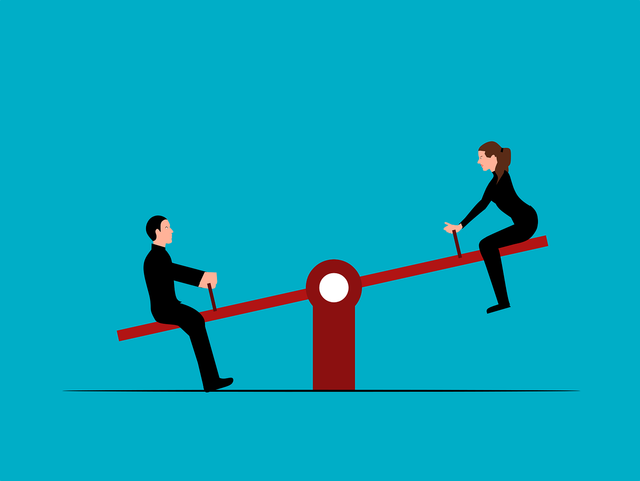
The weight of the people on each side must be the same.
The distance from the people to the pivot on each side must be the same.
The total weight must add up to zero.
They must be on the same side of the seesaw.
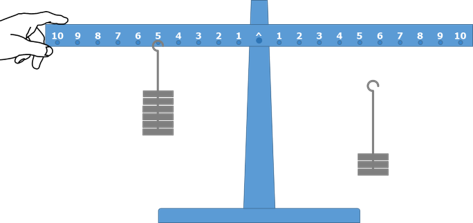
Q3.Six masses are hung 5 cm from the left on this balance beam. Where on the right side should the three masses be hung to make the beam balance?
Six masses are hung 5 cm from the left on this balance beam. Where on the right side should the three masses be hung to make the beam balance?
1 cm
4 cm
5 cm
8 cm
Q4.A 4 N weight is placed 0.5 m from a pivot on a balance beam. Where should an 8 N weight be placed to balance the beam?
A 4 N weight is placed 0.5 m from a pivot on a balance beam. Where should an 8 N weight be placed to balance the beam?
0.5 m on the opposite side of the pivot
1.0 m on the opposite side of the pivot
0.25 m on the same side of the pivot
0.5 m on the same side of the pivot
Q5.Starting with the largest, put the following forces and distances from a pivot into order of decreasing size of the moment they will cause.
Starting with the largest, put the following forces and distances from a pivot into order of decreasing size of the moment they will cause.
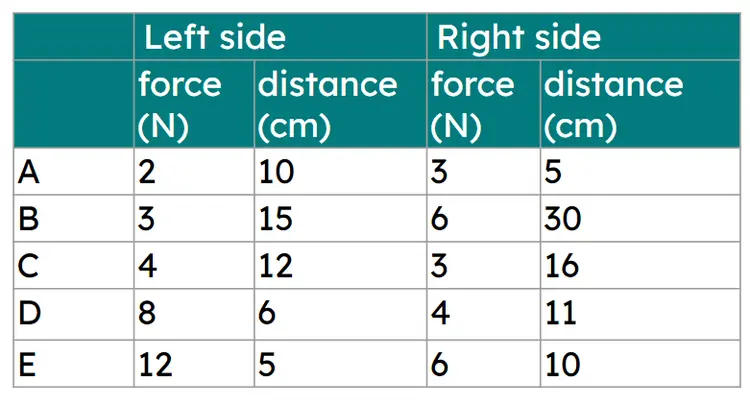
Q6.A pupil tests different combinations of force and distance on opposite sides of a balance beam. Which rows show combinations that will balance the beam?
A pupil tests different combinations of force and distance on opposite sides of a balance beam. Which rows show combinations that will balance the beam?
A
B
D
