


New
New
Two congruent triangles can be arranged to compose a parallelogram
I can explain how two congruent triangles can arranged to compose a parallelogram.


Lesson 7 of 10
New
New
- Year 6
Two congruent triangles can be arranged to compose a parallelogram
I can explain how two congruent triangles can arranged to compose a parallelogram.
Lesson details
Key learning points
- The area of a triangle is equal to half the area of the parallelogram you create from 2 congruent triangles.
- Any parallelogram can be decomposed into two congruent triangles.
Keywords
Congruent - If one shape can fit exactly on top of another using rotation, reflection or translation, then the shapes are congruent.
Parallelogram - A parallelogram is a quadrilateral with two pairs of parallel and equal sides.
Common misconception
If pupils do not cut a parallelogram from vertex to opposite vertex, they will end up with either two non-congruent shapes or two congruent quadrilaterals.
Modelling is key and this is a useful time to revisit the concept of a shape's diagonal, that is, a line connecting vertex to a non-adjacent vertex.
In this lesson pupils will need to be familiar with triangle types and their properties. Consider how you might scaffold this knowledge for learners if required.

Teacher tip

Licence
This content is © Oak National Academy Limited (2025), licensed on Open Government Licence version 3.0 except where otherwise stated. See Oak's terms & conditions (Collection 2).
Lesson video
Loading...
Prior knowledge starter quiz
6 Questions
Q1.Which of these are properties of all triangles?
Which of these are properties of all triangles?
All sides must be equal.
Four sides.
3-dimensional.
Q2.Match the triangle with the correct property.
Match the triangle with the correct property.

Q3.Which of these polygons is also classified as a parallelogram?
Which of these polygons is also classified as a parallelogram?
Triangle
Trapezium
Q4.Which of these statements apply to all parallelograms?
Which of these statements apply to all parallelograms?
Opposite angles are different.
Opposite sides are different in length.
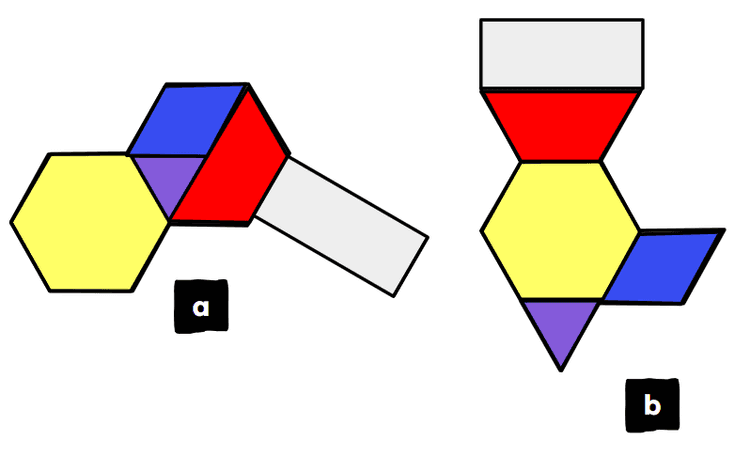
Q5.Which of these statements is true about these shapes?
Which of these statements is true about these shapes?
Shape a is a parallelogram but Shape b is not.
Neither shape is a parallelogram.
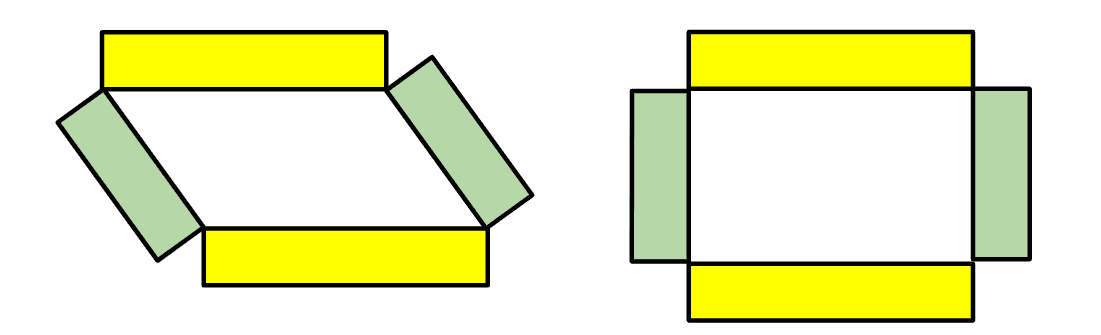
Q6.The two compound shapes have been composed of identical smaller shapes. Which of these statements is true?
The two compound shapes have been composed of identical smaller shapes. Which of these statements is true?
The area of a is greater than the area of b.
The area of b is greater than the area of a.
Assessment exit quiz
6 Questions
Q1.If two shapes are congruent, what does this mean?
If two shapes are congruent, what does this mean?
They are different types of shape.
They are different sizes.
Q2.Which of these triangles are congruent?
Which of these triangles are congruent?
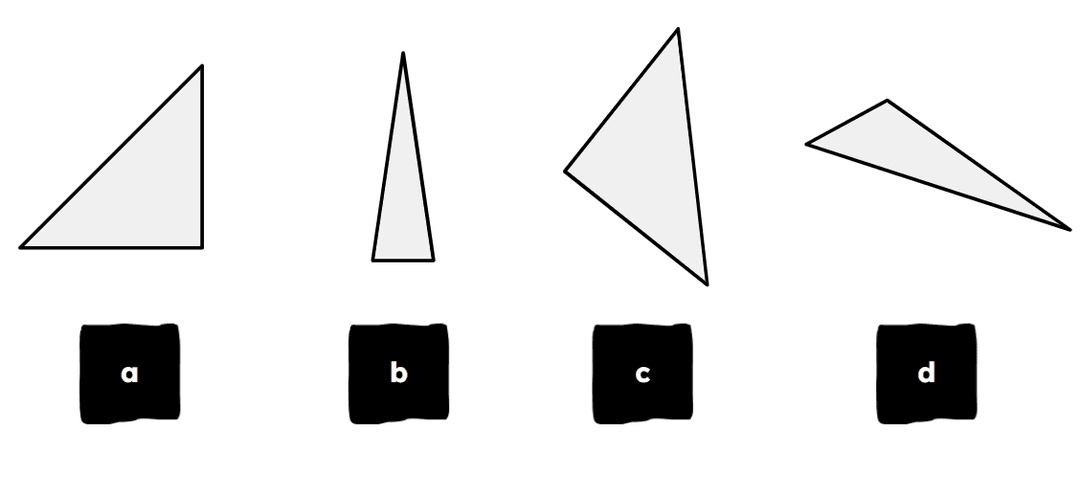
b
d
Q3.Which of these statements could be true of two congruent shapes?
Which of these statements could be true of two congruent shapes?
They must be identical in every way including their position.
Q4.Which of the statements are true?
Which of the statements are true?
A triangle can be composed from two parallelograms.
Q5.This parallelogram has been decomposed into two congruent triangles. What type of triangle is each part?
This parallelogram has been decomposed into two congruent triangles. What type of triangle is each part?
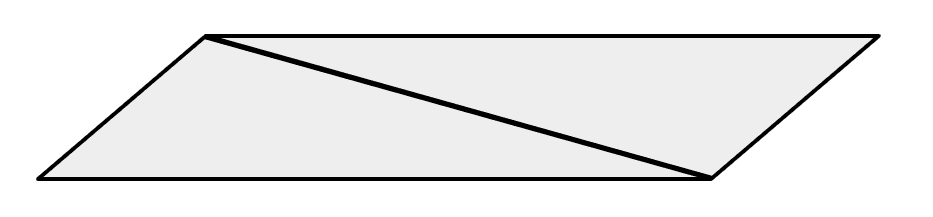
equilateral
isosceles
Q6.Which of these quadrilaterals cannot be decomposed into two congruent triangles?
Which of these quadrilaterals cannot be decomposed into two congruent triangles?
Parallelogram
Rectangle
Square
Rhombus
