


New
New
Understanding constructing a circle
I can recognise a circle as a collection of points equidistant from a fixed point.


Lesson 3 of 10
New
New
- Year 8
Understanding constructing a circle
I can recognise a circle as a collection of points equidistant from a fixed point.
Lesson details
Key learning points
- A pair of compasses can be used to draw circle with a particular radius.
- All the points on the circle will be the same distance from the centre.
- The centre of a circle is the point that is the same distance from every point on the circle.
- The collection of points an equal distance from a given point form a circle.
Keywords
Fixed point - A fixed point is a point that does not change or move.
Circumference - The circumference of a circle is the perimeter of the circle.
Arc - An arc is part of a curve. An arc of a circle is part of the circle’s circumference.
Equidistant - Points A and B are equidistant from a third point C if the distance AC is equal to the distance BC.
Common misconception
During tasks, pupils may use a ruler to draw or check whether points are equidistant from a centre.
While the tasks could be completed with a ruler, it may be quicker, easier and more accurate to use a pair of compasses.
The teacher could sit or stand in the middle of a large empty space and ask all pupils to position themselves equidistantly to the teacher. What shape have the pupils formed?

Teacher tip

Licence
This content is © Oak National Academy Limited (2025), licensed on Open Government Licence version 3.0 except where otherwise stated. See Oak's terms & conditions (Collection 2).
Lesson video
Loading...
Prior knowledge starter quiz
6 Questions
Q1.Which part of the circle is highlighted and labelled with a question mark?
Which part of the circle is highlighted and labelled with a question mark?
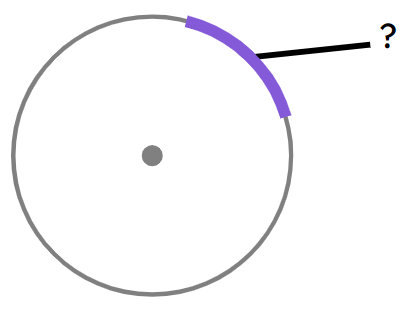

circumference
diameter
radius
Q2.What are the co-ordinates of point A?
What are the co-ordinates of point A?
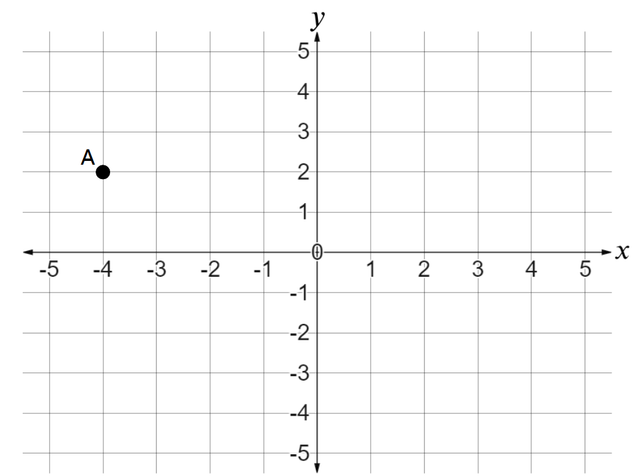
(-2, 4)
(2, -4)
(4, -2)
Q3.Izzy tries to draw a circle with a pair of compasses without moving the ruler. The pencil starts at the 2 cm mark on the ruler. Half way around, the pencil touches the cm mark on the ruler.
Izzy tries to draw a circle with a pair of compasses without moving the ruler. The pencil starts at the 2 cm mark on the ruler. Half way around, the pencil touches the cm mark on the ruler.
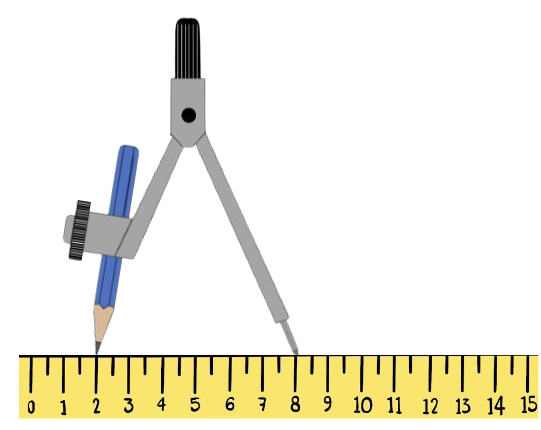
Q4.The image shows a circle with centre at point A. Sofia draws a circle with radius 2 cm with its centre at point B. How many times will the two circles intersect?
The image shows a circle with centre at point A. Sofia draws a circle with radius 2 cm with its centre at point B. How many times will the two circles intersect?
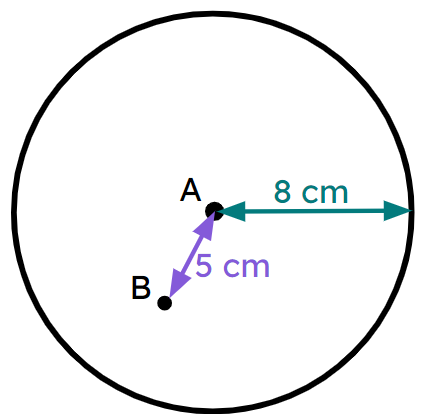
1
2
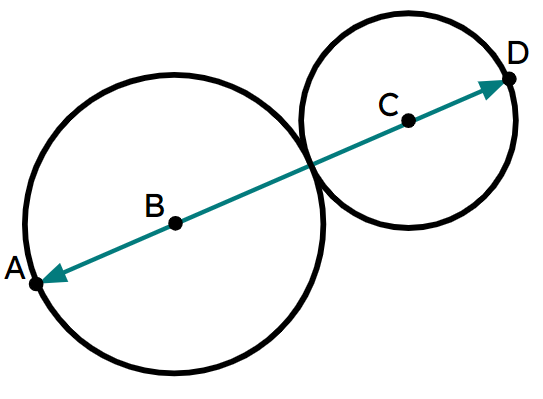
Q5.The diagram is not to scale. Points A, B, C and D lie on a straight line. The distance from A to D is 20 cm. The radius of the large circle is 8 cm; the radius of the small circle is .
The diagram is not to scale. Points A, B, C and D lie on a straight line. The distance from A to D is 20 cm. The radius of the large circle is 8 cm; the radius of the small circle is .
4 cm
6 cm
12 cm
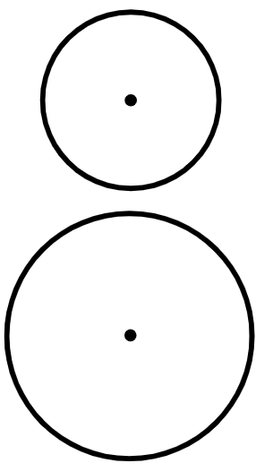
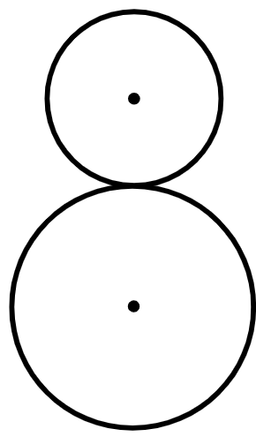
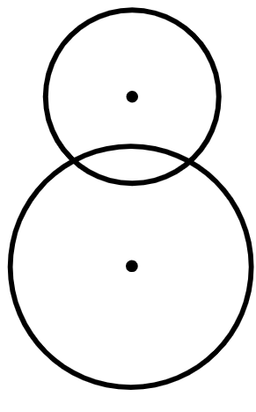
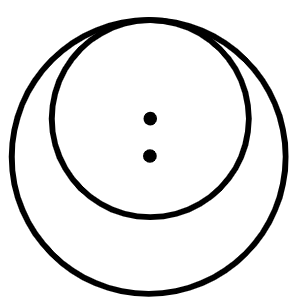
Q6.Laura draws two circles. One has a radius 5 cm, the other has a radius 9 cm. The distance between the centre points of each circle is 16 cm. Which image matches Aisha's drawings?
Laura draws two circles. One has a radius 5 cm, the other has a radius 9 cm. The distance between the centre points of each circle is 16 cm. Which image matches Aisha's drawings?
Assessment exit quiz
6 Questions
Q1.A circle is a shape such that every point is to its centre.
A circle is a shape such that every point is to its centre.
horizontal
vertical
vertically opposite
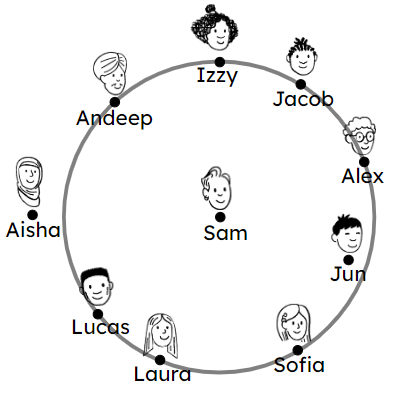
Q2.Sam is stood in the centre of a circle. Which pupil is the closest to Sam?
Sam is stood in the centre of a circle. Which pupil is the closest to Sam?
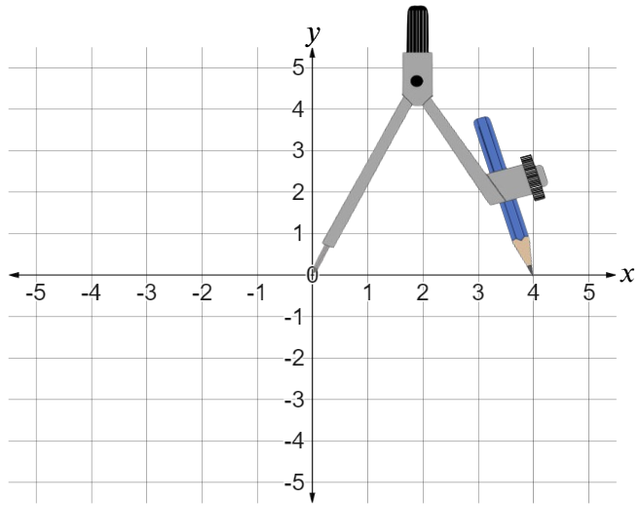
Q3.The pair of compasses in the image are used to draw a circle around the origin of the co-ordinate grid. Which point would lie on the circle?
The pair of compasses in the image are used to draw a circle around the origin of the co-ordinate grid. Which point would lie on the circle?
(0, 5)
(-3, 0)
(0, 0)
Q4.The pair of compasses in the image are used to draw a circle around the origin of the co-ordinate grid. The diameter of the circle is units.
The pair of compasses in the image are used to draw a circle around the origin of the co-ordinate grid. The diameter of the circle is units.
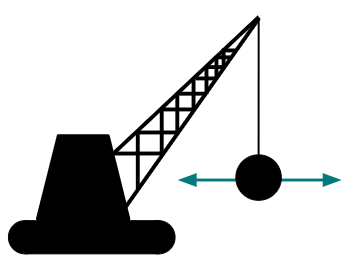
Q5.The images show a wrecking ball swinging from a fixed point on a crane. Which image correctly shows the movement of the wrecking ball?
The images show a wrecking ball swinging from a fixed point on a crane. Which image correctly shows the movement of the wrecking ball?
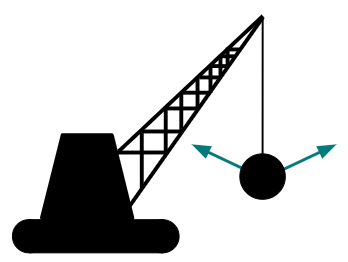
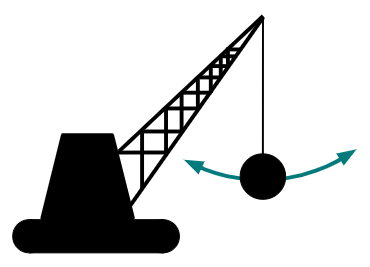
Q6.Which arc will the pair of compass draw?
Which arc will the pair of compass draw?
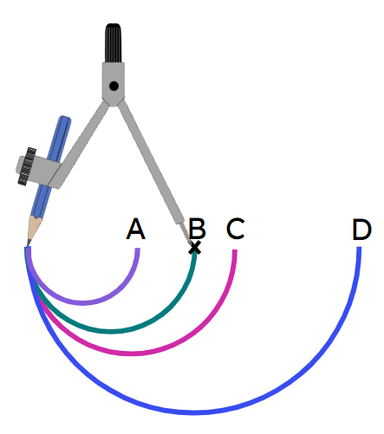
A
B
C
