


- Year 11•
- AQA
Unstable nuclei
I can explain why some nuclei are stable and why some are unstable.
Lesson details
Key learning points
- Protons have a positive electric charge of +1 and a mass number of 1.
- Neutrons have no electric charge and have a mass number of 1.
- The atomic number of an element equals the number of protons in the nucleus of each atom of that element.
- The atomic number of an element equals the number of electrons in each atom of that element.
- Atoms of an element that have different numbers of neutrons in their nuclei are isotopes of the element.
Keywords
Nucleus - the central part of an atom which contains protons and neutrons
Nucleon - the term for particles in a nucleus (protons and neutrons)
Atomic (proton) number - the number of protons within a particular nucleus
Mass (nucleon) number - the total number of nucleons within a particular nucleus (protons + neutrons)
Isotopes - atoms of the same element with differing numbers of neutrons
Common misconception
Many pupils are uncertain about the forces attracting or repelling particles inside an atom.
Extend explanations to include electrostatic forces between protons in the nucleus and introduce the strong nuclear force to explain why nuclei do not self destruct.


Licence
Lesson video
Loading...
Prior knowledge starter quiz
6 Questions
Q1.Which of these are examples of natural sources of background radiation?

Q2.Which of these devices is used to detect nuclear radiation?
Q3.The figure shows a model of the atom developed by JJ Thompson. It is the model of the atom.
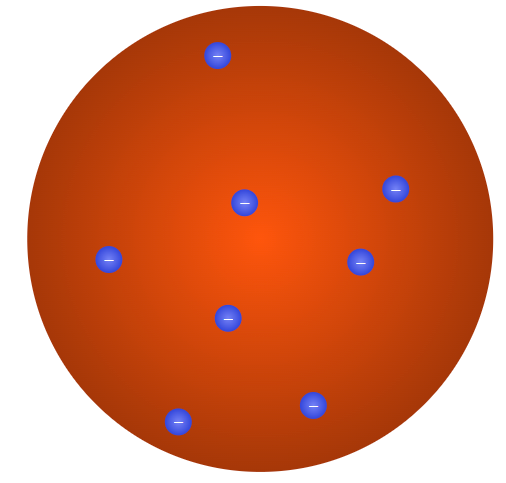
Q4.Which particles did Rutherford use in his experiment which led to the development of the nuclear model of the atom?
Q5.Which of these are conclusions from Rutherford’s scattering experiment?
Q6.Which of these refinements of the nuclear model is Niels Bohr responsible for?
Assessment exit quiz
6 Questions
Q1.Match each key word or phrase to the correct definition.
nucleus - the central part of an atom that contains protons and neutrons
nucleon - a proton or neutron in a nucleus
atomic (proton) number - the number of protons within a particular nucleus
mass (nucleon) number - the total number of protons + neutrons within a particular nucleus
isotopes - atoms of the same element with differing numbers of neutrons
Q2.Which of the following particles has the smallest mass?
Q3.Nuclei can be represented by nuclear notation ($$^{\text{A}}_{\text{Z}}$$X). For example, $$^{21}_{10}$$Ne.
Which of these statements about this notation are correct?
Q4.A sulfur atom is represented by the symbol $$^{34}_{16}$$S. Which of these statements are correct?
Q5.Which of these statements about neutrons are correct?
Q6.There are 13 known isotopes of lithium. The most common is lithium-7, which can be represented as $$^{7}_{3}$$Li.
Which of these statements about the nuclei of other isotopes of lithium are correct?
