Use equivalence and compensation strategies to solve problems
You can use equivalence and compensation strategies to solve problems.


- Year 6
Use equivalence and compensation strategies to solve problems
You can use equivalence and compensation strategies to solve problems.
Lesson details
Key learning points
- The part-whole structure can be used to represent additive problems.
- A bar model can be used to represent additive problems.
- A balance beam can be used to represent equivalence and compensation.
Keywords
Equivalence - Equivalence is when two or more things have the same value.
Compensation - Compensation is a mental strategy which involves adjusting parts of an equation while maintaining equivalence.
Unknown - An unknown is a quantity that has a set value but it is represented by a symbol or letter.
Expression - An expression contains one or more values, where each value is separated by an operator.
Common misconception
Pupils might find it hard to understand that they needn't recalculate the parts after adjustment if the question wants the new whole.
Show jottings and workings for two examples side-by-side. In the 1st example, calculate all the parts after adjustment as well as the new whole. In the 2nd, calculate only the new whole. Discuss with the pupils which is the most efficient and why.


Licence
Lesson video
Loading...
Prior knowledge starter quiz
6 Questions
Q1.What do expressions have if they are equivalent?

Q2.What is the unknown in the equation below?
+ 3 + 8 = 15
Q3.What is the unknown in the equation below? + 0.6 + 0.8 = 1.5
Q4.What is the unknown in the equation below?
+ 67 = 82 + 18
Q5.Which inequality symbol should go between these two expressions?
54 + 98 52 + 101
Q6.Which inequality symbol should go between these two expressions?
3.6 + 2.3 3.3 + 2.1
Assessment exit quiz
6 Questions
Q1.Which of the equations below is incorrect and does not contain two equivalent expressions?
Q2.Calculate the unknown in this equation.
45 + = 97
Q3.Calculate the unknown in this equation.
1.3 + + 1.7 = 1.1 + 2.1 + 0.8
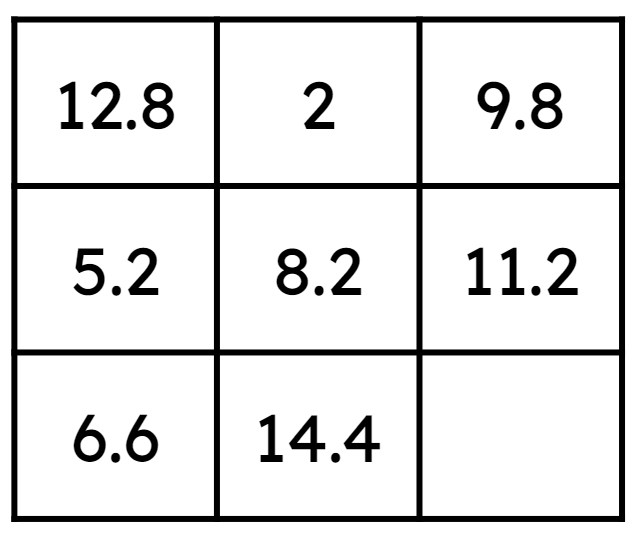
Q4.Calculate the unknown in the empty box of this magic square.
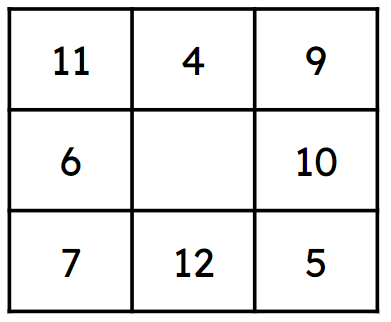
Q5.Calculate the unknown in the empty box of this magic square.