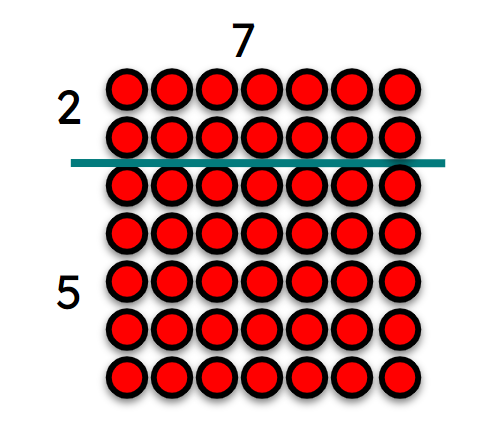
Use known facts from the 2, 5 and 6 times tables to solve problems involving the 7 times table
I can use known facts from the 2, 5 and 6 times tables to solve problems involving the 7 times table.


- Year 4
Use known facts from the 2, 5 and 6 times tables to solve problems involving the 7 times table
I can use known facts from the 2, 5 and 6 times tables to solve problems involving the 7 times table.
Lesson details
Key learning points
- If 7 is equal to 5 plus 2 then 7 groups of 6 is equal to 5 groups of 6 plus 2 groups of 6
- 7 times a number and 6 times the same number are adjacent multiples
- Arrays can represent the connections between the 2, 5, 6 and 7 times tables
Keywords
Multiple - A multiple is the result of multiplying a number by another whole number.
Partition - Partitioning is the act of splitting an object or value down into smaller parts.
Distributive law - The distributive law says that multiplying a number by a group of numbers added together is the same as doing each multiplication separately.
Array - An array is the layout of items (such as objects, numbers, etc.) arranged in rows and/or columns.
Common misconception
Pupils may not realise they can use simpler multiplication facts to build up to the 7 times table or may not know their times tables facts.
You can provide multiplication charts. Continue to encourage pupils to break down problems involving 7 into smaller, known facts (e.g., 7 × 6 = 5 × 6 + 2 × 6).


Licence
Lesson video
Loading...
Prior knowledge starter quiz
6 Questions
Q1.Match the multiplication expression to the correct product.

Q2.What calculation does this array show?

Q3.Which numbers are not multiples of 5?
Q4.Which symbol goes in the gap to make this correct? 8 × 7 = 9 × 7 ___ 7
Q5.Select the correct symbol to go in the gap: 12 × 7 ___ 11 × 7 + 7
Q6.Which multiples of 7 are adjacent to 56?
Assessment exit quiz
6 Questions
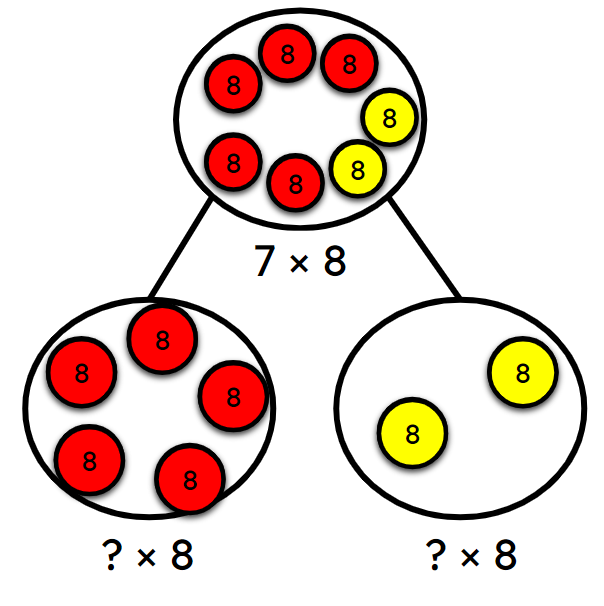
Q1.Jacob has modelled partitioning the factor 7 into 5 and 2 on a part-part-whole model. Which equation does this model show?
Q2.Adjacent multiples of 7 have a difference of
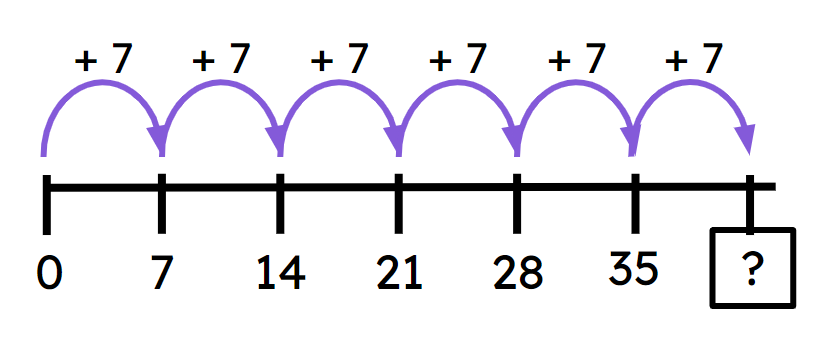
Q3.Andeep uses adjacent multiples to find the missing number on the number line. Which symbol is missing from the calculation? 6 × 7 = 5 × 7 ___ 7
Q4.Which equation does this array show using the distributive law?