


New
New
Using redistribution with addition of decimal fractions
I can use redistribution with addition of decimal fractions.


Lesson 2 of 10
New
New
- Year 6
Using redistribution with addition of decimal fractions
I can use redistribution with addition of decimal fractions.
Lesson details
Key learning points
- If one part is increased and the other is decreased by the same amount, the whole stays the same.
- If one part is decreased and the other is increased by the same amount, the whole stays the same.
- Redistributing between parts with the whole staying the same is sometimes known as the 'same sum' rule.
Keywords
Redistribution - Redistribution is where part of one addend is moved to another addend. It is sometimes known as the same sum rule.
Decimal fraction - A decimal fraction is a fraction written as a decimal. A decimal point separates whole numbers from decimal fractions.
Whole - The whole is all the parts or everything, the total amount.
Part - A part is some of the whole.
Common misconception
Children may struggle to not immediately rush to making use of a written method such as columns addition.
Encourage the children to be resilient and remind them that practice makes perfect.
You might want to begin the lesson with some counting in tenths and hundredths to refamiliarise them with these values.

Teacher tip

Licence
This content is © Oak National Academy Limited (2025), licensed on Open Government Licence version 3.0 except where otherwise stated. See Oak's terms & conditions (Collection 2).
Lesson video
Loading...
Prior knowledge starter quiz
6 Questions
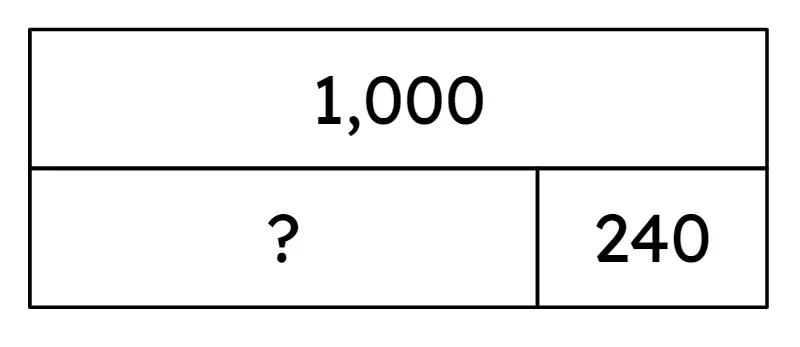
Q1.What is the missing part in this bar model?
What is the missing part in this bar model?

Q2.Complete: 327 + 99 =
Complete: 327 + 99 =
Q3.Jun buys two packs of oranges which cost £1.49 each. How much does he spend altogether? £
Jun buys two packs of oranges which cost £1.49 each. How much does he spend altogether? £
Q4.Sofia has £10 to spend. She buys a souvenir bear for £4.50 How much change should she receive? £
Sofia has £10 to spend. She buys a souvenir bear for £4.50 How much change should she receive? £
Q5.Sam thinks of a 2-digit number. She adds 7 before halving it to finish with the number 25
What was her starting number?
Sam thinks of a 2-digit number. She adds 7 before halving it to finish with the number 25
What was her starting number?
41
42
44
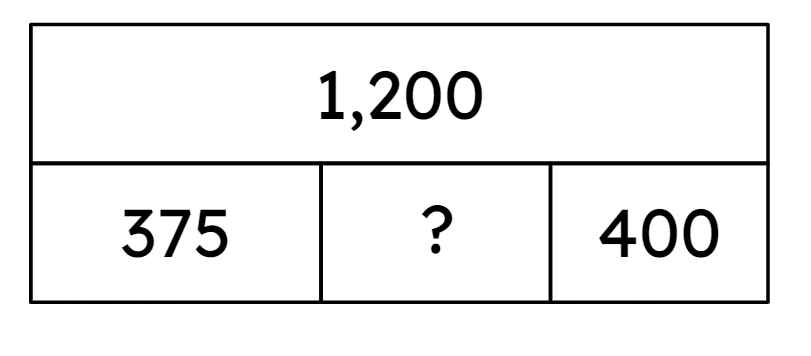
Q6.What is the missing part in this bar model?
What is the missing part in this bar model?
Assessment exit quiz
6 Questions
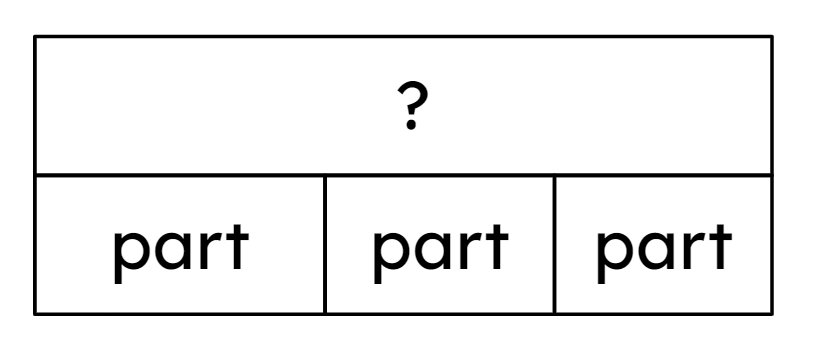
Q1.Is the question mark on the bar model a part or whole?
Is the question mark on the bar model a part or whole?
part
Q2.Use the mental strategy of redistribution to calculate the whole. 3.1 + 3.6 =
Use the mental strategy of redistribution to calculate the whole. 3.1 + 3.6 =
Q3.Use the mental strategy of redistribution to calculate the whole. 5.9 + 6.6 =
Use the mental strategy of redistribution to calculate the whole. 5.9 + 6.6 =
Q4.Use the mental strategy of redistribution to calculate the whole. 4.99 + 3.45 =
Use the mental strategy of redistribution to calculate the whole. 4.99 + 3.45 =
Q5.Which of the following additions do you think was most likely to have been solved using redistribution?
Which of the following additions do you think was most likely to have been solved using redistribution?
3.47 + 6.12 = 9.59
Q6.Which inequality symbol should be placed between these two addition expressions? Use redistribution to help.
2.02 + 5.79 5.81 + 1.95
Which inequality symbol should be placed between these two addition expressions? Use redistribution to help.
2.02 + 5.79 5.81 + 1.95
<
=
