New
New
Using short and long division to divide by a 2-digit divisor
I can use short and long division to divide by a 2-digit divisor.


Lesson 9 of 15
New
New
- Year 6
Using short and long division to divide by a 2-digit divisor
I can use short and long division to divide by a 2-digit divisor.
Lesson details
Key learning points
- Long division records the subtraction as a calculation underneath the dividend.
- Long division records the regrouping alongside the subtraction.
- There are similarities and differences between long and short division.
Keywords
Estimate - Estimate means to find a value that is close enough to the right answer, usually with some thought or calculation involved.
Long division - Long division is a method used for dividing large numbers by breaking the number down into smaller groups.
Remainder - A remainder is an amount left after a division.
Common misconception
Pupils may not unitise when using long division and make errors (e.g. when dividing 7 hundreds by 12).
Explain to pupils that they are looking for multiples of the divisor (1 hundred × 12 = 1,200). This becomes clearer when dividing the tens digits (6 tens × 12 = 72 tens).
Pupils need to have a good grasp of the 12 time tables before starting this session. Some mental mathematics around the 12 times table would provide useful practise before the session. It might also be advantageous to calculate multiples of ten (e.g. what is 10 × 12? 20 × 12? 50 × 12? etc)

Teacher tip

Equipment

Licence
This content is © Oak National Academy Limited (2025), licensed on Open Government Licence version 3.0 except where otherwise stated. See Oak's terms & conditions (Collection 2).
Lesson video
Loading...
Prior knowledge starter quiz
6 Questions
Q1.Match the key words to their definitions
Match the key words to their definitions

Q2.Use 27 × 3 = 81 to calculate 27 × 6 =
Use 27 × 3 = 81 to calculate 27 × 6 =
Q3.Calculate 840 ÷ 7 =
Calculate 840 ÷ 7 =
Q4.Which expression could help to solve this problem?
Which expression could help to solve this problem?
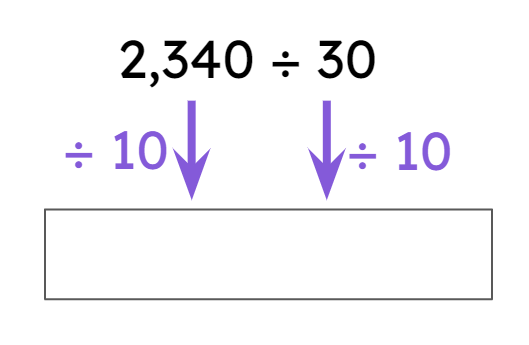
2,340 ÷ 30
234 ÷ 30
2,340 ÷ 0.3
23,400 ÷ 30
Q5.Which expressions could you use to solve this problem? Some tomatoes have a total mass of 1.44 kg. Each tomato has a mass of 80 g. How many tomatoes are there altogether?
Which expressions could you use to solve this problem? Some tomatoes have a total mass of 1.44 kg. Each tomato has a mass of 80 g. How many tomatoes are there altogether?
144 ÷ 80
1,440 ÷ 8
144 x 8
Q6.Sam’s mum takes part in an 2.7 km swimming race. She swims 60 m in one minute. How long will it take her to complete the race? minutes.
Sam’s mum takes part in an 2.7 km swimming race. She swims 60 m in one minute. How long will it take her to complete the race? minutes.
Assessment exit quiz
6 Questions
Q1.Match the multiplication equations to related division facts.
Match the multiplication equations to related division facts.
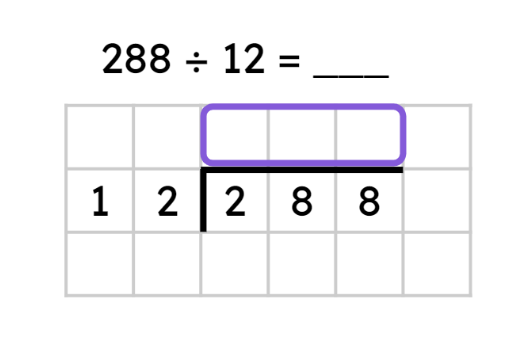
Q2.Which part of the equation is written above the division frame?
Which part of the equation is written above the division frame?
dividend
divisor
factor
product
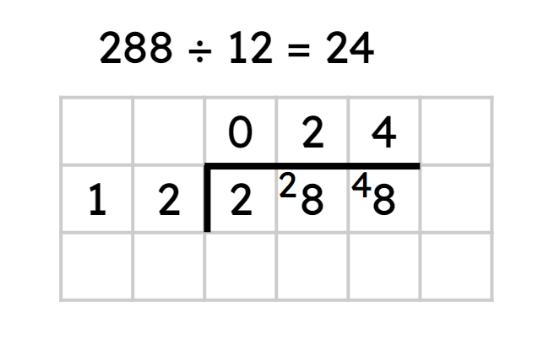
Q3.How many hundreds have been regrouped?
How many hundreds have been regrouped?
12
24
288
4
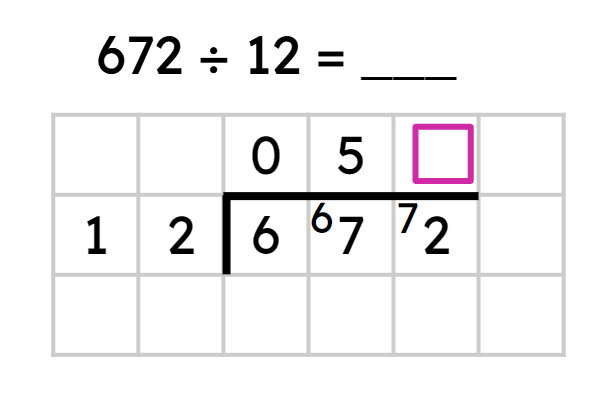
Q4.What is the missing digit in this short division?
What is the missing digit in this short division?
Q5.Which of the following is a reasonable estimate for the following equation. 576 ÷ 12 =
Which of the following is a reasonable estimate for the following equation. 576 ÷ 12 =
30
40
50
60
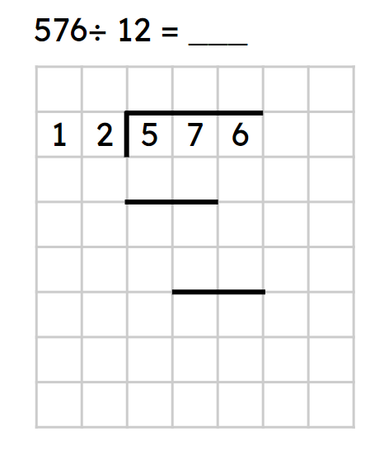
Q6.Calculate the equation using long division. 576÷ 12 =
Calculate the equation using long division. 576÷ 12 =