


New
New
Writing a generalised statement about specific number properties
I can describe a situation using algebraic symbols.


Lesson 10 of 14
New
New
- Year 11
Writing a generalised statement about specific number properties
I can describe a situation using algebraic symbols.
Lesson details
Key learning points
- A conjecture about a generalisation can be expressed algebraically.
- The algebraic expression can be used to test the conjecture.
- Substituting values can reveal whether the conjecture is wrong.
- Substituting values cannot prove the conjecture unless all possibilities are exhausted.
Keywords
Conjecture - A conjecture is a (mathematical) statement that is thought to be true but has not been proved yet.
Generalise - To generalise is to formulate a statement or rule that applies correctly to all relevant cases.
Common misconception
Pupils may think it is acceptable to use the same letter for all expressions.
It may be acceptable for the letter to be the same but that depends on what the letter is representing.
Pupils may benefit from a review on the product of two binomials as this is used in the lesson.

Teacher tip

Licence
This content is © Oak National Academy Limited (2025), licensed on Open Government Licence version 3.0 except where otherwise stated. See Oak's terms & conditions (Collection 2).
Lesson video
Loading...
Prior knowledge starter quiz
6 Questions
Q1.Match the number properties with their generalised forms.
Match the number properties with their generalised forms.
Correct Answer:Any integer,$$n$$ where $$n$$ is an integer.

Any integer - $$n$$ where $$n$$ is an integer.
Correct Answer:Any odd number,$$2n + 1$$ where $$n$$ is an integer.
Any odd number - $$2n + 1$$ where $$n$$ is an integer.
Correct Answer:Any positive number,$$n $$ where $$n > 0$$
Any positive number - $$n $$ where $$n > 0$$
Correct Answer:Any even number,$$2n $$ where $$n$$ is an integer.
Any even number - $$2n $$ where $$n$$ is an integer.
Q2.Which of these is true for the expression $$4n + 7$$ where $$n$$ is an integer?
Which of these is true for the expression $$4n + 7$$ where $$n$$ is an integer?
Correct answer: It is always odd.
It is always odd.
It is sometimes odd.
It is never odd.
Q3.Which of these must be even for any integer value of $$n$$?
Which of these must be even for any integer value of $$n$$?
Correct answer: $$2(n + 1)$$
$$2(n + 1)$$
$$3(n+1)$$
Correct answer: $$3(2n + 2)$$
$$3(2n + 2)$$
$$12n + 9$$
$$(2n +1)(2n+1)$$
Q4.Which of these must be odd for any integer value of $$n$$?
Which of these must be odd for any integer value of $$n$$?
$$6n + 8$$
$$3(n+1)$$
Correct answer: $$5(2n-1)$$
$$5(2n-1)$$
Correct answer: $$4(n+2) + 1$$
$$4(n+2) + 1$$
$$7n + 13$$
Q5.Which of these represent any two consecutive integers?
Which of these represent any two consecutive integers?
$$n-1$$ and $$n+1$$ where $$n$$ is an integer.
$$n$$ and $$2n$$ where $$n$$ is an integer.
Correct answer: $$n+3$$ and $$n+4$$ where $$n$$ is an integer.
$$n+3$$ and $$n+4$$ where $$n$$ is an integer.
$$n$$ and $$m$$ where $$n$$ and $$m$$ are integers.
$$2n+1$$ and $$2n + 3$$ where $$n$$ is an integer.
Q6.What is the correct expansion of $$(3n-1)^2$$?
What is the correct expansion of $$(3n-1)^2$$?
$$9n^2 -1$$
$$9n^2 +1$$
$$9n^2 -6n - 1$$
Correct answer: $$9n^2 -6n + 1$$
$$9n^2 -6n + 1$$
$$9n^2 -9n + 1$$
Assessment exit quiz
6 Questions
Q1.Which of these represent any 3 consecutive even numbers?
Which of these represent any 3 consecutive even numbers?
$$n, n+ 1, n+2$$ where $$n$$ is an integer
$$n, n+ 2, n+4$$ where $$n$$ is an integer
$$2n, 2n+ 1, 2n+2$$ where $$n$$ is an integer
Correct answer: $$2n, 2n+ 2, 2n+4$$ where $$n$$ is an integer
$$2n, 2n+ 2, 2n+4$$ where $$n$$ is an integer
$$2(n - 1), 2(n + 1), 2(n + 2)$$ where $$n$$ is an integer
Q2.Which of these could be the general form for any multiple of 5 greater than 10?
Which of these could be the general form for any multiple of 5 greater than 10?
$$n+ 5$$ where $$n>5$$ (and $$n$$ is an integer)
Correct answer: $$5n$$ where $$n>2$$ (and $$n$$ is an integer)
$$5n$$ where $$n>2$$ (and $$n$$ is an integer)
$$5n$$ where $$n>10$$ (and $$n$$ is an integer)
$$5n + 5$$ where $$n>0$$ (and $$n$$ is an integer)
Correct answer: $$5n + 10$$ where $$n>0$$ (and $$n$$ is an integer)
$$5n + 10$$ where $$n>0$$ (and $$n$$ is an integer)
Q3.Which of these would be a good first step to prove "The product of any two odd numbers is an odd number"?
Which of these would be a good first step to prove "The product of any two odd numbers is an odd number"?
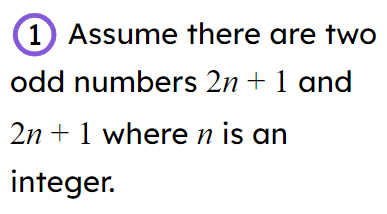
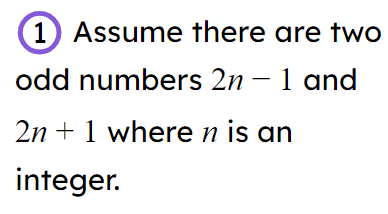
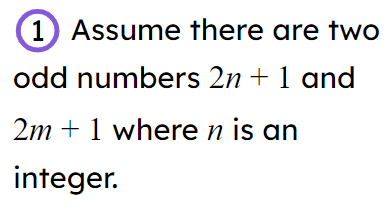
Correct answer: None of these are good first steps.
None of these are good first steps.
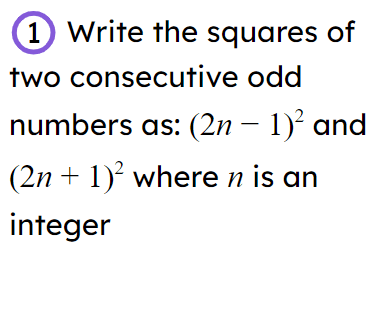
Q4.Which of these would be the best first step to prove "The difference between the squares of consecutive odd numbers is always a multiple of 8"?
Which of these would be the best first step to prove "The difference between the squares of consecutive odd numbers is always a multiple of 8"?
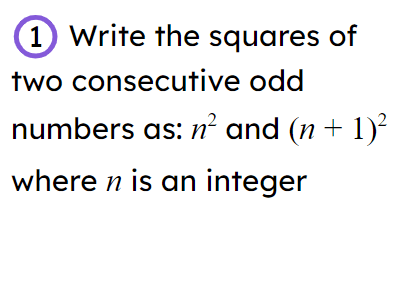
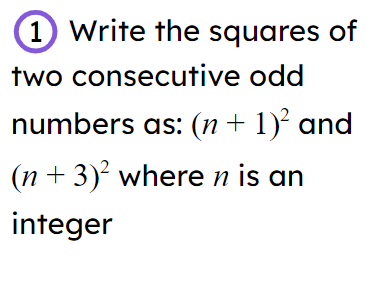
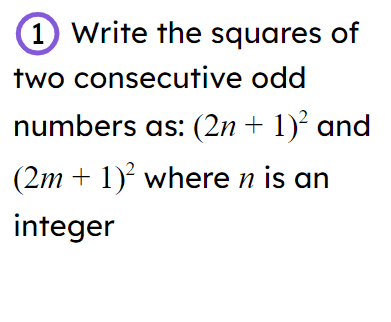
Correct Answer: An image in a quiz
Q5.Which of these statements are true for the expression $$12n + 15$$ where $$n$$ is an integer?
Which of these statements are true for the expression $$12n + 15$$ where $$n$$ is an integer?
It is always an even number
Correct answer: It is always a multiple of 3
It is always a multiple of 3
It is always a muliple of 4
Correct answer: It is always 3 more than a multiple of 6
It is always 3 more than a multiple of 6
It is always 1 less than a multiple of 8
Q6.Starting with step 1 put these steps in order to form a complete proof for "The product of two odd numbers is always odd".
Starting with step 1 put these steps in order to form a complete proof for "The product of two odd numbers is always odd".
1 - Take two odd numbers $$2n + 1$$ and $$2m +1$$ where $$n$$ and $$m$$ are integers
1
- Take two odd numbers $$2n + 1$$ and $$2m +1$$ where $$n$$ and $$m$$ are integers
2 - $$(2n +1)(2m+1)$$
2
- $$(2n +1)(2m+1)$$
3 - $$4nm + 2n + 2m + 1$$
3
- $$4nm + 2n + 2m + 1$$
4 - $$2(2nm + n + m) + 1$$
4
- $$2(2nm + n + m) + 1$$
5 - Any number one more than a multiple of 2 is odd.
5
- Any number one more than a multiple of 2 is odd.
6 - Therefore the product of any two odd numbers is odd.
6
- Therefore the product of any two odd numbers is odd.
