Choose exam board for KS4 Computer Science (GCSE)
Choose exam board for KS4 English
Choose exam board for KS4 French
Choose exam board for KS4 Geography
Choose exam board for KS4 German
Choose exam board for KS4 History
Choose tier for KS4 Maths
Choose exam board for KS4 Music
Choose exam board for KS4 Physical education (GCSE)
Choose exam board for KS4 Religious education (GCSE)
Choose exam board for KS4 Spanish

      Controlling water balance: the kidneys, nephron structure and kidney failure
      Lesson details

      Learning outcome

      I can describe the role of the kidneys in filtering the blood to control the water balance of the human body, the structure of a nephron, and treatments for kidney failure.

      Key learning points

      1. The kidneys are organs of the excretory system in the human body.
      2. Blood passes through the kidneys and is filtered.
      3. Urea and excess water and ions move out of the blood plasma into the kidney tubules and are excreted as urine.
      4. The kidneys reabsorb as much water as needed from the urine into the blood plasma to maintain water balance in the body.
      5. Having too much water in the body leads to dilute urine, and vice versa.

      Keywords

      • Urea - a waste product created in the process of breaking down excess amino acids

      • Blood plasma - the liquid part of the blood which contains dissolved nutrients and waste products

      • Kidney - the organ in the excretory system which filters waste products from blood plasma and controls water balance

      • Excretory system - the organ system responsible for removing waste from blood plasma

      • Urine - a combination of urea, and excess water and ions which is stored in the bladder until urinated

      Common misconception

      Misconceptions about the roles of the kidneys, bladder and how the blood is 'cleaned' exist. Students often conflate/confuse these roles, muddle key terms or offer weak descriptions or explanations.

      The roles of the kidney and nephron are clearly described, and diagrams and flowcharts are used to support the detailed explanations. Tasks that reinforce understanding and check for clarity and correct use of key words are included too.

      Teacher tip

      Relate this content to their own experiences when they have either drunk a lot or very little, although stick to key facts and terms to avoid crass language or embarrassment.

      Equipment

      None required.

      Licence

      This content is © Oak National Academy Limited (2026), licensed on Open Government Licence version 3.0
      except where otherwise stated. See Oak's terms & conditions
      (Collection 2).

      Lesson video

      Loading...

      Prior knowledge starter quiz

      6 Questions

      Q1.
      What substance is stored in the bladder?

      Correct Answer: urine

      Q2.
      Match the constituent of blood to its description.

      Correct Answer:red blood cells,transports oxygen to cells

      transports oxygen to cells

      Correct Answer:white blood cells,play a huge role in immunity

      play a huge role in immunity

      Correct Answer:platelets,are involved in blood clotting

      are involved in blood clotting

      Correct Answer:plasma,contains dissolved substances such as glucose and ions

      contains dissolved substances such as glucose and ions

      Q3.
      Label these parts of the excretory system.

      An image in a quiz
      Correct Answer:a,ureter

      ureter

      Correct Answer:b,bladder

      bladder

      Correct Answer:c,urethra

      urethra

      Correct Answer:d,kidney

      kidney

      Q4.
      What are proteins made of?

      Correct Answer: amino acids

      Q5.
      Which of these are ions?

      Water
      Correct answer: Na+
      Correct answer: K+
      Correct answer: HCO$$_3$$-
      CO$$_2$$

      Q6.
      The process that uses glucose as a fuel to transfer energy for life processes is called cellular .

      Correct Answer: respiration

      6 Questions

      Q1.
      Which body system are the kidneys part of?

      digestive
      waste
      Correct answer: excretory
      glandular
      circulatory

      Q2.
      Which substances are filtered from the blood and removed from the body in urine?

      Correct answer: water
      Correct answer: ions
      carbon dioxide
      Correct answer: urea
      glucose

      Q3.
      Which substances are reabsorbed by the kidney tubules?

      Correct answer: water
      Correct answer: glucose
      urine
      urea
      carbon dioxide

      Q4.
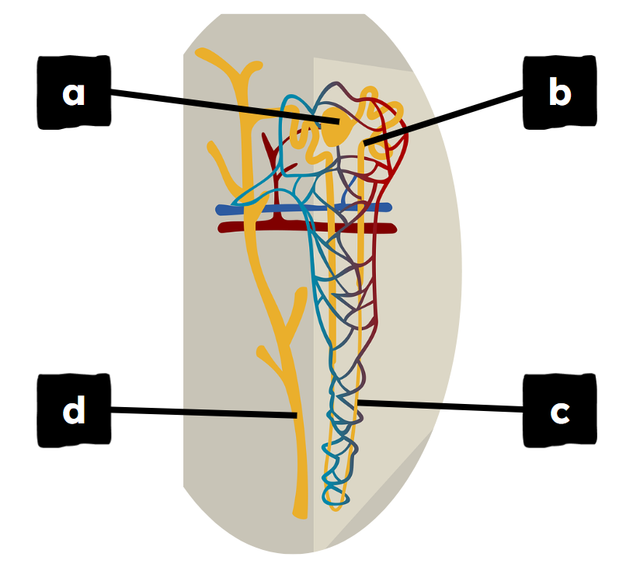
      Match each part of the kidney tubule (nephron) to its correct name.

      An image in a quiz
      Correct Answer:a,glomerulus and Bowman’s capsule

      glomerulus and Bowman’s capsule

      Correct Answer:b,proximal convoluted tubule

      proximal convoluted tubule

      Correct Answer:c,loop of Henlé

      loop of Henlé

      Correct Answer:d,collecting duct

      collecting duct

      Q5.
      If you drink too much water, which of these will happen?

      small quantity of urine
      Correct answer: dilute urine
      concentrated urine
      Correct answer: large quantity of urine
      strong smell

      Q6.
      Match each term to its correct meaning.

      Correct Answer:kidney failure,causes the concentration of urea and ions in the blood to increase

      causes the concentration of urea and ions in the blood to increase

      Correct Answer:kidney dialysis,the blood is filtered by an external machine

      the blood is filtered by an external machine

      Correct Answer:kidney transplant,a damaged kidney is removed and replaced with a donated kidney

      a damaged kidney is removed and replaced with a donated kidney


      To help you plan your 11 biology lesson on: Controlling water balance: the kidneys, nephron structure and kidney failure, download all teaching resources for free and adapt to suit your pupils' needs...