Choose exam board for KS4 Computer Science (GCSE)
Choose exam board for KS4 English
Choose exam board for KS4 French
Choose exam board for KS4 Geography
Choose exam board for KS4 German
Choose exam board for KS4 History
Choose tier for KS4 Maths
Choose exam board for KS4 Music
Choose exam board for KS4 Physical education (GCSE)
Choose exam board for KS4 Religious education (GCSE)
Choose exam board for KS4 Spanish

      Effect of osmosis and sugar concentration on the mass of plant tissue: analysis

      Lesson details

      Learning outcome

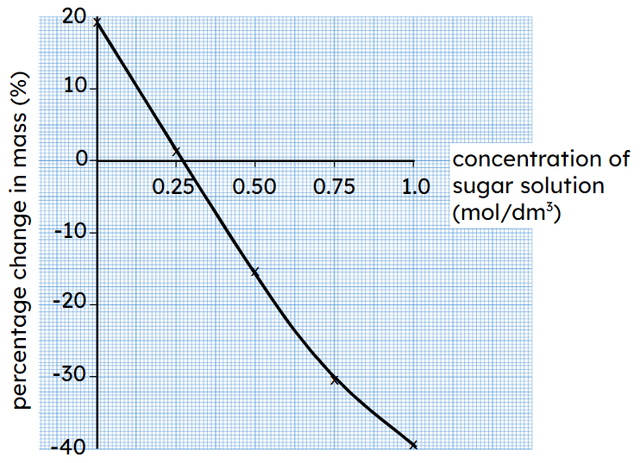
      I can interpret a graph showing the effect of sugar concentration on the mass of potato tissue, and explain the results.

      Key learning points

      1. Plotting and interpretation of a graph showing the effect of sugar concentration on the mass of potato tissue.
      2. Increase in potato mass means water moved in by osmosis (because the sugar solution was more dilute outside).
      3. Decrease in potato mass means water moved out by osmosis (because the sugar solution was more concentrated outside).
      4. The concentration of sugar in the potato tissue can be determined from the point at which there was no change in mass.
      5. At this point the sugar concentration was equal inside and out, so there was no net movement of water.

      Keywords

      • Osmosis - the net movement of water molecules through a selectively-permeable membrane from a dilute solution to a concentrated one

      • Net movement - the overall movement of particles

      • Random error - causes results to differ by different amounts due to a factor other than the independent variable (the factor we changed)

      • Concentration gradient - a difference in the concentration of particles from one area to another

      Common misconception

      Mistakes around calculating change in percentage mass are common, as are misunderstandings around why changes in mass occur.

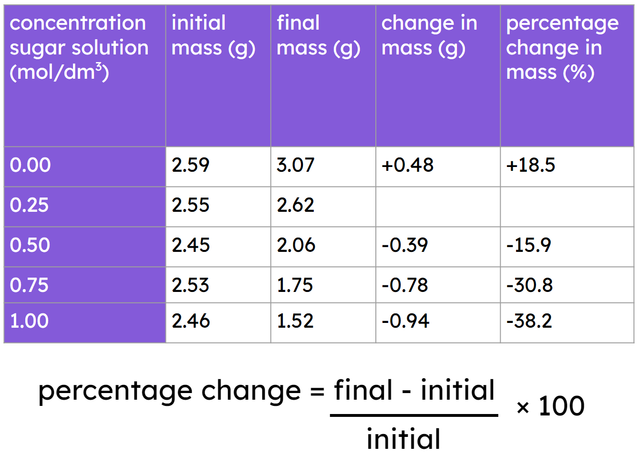
      The calculations for percentage mass are introduced and walked through with an 'I-do, we-do, you-do' model. There are plenty of calculations to practice on. Why mass changes occur is also covered in detail and with supporting diagrams.

      Teacher tip

      It will probably take longer than expected to calculate the changes in mass, and plot the data on the graph, but give sufficient time for these tasks so students are confident with these skills which come up in various locations in the biology curriculum.

      Equipment

      graph paper, rulers, pencils, calculators

      Licence

      This content is © Oak National Academy Limited (2025), licensed on Open Government Licence version 3.0
      except where otherwise stated. See Oak's terms & conditions
      (Collection 2).

      Lesson video

      Loading...

      Prior knowledge starter quiz

      6 Questions
      Q1.
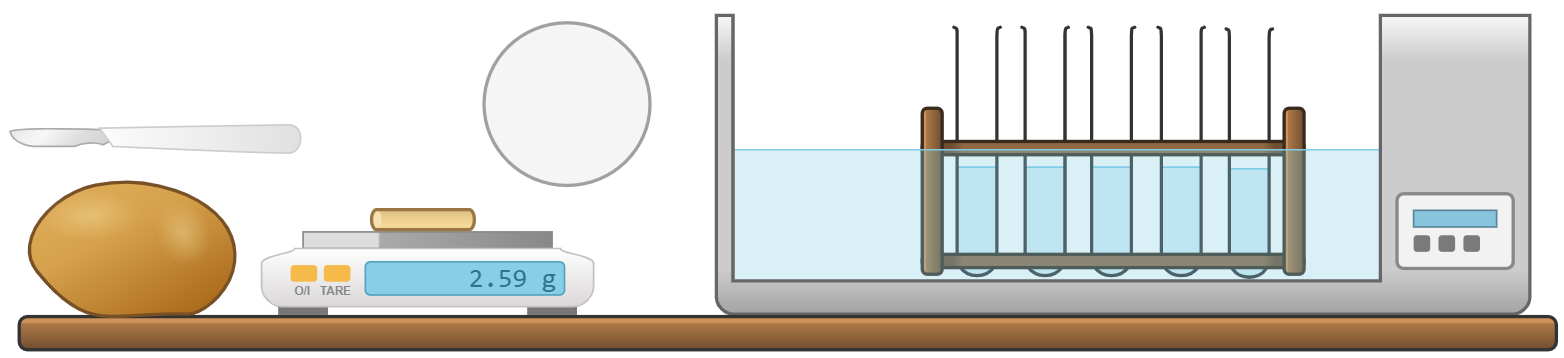
      Match each variable to the correct example when investigating the effect of sugar solution concentration on potato chips.

      An image in a quiz
      Correct Answer:independent variable,concentration of sugar solution

      concentration of sugar solution

      Correct Answer:dependent variable,mass and length of potato chips

      mass and length of potato chips

      Correct Answer:control variable,temperature of the solutions

      temperature of the solutions

      Q2.
      When investigating the effect of sugar solution concentration on potato chips, which piece of apparatus was used to control the temperature?

      An image in a quiz
      boiling tubes
      timer
      thermometer
      Correct answer: water bath

      Q3.
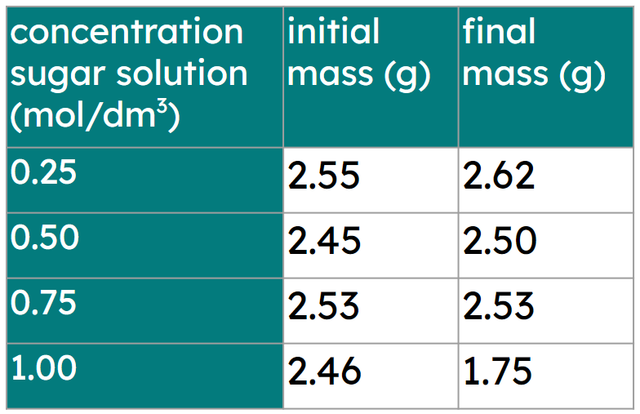
      At which concentration did the potato chip decrease in mass?

      An image in a quiz
      0.25 mol/dm$$^3$$
      0.50 mol/dm$$^3$$
      0.75 mol/dm$$^3$$
      Correct answer: 1.00 mol/dm$$^3$$

      Q4.
      Which concentration caused the potato chips to lose water by osmosis?

      An image in a quiz
      0.25 mol/dm$$^3$$
      0.50 mol/dm$$^3$$
      0.75 mol/dm$$^3$$
      Correct answer: 1.00 mol/dm$$^3$$

      Q5.
      Whose prediction is correct?

      Lucas: Potato chips will gain mass in the most concentrated solutions.
      Correct answer: Sam: Potato chips will lose mass in the most concentrated solutions.
      Laura: The most concentrated solutions will have no effect on the potato chips.

      Q6.
      Water can move out of and into potato chips because the potato cells have a selectively- membrane.

      Correct Answer: permeable

      6 Questions

      Q1.
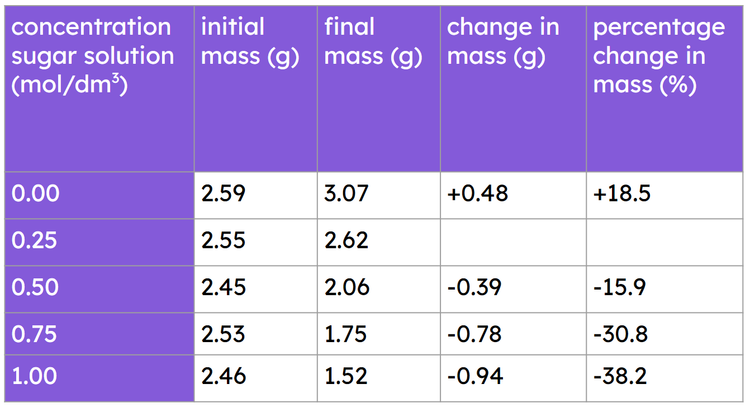
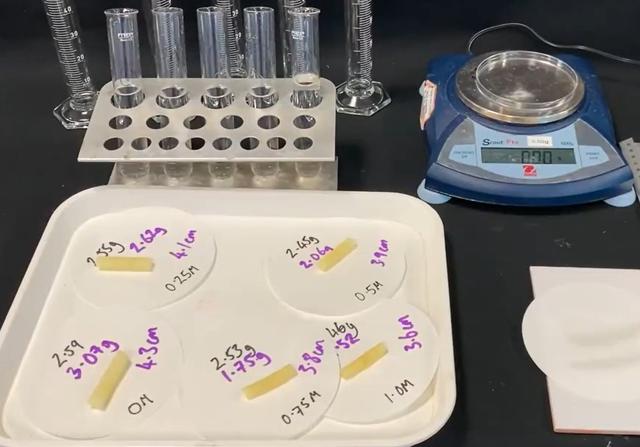
      Calculate the change in mass, in grams (g), for the potato chip in sugar solution at a concentration of 0.25 mol/dm$$^3$$.

      An image in a quiz
      Correct Answer: +0.07, +0.07 g, +0.07g

      Q2.
      Calculate the percentage change in mass (%) for the potato chip in sugar solution at a concentration of 0.25 mol/dm$$^3$$. Give your answer to 2 decimal places.

      An image in a quiz
      Correct Answer: +2.75, +2.75 %, +2.75%, 2.75%, 2.75

      Q3.
      Why is it necessary to calculate the percentage change in mass before comparing the effect of concentration on the potato chips?

      Calculating the percentage is a more scientific measurement.
      Not all the chips have the same final mass.
      Correct answer: Not all the chips have the same initial mass.
      The percentage is closer to the true value.

      Q4.
      Calculating the percentage change in mass helps to remove __________ error from the results.

      calculation
      percentage
      Correct answer: random
      systematic

      Q5.
      Match each direction of water movement to where it is shown on the graph.

      An image in a quiz
      Correct Answer:net movement into potato chip cells,when the line is above the x-axis

      when the line is above the x-axis

      Correct Answer:net movement out of potato chip cells,when the line is below the x-axis

      when the line is below the x-axis

      Correct Answer:no net movement,when the line crosses the x-axis

      when the line crosses the x-axis

      Q6.
      Which point on the graph enables us to estimate the concentration of sugar inside the potato chip cells?

      An image in a quiz
      The point on the line where the change in mass was the most positive.
      The point on the line where the change in mass was the most negative.
      Correct answer: The point where the line crosses the x-axis.
      The point where the line crosses the y-axis.

      To help you plan your 11 biology lesson on: Effect of osmosis and sugar concentration on the mass of plant tissue: analysis, download all teaching resources for free and adapt to suit your pupils' needs...