


The human endocrine system


Lesson details
Learning outcome
I can explain how the human endocrine system uses glands and hormones to control changes in the body.
Key learning points
- The human body has an endocrine system that uses hormones to control changes in the body.
- Hormones are chemicals secreted by glands, transported in blood plasma and detected by receptors on cells and tissues.
- Changes in the body can be triggered by an increase in hormones (e.g. puberty) and a decrease in them (e.g. menopause).
- Changes in the body are detected by receptors; the nervous system sends nerve impulses to glands to secrete hormones.
Keywords
Endocrine system - A system that regulates body conditions; glands secrete hormones into the blood that target specific organs.
Hormone - A chemical substance produced by a gland that travels in the bloodstream to a specific organ.
Gland - An organ or tissues that produces and secretes substances, such as hormones.
Receptor - Specialised cells that detect changes in the environment (stimuli) and respond by stimulating electrical impulses.
Common misconception
Pupils may think that all hormones in the body form part of the reproductive system and its regulation.
The slide deck gives specific examples of hormones that are not part of the reproductive system; this includes the example of antagonistic hormones.
Teacher tip
This is a good opportunity to recall students on their understanding of the nervous system and how the nervous and endocrine system work together, but also their differences.

Equipment
None required.

Licence

Lesson video
Loading...
Prior knowledge starter quiz
6 Questions
Q1.Which part of the blood transports dissolved substances?
Q2.Match the systems to their correct description.

Q3.Which of the following is a female reproductive organ?
Q4.Which hormone is involved in the fight or flight response and is triggered in stressful situations?
Q5.The changes that happen during puberty are because of chemical messengers called hormones. Which glands release the sex hormones?
Q6.What is the name of the sugar that is transported in the blood plasma and delivered to cells as a reactant for respiration?
Assessment exit quiz
6 Questions
Q1.Match each letter to the endocrine gland it is labelling.
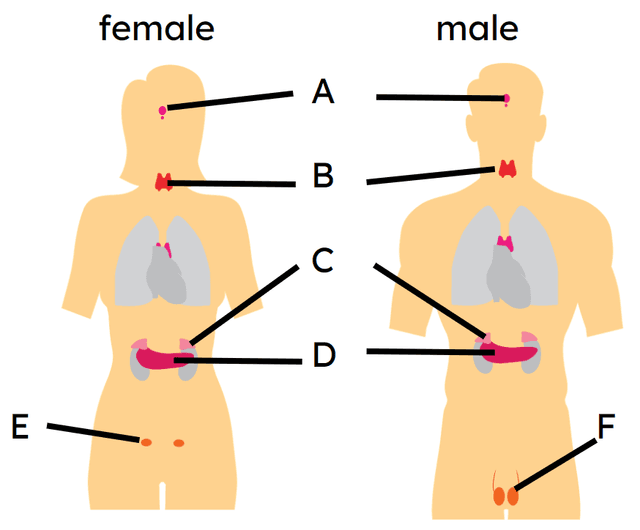
Q2.A is a chemical messenger that is secreted by glands into the bloodstream to target certain organs.
Q3.Put these stages in order to show how the endocrine system brings about a change in the body.
Q4.Which statements are true for the endocrine system?
Q5.Which statements are true about the endocrine system?
Q6.Which of the following changes in the body can be triggered by changes in hormone levels?
To help you plan your 10 biology lesson on: The human endocrine system, download all teaching resources for free and adapt to suit your pupils' needs...
To help you plan your 10 biology lesson on: The human endocrine system, download all teaching resources for free and adapt to suit your pupils' needs.
The starter quiz will activate and check your pupils' prior knowledge, with versions available both with and without answers in PDF format.
We use learning cycles to break down learning into key concepts or ideas linked to the learning outcome. Each learning cycle features explanations with checks for understanding and practice tasks with feedback. All of this is found in our slide decks, ready for you to download and edit. The practice tasks are also available as printable worksheets and some lessons have additional materials with extra material you might need for teaching the lesson.
The assessment exit quiz will test your pupils' understanding of the key learning points.
Our video is a tool for planning, showing how other teachers might teach the lesson, offering helpful tips, modelled explanations and inspiration for your own delivery in the classroom. Plus, you can set it as homework or revision for pupils and keep their learning on track by sharing an online pupil version of this lesson.
Explore more key stage 4 biology lessons from the Coordination and control: hormones and the human endocrine system unit, dive into the full secondary biology curriculum, or learn more about lesson planning.