


Mutations and genetic variants


Lesson details
Learning outcome
I can explain how mutations in DNA cause genetic variants.
Key learning points
- A change in the sequence of nucleotide bases in the DNA of the genome is called a mutation.
- Mutations can be caused by some substances and by ionising radiation.
- Most mutations are caused by errors when DNA is copied, when cells divide to make new cells.
- How substitution, insertion and deletion mutations change the base sequence in DNA.
- A mutation creates a genetic variant (a region of DNA in which the sequence of nucleotide bases has been changed).
Keywords
DNA - DNA is a large chemical molecule made of smaller chemical groups. It carries the genetic code of all living organisms.
Nucleotide - Nucleotides are the chemical groups that are the building blocks of DNA. The four types are coded A, T, C and G.
Mutation - A mutation is a change in the nucleotide base sequence in the DNA of the genome.
Ionising radiation - Ionising radiation (e.g. X-rays, gamma rays and high-energy ultraviolet) can cause mutations in DNA.
Genetic variant - A genetic variant is produced when a mutation causes a change in the genetic sequence of a gene or a non-coding region of DNA.
Common misconception
Mixing up amino acids and nucleotides, also nucleotides and bases.
Activity checks: Nucleotides contain a base; DNA is a polymer of nucleotides that codes for the order of amino acids in a protein.
Teacher tip
The diagram activity can be completed in different ways, it can be a step-by-step comic strip, a poster or a presentation.

Licence

Lesson video
Loading...
Prior knowledge starter quiz
6 Questions
Q1.DNA has two nucleic acid chains, each made from nucleotides. The chains are held together because subunits of the nucleotides pair up. Which subunits of a nucleotide molecule pair up?
Q2.True or false? An mRNA molecule has two nucleic acid strands.
Q3.Which of these statements is true?
Q4.The protein myoglobin is found in muscles and is made from a chain of 153 amino acids. How many nucleotide bases code for this chain of amino acids?
Q5.Which of these statements is true?
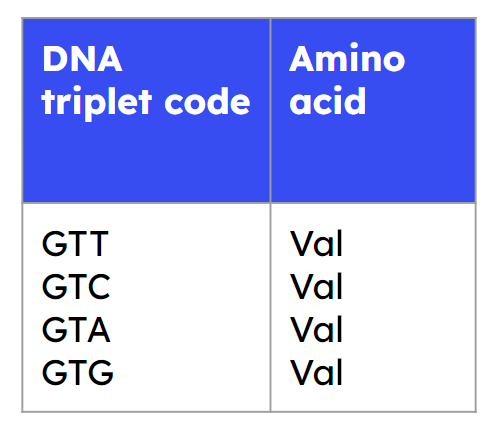
Q6.The table shows the four triplet codes that code for the amino acid Val. A change to which of the three bases could cause this triplet to code for an amino acid other than Val?
Assessment exit quiz
6 Questions
Q1.What is the best description of the genetic code?
Q2.This is part of a genetic code: TAC CAG TCA CAG. A mutation changes the code to TAC CAT TCA CAG. What kind of mutation has taken place?
Q3.Who best describes a genetic variant?



Q4.Match each word to its correct meaning.

Q5.Mutations change the genetic code in a gene. A change to the gene can change the structure of the that is made when the code is read.
Q6.Deletion mutations have a greater effect on the genetic code than substitution mutations. Why?
To help you plan your 10 biology lesson on: Mutations and genetic variants, download all teaching resources for free and adapt to suit your pupils' needs...
To help you plan your 10 biology lesson on: Mutations and genetic variants, download all teaching resources for free and adapt to suit your pupils' needs.
The starter quiz will activate and check your pupils' prior knowledge, with versions available both with and without answers in PDF format.
We use learning cycles to break down learning into key concepts or ideas linked to the learning outcome. Each learning cycle features explanations with checks for understanding and practice tasks with feedback. All of this is found in our slide decks, ready for you to download and edit. The practice tasks are also available as printable worksheets and some lessons have additional materials with extra material you might need for teaching the lesson.
The assessment exit quiz will test your pupils' understanding of the key learning points.
Our video is a tool for planning, showing how other teachers might teach the lesson, offering helpful tips, modelled explanations and inspiration for your own delivery in the classroom. Plus, you can set it as homework or revision for pupils and keep their learning on track by sharing an online pupil version of this lesson.
Explore more key stage 4 biology lessons from the DNA and the genome unit, dive into the full secondary biology curriculum, or learn more about lesson planning.