


Combustion of alcohols: practical


Lesson details
Learning outcome
I can analyse calorimetry data to determine which alcohol releases the most energy when combusted.
Key learning points
- Calorimetry can be used to measure a reaction's energy change indirectly.
- Calorimetry data can be used to calculate the mass of alcohol needed to cause a 1°C rise in temperature of the water.
- An alcohol that causes a 1°C temperature rise when the least amount is combusted is releasing the most energy.
- The energy change of combustion for a variety of alcohols can be compared to the molecular formula of each alcohol.
Keywords
Alcohols - Alcohols are a homologous series that contain the -OH functional group.
Combustion - Combustion is an exothermic reaction where a substance reacts with oxygen.
Calorimetry - Calorimetry is an experiment that can be used to measure the energy released from a fuel such as alcohol.
Independent variable - The independent variable is the single variant that is changed in an investigation.
Common misconception
Forgetting to measure the initial mass of the burner and initial temperature of the water.
Emphasise the importance in remembering to measure this data when writing a method for this practical.
Teacher tip
Demonstrate how the equipment should be set up, and how heat loss to the surroundings can be minimalised.

Equipment
Alcohol burners and calorimetry apparatus.

Content guidance
Risk assessment required - equipment

Supervision
Adult supervision required

Licence

Lesson video
Loading...
Prior knowledge starter quiz
6 Questions
Q1.Name the alcohol shown in the image
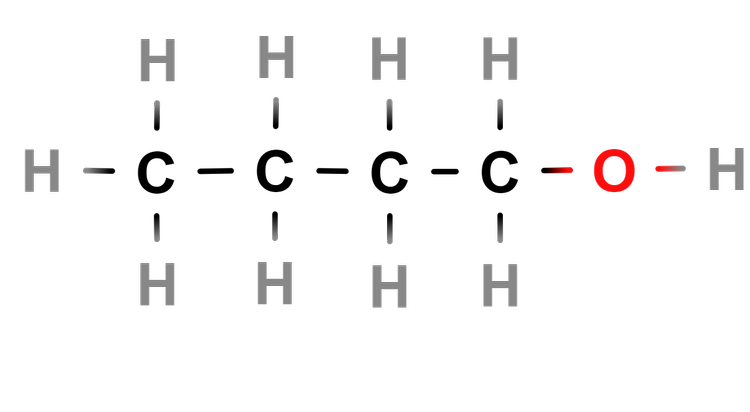

Q2.What hazard symbol would you expect to find on an alcohol burner in the lab?
Q3.Which variable is defined as the single variant that is changed in an investigation.
Q4.What is the molecular formula of propanol?
Q5.In a calorimetry experiment the initial temperature of water is 23ᵒC. The water temperature rises to 55ᵒC. What is the temperature change?
Q6.What number needs to be placed in front of the CO₂ to balance this equation?
C₄H₉OH + 6O₂ → _CO₂ + 5H₂O.
Assessment exit quiz
6 Questions
Q1.Which of the following statements about the combustion of alcohols are true?
Q2.What is the name of an experiment that can be used to measure the energy released from a fuel such as alcohol?
Q3.2 g of methanol, ethanol and propanol were combusted in a calorimetry experiment. Which fuel will cause the greatest temperature rise in 50 cm³ of water in the calorimeter?
Q4.Using the data of the mass needed to cause a temperature rise. Which alcohol releases the most energy during combustion?
Q5.Calculate the mass of butanol needed to produce a 1°C temperature rise when 1.3 g of butanol produced a 49°C rise in temperature of 100 cm³ of water.
Q6.Calculate the mass of propanol needed to produce a 10°C temperature rise when 1.45 g of propanol produced a 46°C rise in temperature of 100 cm³ of water.
To help you plan your 11 chemistry lesson on: Combustion of alcohols: practical, download all teaching resources for free and adapt to suit your pupils' needs...
To help you plan your 11 chemistry lesson on: Combustion of alcohols: practical, download all teaching resources for free and adapt to suit your pupils' needs.
The starter quiz will activate and check your pupils' prior knowledge, with versions available both with and without answers in PDF format.
We use learning cycles to break down learning into key concepts or ideas linked to the learning outcome. Each learning cycle features explanations with checks for understanding and practice tasks with feedback. All of this is found in our slide decks, ready for you to download and edit. The practice tasks are also available as printable worksheets and some lessons have additional materials with extra material you might need for teaching the lesson.
The assessment exit quiz will test your pupils' understanding of the key learning points.
Our video is a tool for planning, showing how other teachers might teach the lesson, offering helpful tips, modelled explanations and inspiration for your own delivery in the classroom. Plus, you can set it as homework or revision for pupils and keep their learning on track by sharing an online pupil version of this lesson.
Explore more key stage 4 chemistry lessons from the Organic chemistry unit, dive into the full secondary chemistry curriculum, or learn more about lesson planning.