


Giant ionic structures


Lesson details
Learning outcome
I can describe how metal and non-metal ions bond together to form giant ionic structures.
Key learning points
- Salts form ionic structures because they contain metal and non-metal ions.
- In an ionic structure each positive ion attracts the negative ions and vice-versa.
- Metal ions attract all non-metal ions and vice-versa, they bond to the opposite charged ions that are closest.
- An ionic bond is the electrostatic force of attraction between oppositely-charged ions acting in all directions.
- Ionic substances are 3D lattices with regular arrangements of ions ( in a repeating pattern of +ve and -ve charge).
Keywords
Ionic bond - the electrostatic force of attraction between oppositely-charged ions acting in all directions
Ball-and-stick model - used to represent the atoms and bonds in a chemical compound
Lattice - the regular arrangement of atoms or ions in a 3D space
Common misconception
That the ionic bond is the transfer of electrons and not the electrostatic forces of attraction between the ions. The ball and stick model implies that there is a physical link between the ions.
Ensure that students have a good understanding of how ions are formed and that ionic bond forms when oppostive ions attract; before moving on to dot and cross diagrams for binary ionic substances.
Teacher tip
Show your students a range of ionic crystals or grow some copper sulfate crystals. Encourage students to build a model of a giant lattice structure using model kits, playdoh, or clay and straws. Demonstrate that opposites attract by charging a balloon and sticking it to the wall.

Licence

Lesson video
Loading...
Prior knowledge starter quiz
6 Questions
Q1.How is a negative ion formed?
Q2.Explain how sodium atoms become sodium ions.
Q3.Which of the following types of bonding occurs between non–metal atoms.
Q4.Most atoms increase their stability by forming bonds with other atoms so that they have a full of electrons.
Q5.Which of the following are examples of non–metal elements?
Q6.Sulfur is in Group 6 of the periodic table. Which of the following correctly shows the charge on a sulfur ion?
Assessment exit quiz
6 Questions
Q1.Match the following key terms to their definitions.

Q2.A ionic bond is the force of attraction between oppositely–charged ions that acts in all directions.
Q3.What is the name given to the type of model shown in the diagram?
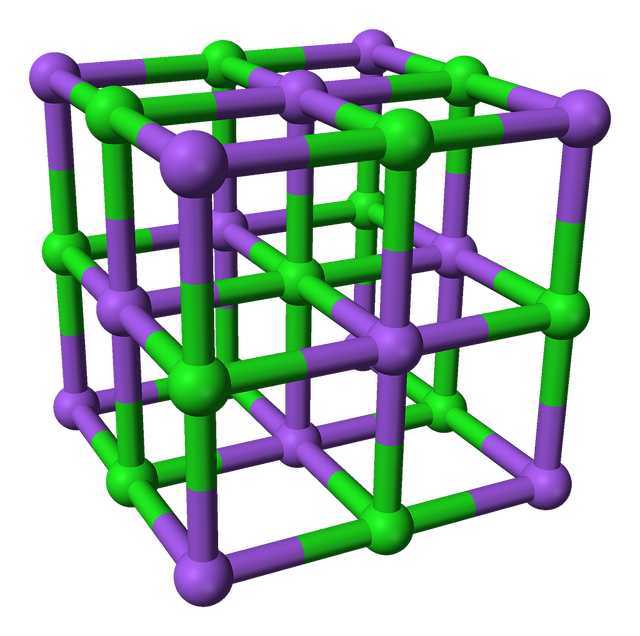
Q4.Which of the following types of structure do ionic compounds form?
Q5.Magnesium oxide, MgO, contains ionic bonds. Which of the following statements about magnesium oxide are correct?
Q6.The diagram shows a 3D model of the giant ionic structure of magnesium oxide. What is an advantage of this type of model?

To help you plan your 10 chemistry lesson on: Giant ionic structures, download all teaching resources for free and adapt to suit your pupils' needs...
To help you plan your 10 chemistry lesson on: Giant ionic structures, download all teaching resources for free and adapt to suit your pupils' needs.
The starter quiz will activate and check your pupils' prior knowledge, with versions available both with and without answers in PDF format.
We use learning cycles to break down learning into key concepts or ideas linked to the learning outcome. Each learning cycle features explanations with checks for understanding and practice tasks with feedback. All of this is found in our slide decks, ready for you to download and edit. The practice tasks are also available as printable worksheets and some lessons have additional materials with extra material you might need for teaching the lesson.
The assessment exit quiz will test your pupils' understanding of the key learning points.
Our video is a tool for planning, showing how other teachers might teach the lesson, offering helpful tips, modelled explanations and inspiration for your own delivery in the classroom. Plus, you can set it as homework or revision for pupils and keep their learning on track by sharing an online pupil version of this lesson.
Explore more key stage 4 chemistry lessons from the Structure and bonding unit, dive into the full secondary chemistry curriculum, or learn more about lesson planning.