Choose exam board for KS4 Computer Science (GCSE)
Choose exam board for KS4 English
Choose exam board for KS4 French
Choose exam board for KS4 Geography
Choose exam board for KS4 German
Choose exam board for KS4 History
Choose tier for KS4 Maths
Choose exam board for KS4 Music
Choose exam board for KS4 Physical education (GCSE)
Choose exam board for KS4 Religious education (GCSE)
Choose exam board for KS4 Spanish

      Effect of osmosis and sugar concentration on the mass of plant tissue: practical
      Lesson details

      Learning outcome

      I can carry out an investigation into the effect of sugar solution concentration on the mass of fresh potato tissue.

      Key learning points

      1. Water diffuses into and out of cells by osmosis; net movement is from a more dilute solution to a more concentrated one.
      2. Investigating the effect of sucrose solution concentration on the mass of potato chips.
      3. Use of appropriate apparatus to measure volumes, masses and times accurately.
      4. Safe use of materials and apparatus.
      5. Control of variables that might affect the results (e.g. temperature).

      Keywords

      • Osmosis - the net movement of water molecules through a selectively-permeable membrane from a dilute solution to a concentrated one

      • Net movement - the overall movement of particles

      • Mass - a measure of how much matter something contains, in grams

      • Control - a variable which is kept constant between all experiments

      Common misconception

      Coordinating the measurements and the sugar solution in this practical is fiddly and if not done methodically, the results can be easily confused.

      The table in which results will be recorded is clearly labelled and used, and a copy is provided in the worksheet.

      Teacher tip

      Consider using a draft version of the data during the practical. You could use salt water instead, and different vegetable chips, or spread these changes throughout the class to compare the results to see how the same biology is occurring, despite these differences.

      Equipment

      fresh potato, test tubes, sharp knife or borer, cutting tile, ruler, balance, filter paper, sugar solutions (0.25, 0.5, 0.75, 1 M), distilled water, water bath, test tube racks, timer

      Content guidance

      Risk assessment required - equipment

      Supervision

      Adult supervision required

      Licence

      This content is © Oak National Academy Limited (2026), licensed on Open Government Licence version 3.0
      except where otherwise stated. See Oak's terms & conditions
      (Collection 2).

      Lesson video

      Loading...

      Prior knowledge starter quiz

      6 Questions
      Q1.
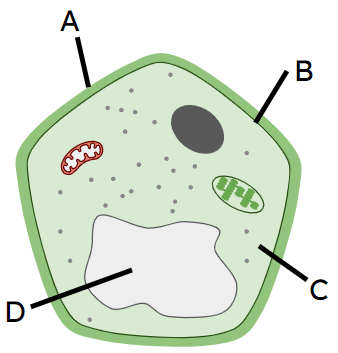
      Which part of the plant cell is the selectively-permeable cell membrane?

      An image in a quiz
      A
      Correct answer: B
      C
      D

      Q2.
      The net movement of water molecules through a selectively-permeable membrane is called …

      active transport
      circulation
      Correct answer: osmosis
      reaction

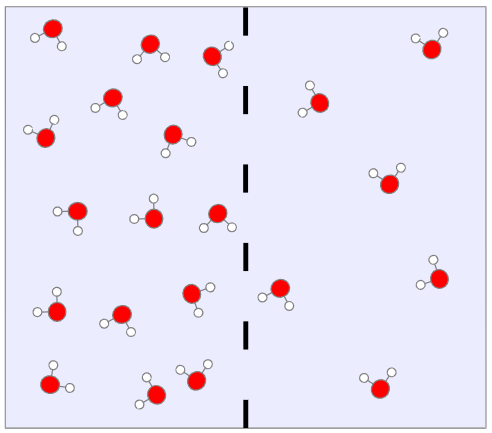
      Q3.
      When there are more water molecules on one side of a selectively-permeable membrane than the other, this creates a gradient.

      An image in a quiz
      Correct Answer: concentration

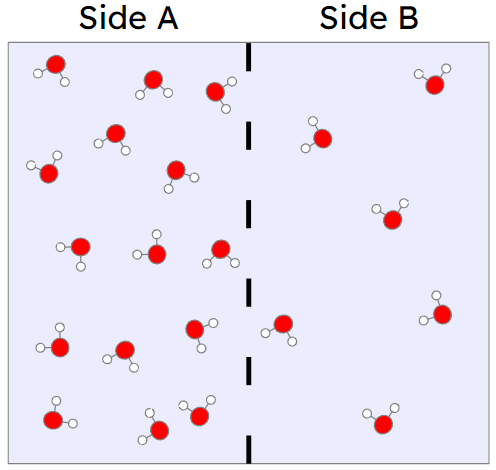
      Q4.
      The net movement of water molecules through the membrane will be …

      An image in a quiz
      Correct answer: … from side A to side B.
      … from side B to side A.
      … equal in both directions.

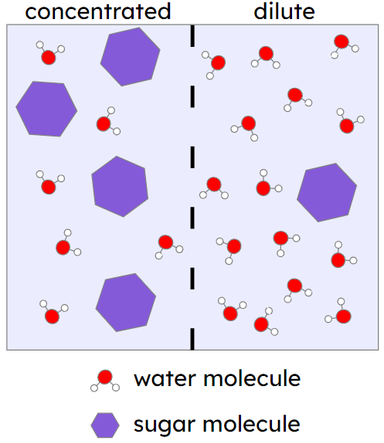
      Q5.
      The net movement of water molecules through the membrane will be …

      An image in a quiz
      … from the concentrated solution to the dilute solution.
      Correct answer: … from the dilute solution to the concentrated solution.
      … equal in both directions.

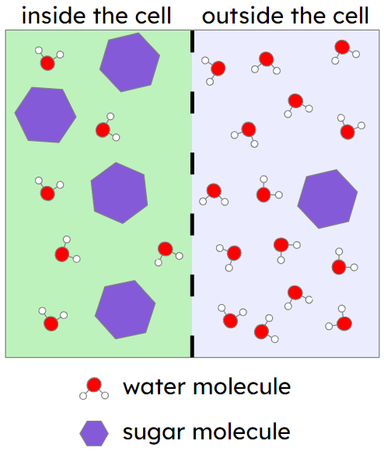
      Q6.
      Which prediction is correct?

      An image in a quiz
      Correct answer: The cell will gain water.
      The cell will lose water.
      The cell will neither gain nor lose water.

      6 Questions

      Q1.
      When potato chips are placed in sugar solution, they gain and lose water from the solution due to the process of .

      Correct Answer: osmosis, diffusion

      Q2.
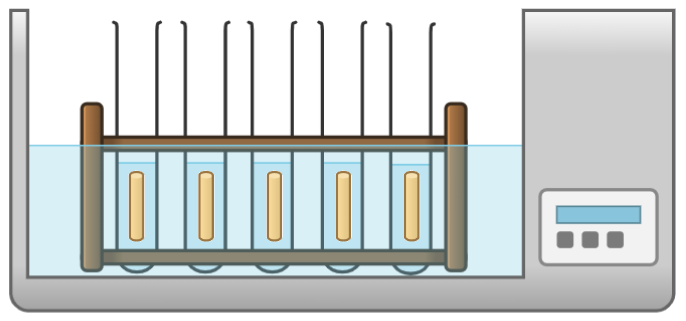
      When investigating the effect of sugar solution concentration on potato chips, why were the test tubes placed in a water bath?

      An image in a quiz
      to control the concentration of the solutions
      to measure the concentration of the solutions
      Correct answer: to control the temperature of the solutions
      to measure the temperature of the solutions

      Q3.
      When investigating the effect of sugar solution concentration on potato chips, what is the independent variable?

      Correct answer: the concentration of the sugar solution
      the mass and length of the potato chips
      the number of potato chips in each solution
      the temperature of the solutions

      Q4.
      When investigating the effect of sugar solution concentration on potato chips, what is the dependent variable?

      the concentration of the sugar solution
      Correct answer: the mass and length of the potato chips
      the number of potato chips in each solution
      the temperature of the solutions

      Q5.
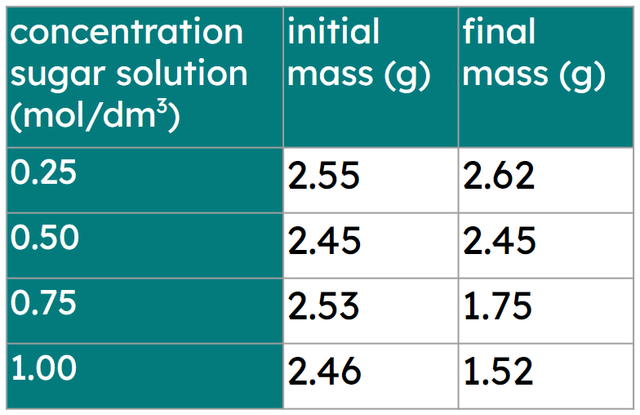
      At which concentration did the potato chip increase in mass?

      An image in a quiz
      Correct answer: 0.25 mol/dm$$^3$$
      0.50 mol/dm$$^3$$
      0.75 mol/dm$$^3$$
      1.00 mol/dm$$^3$$

      Q6.
      Which concentration caused the potato chips to take in water by osmosis?

      An image in a quiz
      Correct answer: 0.25 mol/dm$$^3$$
      0.50 mol/dm$$^3$$
      0.75 mol/dm$$^3$$
      1.00 mol/dm$$^3$$

      To help you plan your 11 combined science lesson on: Effect of osmosis and sugar concentration on the mass of plant tissue: practical, download all teaching resources for free and adapt to suit your pupils' needs...