


Velocity on a graph (v = x ÷ t)



Lesson details
Learning outcome
I can sketch accurate displacement-time graphs of different motions.
Key learning points
- The velocity of an object is equal to the gradient of a displacement-time graph.
- A direction in which velocity and displacement are measured needs to be chosen.
- A negative gradient on a displacement-time graph (sloping downwards) represents velocity in the opposite direction.
- A negative value for displacement represents a position ‘behind’ the starting position.
Keywords
Displacement - The displacement of an object is the distance and direction from a specific point. Displacement is a vector.
Displacement-time graph - A displacement-time graph shows the displacement of an object over a period of time.
Motion sensor - A motion sensor measures the distance between itself and an object. We can use the measurements to calculate and plot graphs of displacement, velocity and acceleration.
Common misconception
Negative values on a displacement-time graph always represent motion that is backwards.
Provide opportunities for pupils to plot a range of displacement-time graphs in real time in order for them to understand how the graph represents different motions.
Teacher tip
Allow pupils to plot displacement-time graphs in small groups using a motion sensor on their desk to detect the position of a dynamics trolley they move towards or away from the sensor. A piece of cardboard taped to the back of the trolley provides a reliable target.

Equipment
See additional materials.

Content guidance
Risk assessment required - equipment

Supervision
Adult supervision required

Licence

Lesson video
Loading...
Prior knowledge starter quiz
6 Questions
Q1.Some swimmers compete in a 50m race. Their times are shown.
Starting with the fastest, sort the swimmers in order of their speeds.

Q2.Which of the following are vector quantities?
Q3.A rocket has a velocity of 200 m/s upwards.
What distance will the rocket travel upwards in 30 s?
Q4.A jogger runs for 250 s and they end up 625 m west of their starting point.
Calculate the average velocity of the jogger.
Q5.Two trains are travelling in the same direction. Train A has a speed of 6.5 m/s and train B has a speed of 5.5 m/s.
Q6.An small airplane travels 45 km north in 30 minutes.
Calculate the velocity of the airplane in m/s.

Assessment exit quiz
6 Questions
Q1.Match the key word or phrase to the explanation.

Q2.Which feature of a displacement-time graph shows the velocity?
Q3.An ultrasonic motion sensor is used to measure displacement of a ball. Put the stages in order to explain how the sensor works.
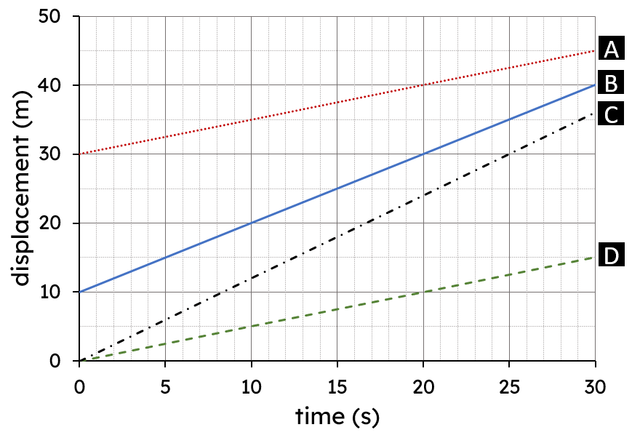
Q4.Which line on the graph show the highest velocity?
Q5.Select the options which describe the motion between 1 s and 5 s.
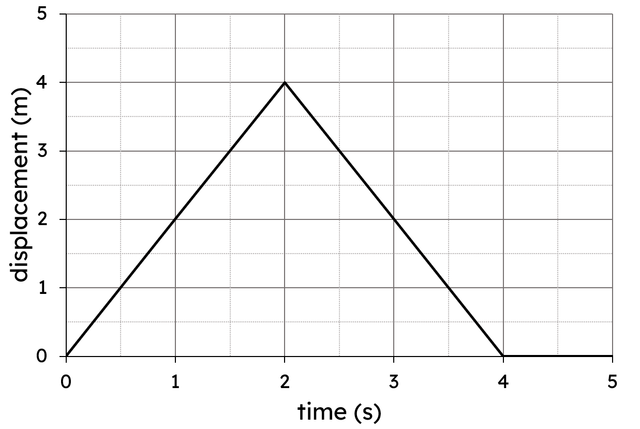
Q6.A pupil has plotted a graph to show their movement as they run across the classroom.
Why is this graph unrealistic?
To help you plan your 10 combined science lesson on: Velocity on a graph (v = x ÷ t), download all teaching resources for free and adapt to suit your pupils' needs...
To help you plan your 10 combined science lesson on: Velocity on a graph (v = x ÷ t), download all teaching resources for free and adapt to suit your pupils' needs.
The starter quiz will activate and check your pupils' prior knowledge, with versions available both with and without answers in PDF format.
We use learning cycles to break down learning into key concepts or ideas linked to the learning outcome. Each learning cycle features explanations with checks for understanding and practice tasks with feedback. All of this is found in our slide decks, ready for you to download and edit. The practice tasks are also available as printable worksheets and some lessons have additional materials with extra material you might need for teaching the lesson.
The assessment exit quiz will test your pupils' understanding of the key learning points.
Our video is a tool for planning, showing how other teachers might teach the lesson, offering helpful tips, modelled explanations and inspiration for your own delivery in the classroom. Plus, you can set it as homework or revision for pupils and keep their learning on track by sharing an online pupil version of this lesson.
Explore more key stage 4 combined science lessons from the Measuring and calculating motion unit, dive into the full secondary combined science curriculum, or learn more about lesson planning.