Choose exam board for KS4 Computer Science (GCSE)
Choose exam board for KS4 English
Choose exam board for KS4 French
Choose exam board for KS4 Geography
Choose exam board for KS4 German
Choose exam board for KS4 History
Choose tier for KS4 Maths
Choose exam board for KS4 Music
Choose exam board for KS4 Physical education (GCSE)
Choose exam board for KS4 Religious education (GCSE)
Choose exam board for KS4 Spanish

      Lesson details

      Learning outcome

      I can predict the state of matter of a substance at different temperatures using the particle model.

      Key learning points

      1. There are changes in arrangement, movement and energy of particles during state changes.
      2. There are two types of change, physical and chemical, and these can be explained in terms of the particle model.
      3. The physical state of a substance can be predicted at specified temperatures.
      4. Forces of attraction between particles have a role in determining the amount of energy needed for state changes.

      Keywords

      • Physical change - A change in which no new substances are formed, such as a change in state, e.g. melting.

      • Chemical change - When a reaction takes place and atoms or ions in the reactants are rearranged to make new products/substances.

      Common misconception

      Pupils often confuse physical and chemical changes. Also, pupils do not appreciate that substances can exist in any state of matter depending on temperature.

      Use the phrasing 'substances in a solid state' rather than solids to avoid pupils thinking that the substance only exits in one specific state.

      Teacher tip

      Use different strength magnets to help pupils understand forces of attraction having varying strengths.

      Equipment

      Optional : pair of magnets that have different magnetic strengths.

      Licence

      This content is © Oak National Academy Limited (2026), licensed on Open Government Licence version 3.0
      except where otherwise stated. See Oak's terms & conditions
      (Collection 2).

      Lesson video

      Loading...

      Prior knowledge starter quiz

      6 Questions

      Q1.
      Which of the following statements can correctly finish this sentence?: Substances in a solid state...

      Correct answer: cannot be compressed.
      Correct answer: do not take the shape of the container they are in.
      have larger particles than all substances in a liquid state.
      have particles which have no energy at all.
      Correct answer: have particles which vibrate around their fixed positions.

      Q2.
      Which of the following statements can correctly finish this sentence?: Substances in a liquid state…

      Correct answer: at boiling point can form bubbles of the substance anywhere in the liquid.
      can be compressed.
      Correct answer: have particles at the surface which may have enough energy to leave.
      Correct answer: have particles which can move around and over each other.
      take the shape of the whole of the container they are in.

      Q3.
      Which of the following statements can correctly finish this sentence?: Substances in a gas state…

      Correct answer: are formed in the bubbles inside a liquid at boiling point
      Correct answer: can be compressed
      have particles which are not attracted to each other at all, ever
      Correct answer: have particles which can escape an open container to fill all the space
      Correct answer: take the shape of the container they are in

      Q4.
      As particles gain energy, they are able to overcome the between them.

      Correct Answer: forces of attraction, force of attraction

      Q5.
      Which aspects of a particle change when a substance’s state of matter changes?

      Correct answer: arrangement relative to other particles
      Correct answer: energy of particle
      Correct answer: movement of particle
      shape of particle
      size of particle

      Q6.
      Match the following terms to their definitions.

      Correct Answer:boiling point,temperature where substance changes from liquid state to gas state

      temperature where substance changes from liquid state to gas state

      Correct Answer:condensing point,temperature where substance changes from gas state to liquid state

      temperature where substance changes from gas state to liquid state

      Correct Answer:freezing point,temperature where substance changes from liquid state to solid state

      temperature where substance changes from liquid state to solid state

      Correct Answer:melting point,temperature where substance changes from solid state to liquid state

      temperature where substance changes from solid state to liquid state

      6 Questions

      Q1.
      Changes of state, such as when a substance in the solid state becomes a substance in the liquid state, do not involve the formation of new substances, so these are changes.

      Correct Answer: physical

      Q2.
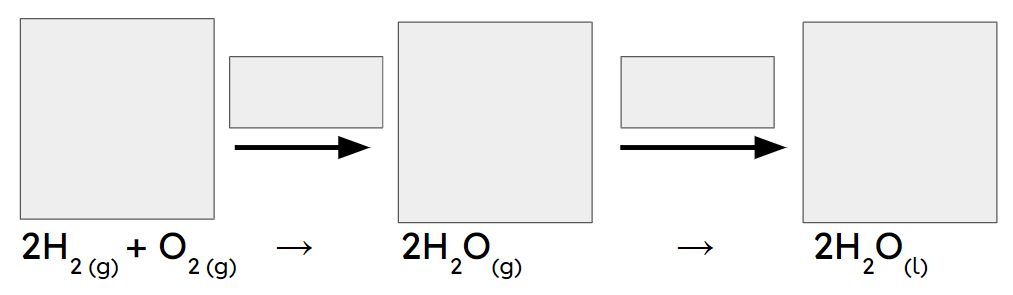
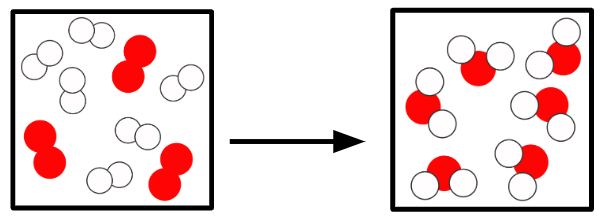
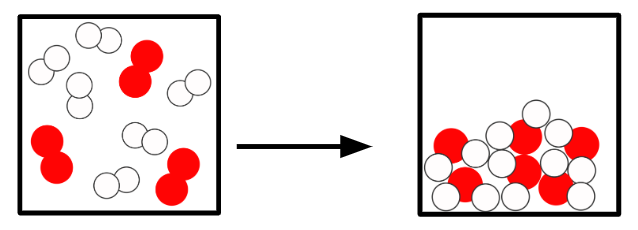
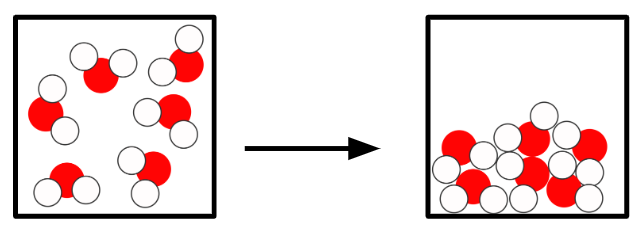
      In the main image, the important information has been replaced with grey boxes. Which of the three images below is the best representation of a chemical change of substances in the same state?

      An image in a quiz
      Correct answer: image 1
      image 2
      image 3

      Q3.
      Starting from a substance in the gas state, sort the states and the temperatures at which changes of state happen in order?

      1 - substance in the gas state
      2 - condensing point
      3 - substance in the liquid state
      4 - freezing point
      5 - substance in the solid state

      Q4.
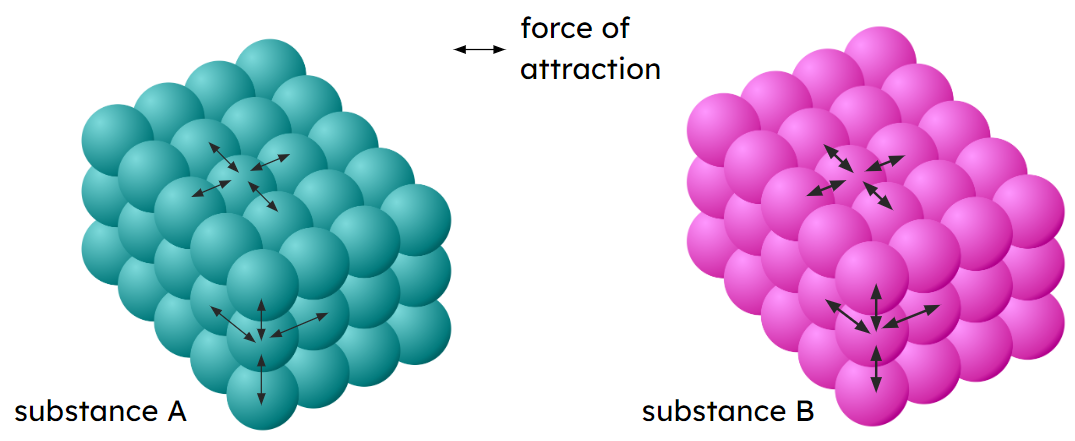
      In the image below, what indicates that substance A has a lower melting point than substance B?

      An image in a quiz
      the colour of the particles: green is a colder colour than pink
      the direction of the arrows: different arrows going in all directions
      the shading of the particles: darker means stronger
      Correct answer: the thickness of the arrows: thinner means weaker

      Q5.
      Three balloons are filled with neon, methane and oxygen, respectively. Why would you expect the substance in the methane filled balloon to have the highest boiling point?

      it has more than one type of atom in its molecules
      it has strong covalent bonds in the molecules
      Correct answer: it has stronger intermolecular forces between the particles
      it has the biggest particles and they do not move

      Q6.
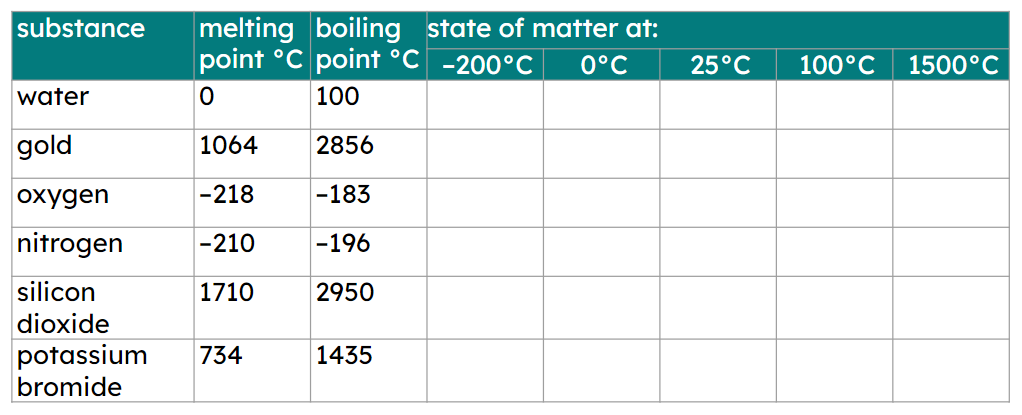
      At which temperature are all these substances in a liquid state?

      An image in a quiz
      at -200$$^o$$C
      at 25$$^o$$C
      at 1500$$^o$$C
      between 0 and 100$$^o$$C
      Correct answer: never

      To help you plan your 10 combined science lesson on: Predicting states of matter, download all teaching resources for free and adapt to suit your pupils' needs...