


Refraction through a rectangular block


Lesson details
Learning outcome
I can describe what refraction is and draw accurate ray diagrams of refraction.
Key learning points
- Refraction is when waves travel from one transparent medium to another, causing a change in direction.
- When waves slow down, they turn towards the normal line (angle of incidence > angle of refraction).
- When waves speed up, they turn away from the normal line (angle of incidence < angle of refraction).
- Refraction can be investigated using a clear rectangular block, ray box and narrow slit, pencil, paper and a protractor.
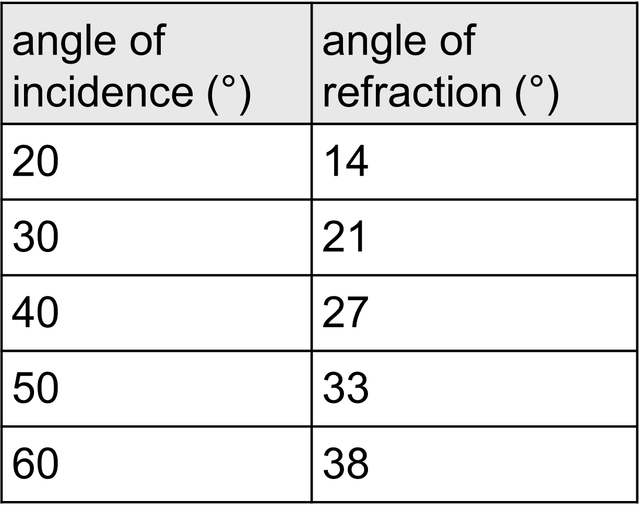
- The greater the angle of incidence, the greater the angle of refraction.
Keywords
Refraction - Refraction occurs when waves travel from one transparent medium to another, causing a change in wave speed and direction.
Normal - The normal is an imaginary line drawn at 90° to a surface.
Angle of incidence - The angle of incidence is the angle between the incident ray and the normal.
Angle of refraction - The angle of refraction is the angle between the refracted ray and the normal.
Common misconception
Pupils sometimes rote-learn what specific examples of refraction look like, rather than developing a more general understanding of the direction waves turn based on changes in wave speed.
Teach pupils the general theory of refraction and apply it to a variety of different examples where wave speed changes (e.g. sound waves refract in the opposite direction to light at an air-glass boundary due to the different wave speeds).
Teacher tip
There are many engaging demonstrations of refraction, e.g. using water to make a coin in the bottom of a tray appear, or shining lasers into refraction tanks (containers of aqueous suspensions, that can be bought or made). Limit examples to straight edges as curves have additional effects.

Content guidance
Risk assessment required - equipment

Supervision
Adult supervision required

Licence

Lesson video
Loading...
Prior knowledge starter quiz
6 Questions
Q1.What is represented by an arrow in a ray diagram?
Q2.Which of the following statements about light is correct?
Q3.Match the key words (relating to how light interacts with different objects) to their definitions.

Q4.In a ray diagram, the ray that approaches a surface or boundary is called the ray.
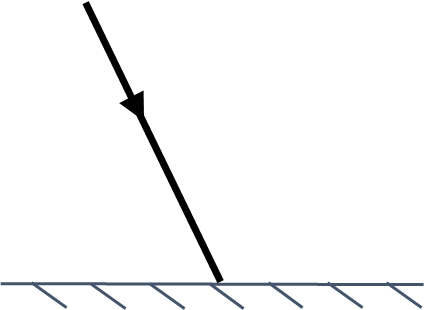
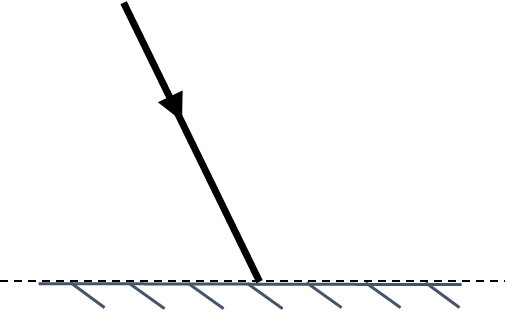
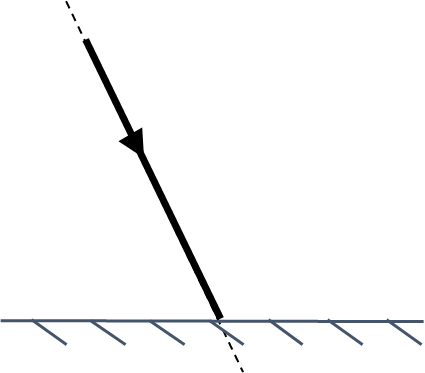
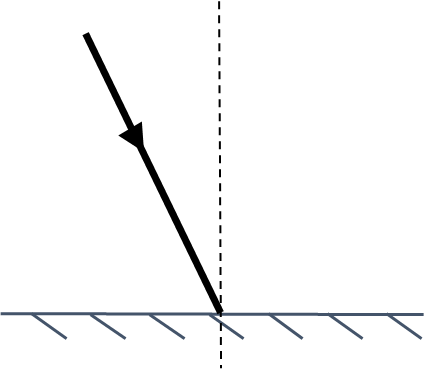
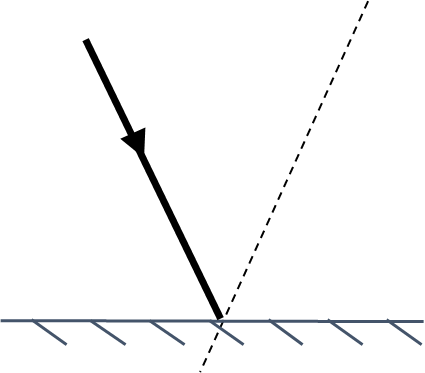
Q5.The ray diagram shown represents a light wave hitting a mirror.
Which of the following diagrams shows the normal line (represented by a dashed line) drawn correctly?
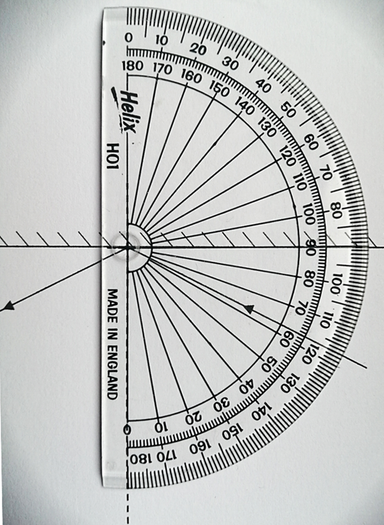
Q6.The ray diagram shown is for a light wave reflecting from a mirror. A student has placed a protractor over the diagram.
What is the angle of incidence?
Assessment exit quiz
6 Questions
Q1.Which of the following words describe what can happen when light hits an object?
Q2.What is refraction?
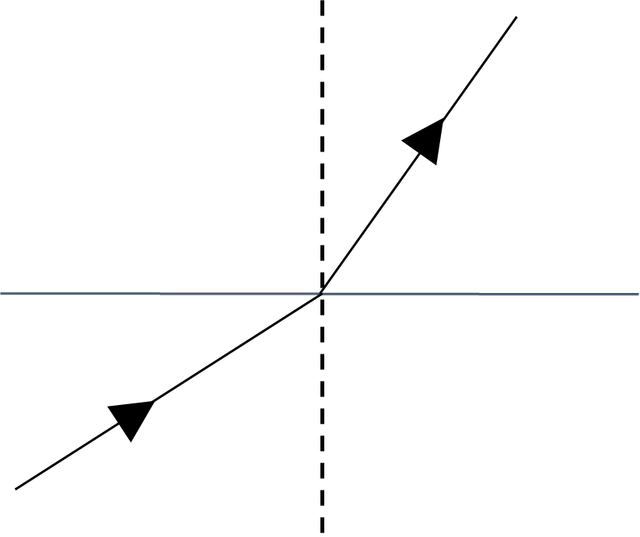
Q3.The ray diagram represents a light wave passing from one medium to another. The normal is drawn as a dashed line. A student has placed a protractor over the diagram. What is the angle of refraction?
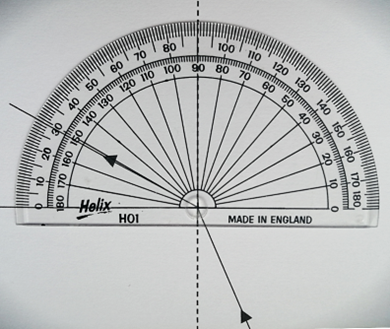
Q4.The ray diagram shows the refraction of a light wave when it crosses a boundary between two materials. Which of these statements are correct?
Q5.A student measures the angle of incidence and the angle of refraction at a boundary from air into a transparent block. The table shows the results. Which of these statements are correct?
Q6.Which of these ray diagrams shows a possible path of a ray through a plastic block?




To help you plan your 11 combined science lesson on: Refraction through a rectangular block, download all teaching resources for free and adapt to suit your pupils' needs...
To help you plan your 11 combined science lesson on: Refraction through a rectangular block, download all teaching resources for free and adapt to suit your pupils' needs.
The starter quiz will activate and check your pupils' prior knowledge, with versions available both with and without answers in PDF format.
We use learning cycles to break down learning into key concepts or ideas linked to the learning outcome. Each learning cycle features explanations with checks for understanding and practice tasks with feedback. All of this is found in our slide decks, ready for you to download and edit. The practice tasks are also available as printable worksheets and some lessons have additional materials with extra material you might need for teaching the lesson.
The assessment exit quiz will test your pupils' understanding of the key learning points.
Our video is a tool for planning, showing how other teachers might teach the lesson, offering helpful tips, modelled explanations and inspiration for your own delivery in the classroom. Plus, you can set it as homework or revision for pupils and keep their learning on track by sharing an online pupil version of this lesson.
Explore more key stage 4 combined science lessons from the Electromagnetic waves unit, dive into the full secondary combined science curriculum, or learn more about lesson planning.