


State changes: fundamentals


Lesson details
Learning outcome
I can describe the processes of melting, freezing, boiling, and condensation, using a simple particle model to explain these state changes.
Key learning points
- A simple particle model explains melting, boiling, freezing, and condensing processes.
- Boiling is when a liquid becomes a gas throughout, forming bubbles. Condensation is when gas turns into liquid.
- Melting is when a solid turns into a liquid with added energy. Freezing is the reverse: liquid to solid, losing energy.
- The particles remain the same size and shape as they do not have bulk properties like melting and boiling points.
Keywords
Melting - When a substance changes from a solid state to a liquid state.
Freezing - The process of a substance changing from a liquid state to a solid state.
Forces of attraction - A pulling force that keeps particles close together.
Boiling - When a substance in the liquid state is heated, gas bubbles form and it changes to the gas state.
Condensing - When a substance in the gas state is cooled and changes to a liquid state.
Common misconception
Pupils often think that the particles within the liquid will have melted or boiled rather than remain the same size and shape, i.e. atoms do not have bulk properties like melting and boiling points.
Ensure that you specifically say that the particles themselves will not melt or boil.
Teacher tip
Using the word 'state' when referring to a state of matter, e.g. liquid state. This helps pupils understand that substances can exist in different states of matter. For example, oxygen can exist in the gas state, liquid state or solid state.

Licence

Lesson video
Loading...
Prior knowledge starter quiz
6 Questions
Q1.As particles gain energy, they are able to overcome the between them.
Q2.For water, what is the temperature at which it turns from the liquid state to the gas state?
Q3.Match the following key terms to their definitions.

Q4.Which of the following statements describe what happens during condensing?
Q5.If a substance has a melting point of 50°C, at what temperature will it freeze?
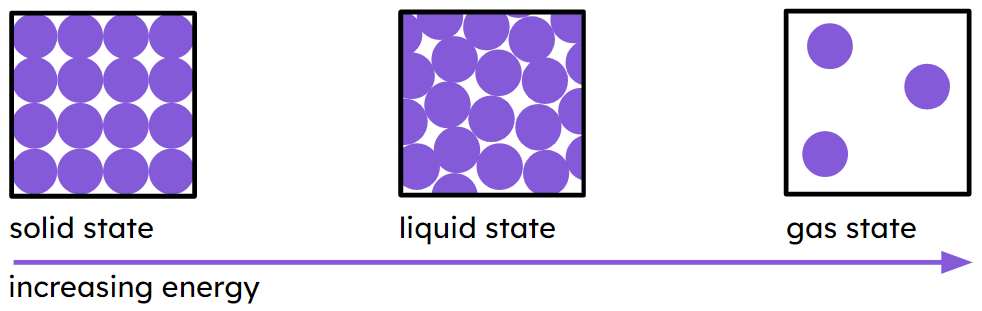
Q6.Models have limitations. What does this image of the particle model NOT attempt to show? Select all that apply.

Assessment exit quiz
6 Questions
Q1.Which of the following statements describe what happens during freezing?
Q2.Imagine candles (wax melting point 65°C; boiling point 300°C) in a room at 25°C. The flames have just been extinguished (see image). What is the temperature of the melted parts?

Q3.Which aspects of a particle change when a substance’s state of matter changes?
Q4.What is inside the bubbles of boiling water?
Q5.Commonly scientists only refer to melting and boiling points of substances. What is the state of matter of mercury at 25°C, if its freezing point is -39°C and condensing point is 357?
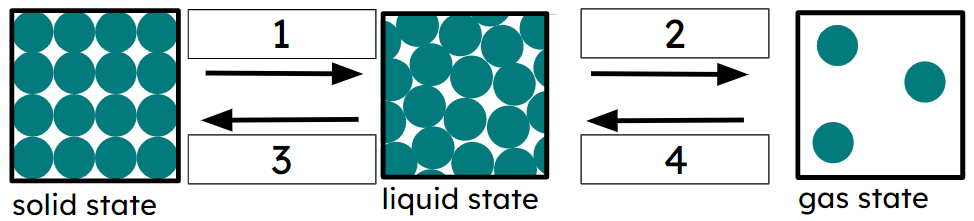
Q6.Match the numbers in the image below with the correct state change.
To help you plan your 10 combined science lesson on: State changes: fundamentals, download all teaching resources for free and adapt to suit your pupils' needs...
To help you plan your 10 combined science lesson on: State changes: fundamentals, download all teaching resources for free and adapt to suit your pupils' needs.
The starter quiz will activate and check your pupils' prior knowledge, with versions available both with and without answers in PDF format.
We use learning cycles to break down learning into key concepts or ideas linked to the learning outcome. Each learning cycle features explanations with checks for understanding and practice tasks with feedback. All of this is found in our slide decks, ready for you to download and edit. The practice tasks are also available as printable worksheets and some lessons have additional materials with extra material you might need for teaching the lesson.
The assessment exit quiz will test your pupils' understanding of the key learning points.
Our video is a tool for planning, showing how other teachers might teach the lesson, offering helpful tips, modelled explanations and inspiration for your own delivery in the classroom. Plus, you can set it as homework or revision for pupils and keep their learning on track by sharing an online pupil version of this lesson.
Explore more key stage 4 combined science lessons from the States of matter unit, dive into the full secondary combined science curriculum, or learn more about lesson planning.