


Making yakisoba noodles


Lesson details
Learning outcome
I can use food skills to make yakisoba noodles.
Key learning points
- Originating from China, yakisoba is now a staple in Japan. It is a popular street food. 'Yaki' means cooked over heat.
- Good food hygiene is essential to reduce the risk of food poisoning.
- The food skills to make yakisoba are measuring, peeling, slicing, mixing and using the hob (stir-frying).
- Vegetables need to be cut to the same size to ensure even cooking (via conduction in the frying pan or wok).
- Sensory evaluation provides feedback about the appearance, odour, taste and texture of a final dish.
Keywords
Yakisoba - a Japanese dish of fried noodles, vegetables, and sometimes meat or fish
Food poisoning - illness caused by eating something contaminated with bacteria
Sensory evaluation - the use of our senses to assess a food or drink
Common misconception
Sushi, raw fish, is the only common food eaten in Japan.
Japan has huge range of foods and dishes, of which sushi is one important aspect. There is a range of cooked dishes, including yakisoba (noodles), teriyaki (grilled with a glaze), yakiniku (grilled meat), and tempura (battered fried foods).
Teacher tip
As the pupils are cooking, ask them to say how they are working safely and hygiencially. It helps to talk about this when cooking, to help contextualise learning.

Equipment
For ingredients and equipment, see the recipe in additional materials.

Content guidance
Risk assessment required - may contain allergens
Risk assessment required - equipment

Supervision
Adult supervision required

Licence

Lesson video
Loading...
Prior knowledge starter quiz
6 Questions
Q1.Which part of the cooker is used to boil pasta in a saucepan?
Q2.What does personal hygiene include?
Q3.True or false? Noodles are usually made from barley.
Q4.What would you use to accurately measure a small amount of oil?
Q5.Which pieces of equipment would you use for the bridge hold?
Q6.We taste food using our...
Assessment exit quiz
6 Questions
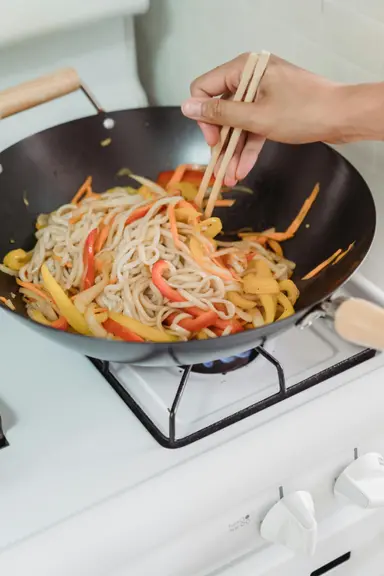
Q1.What piece of equipment is being used here?
Q2.True or false? Sushi (raw fish) is the only popular food in Japan.
Q3.What type of dish is yakisoba?
Q4. is the use of our senses to assess a food or drink.
Q5.Food can be caused by eating something contaminated with bacteria.
Q6.Match the following food hygiene practices.

To help you plan your 7 cooking and nutrition lesson on: Making yakisoba noodles, download all teaching resources for free and adapt to suit your pupils' needs...
To help you plan your 7 cooking and nutrition lesson on: Making yakisoba noodles, download all teaching resources for free and adapt to suit your pupils' needs.
The starter quiz will activate and check your pupils' prior knowledge, with versions available both with and without answers in PDF format.
We use learning cycles to break down learning into key concepts or ideas linked to the learning outcome. Each learning cycle features explanations with checks for understanding and practice tasks with feedback. All of this is found in our slide decks, ready for you to download and edit. The practice tasks are also available as printable worksheets and some lessons have additional materials with extra material you might need for teaching the lesson.
The assessment exit quiz will test your pupils' understanding of the key learning points.
Our video is a tool for planning, showing how other teachers might teach the lesson, offering helpful tips, modelled explanations and inspiration for your own delivery in the classroom. Plus, you can set it as homework or revision for pupils and keep their learning on track by sharing an online pupil version of this lesson.
Explore more key stage 3 cooking and nutrition lessons from the Independent and confident cooking unit, dive into the full secondary cooking and nutrition curriculum, or learn more about lesson planning.