


When can you give money?


Lesson details
Learning outcome
I understand why I might, or might not, want to give money to help others.
Key learning points
- Money can be donated to charity, given to others or spent on others to help.
- Spending money on other people can make people feel a range of emotions.
- Spending money unwisely can lead to regret and unhappiness.
Keywords
Donate - To give money, food, clothes etc. to somebody or something, especially a charity.
Charity - Organisations for helping people or other things that are in need.
Sponsor - To agree to give somebody money for a charity if they complete a particular task.
Common misconception
Pupils might belive fundraising to be exclusive to charities and not something that takes place in other contexts.
Ask the pupils to share fundraising experiences so they understand the range of contexts that it can cover. Have one or two local examples ready to share with the pupils if they're uncertain.
Teacher tip
Remember that there are many different cultural perspectives on giving money and charity. Make sure you are aware of the diversity within your class before teaching the lesson. You might even want to find a place in the lesson to acknowledge and celebrate these differences.

Content guidance
Depiction or discussion of sensitive content

Supervision
Adult supervision recommended

Licence

Lesson video
Loading...
Prior knowledge starter quiz
6 Questions
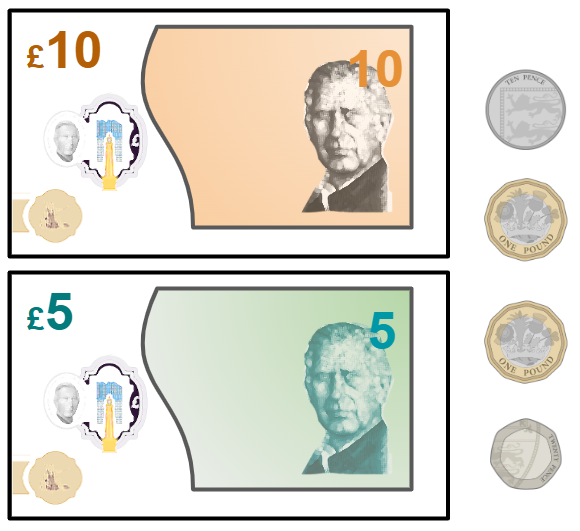
Q1.Look at the coins. How much money is there altogether?

Q2.A new tennis racquet costs £20 and you have £7 in total. How much more will you need to be able to afford one?
Q3.Why should you keep a record of the money that you have?
Q4.Look at Alex’s money record. How much did the popcorn cost him?
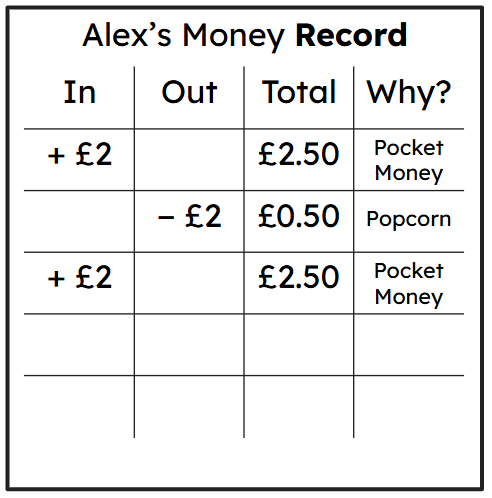
Q5.Look at Alex’s money record. How much pocket money does he get?
Q6.Look at Alex’s money record. What does the − £2 represent?
Assessment exit quiz
6 Questions
Q1.Which of these describes a charity?
Q2.Milkshakes cost £2.50 but Izzy only has £2.20 so she doesn’t have enough. Jun offers to lend her the rest. How much will Jun need to lend Izzy?
Q3.Look at Jun’s sponsorship form. How much did he raise altogether?
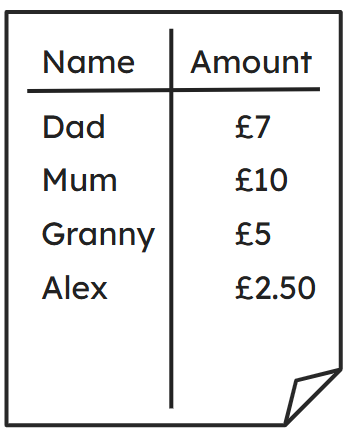
Q4.Look at Izzy’s sponsorship form. How much did she raise altogether?
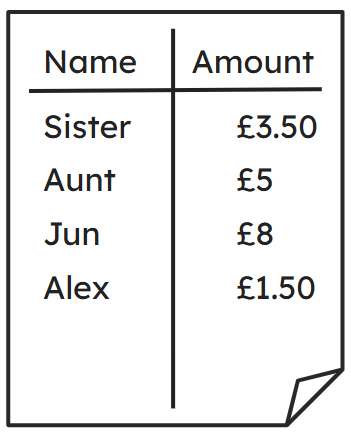
Q5.Tick the situations where you are giving money.
Q6.You should always give money to your friends if they need it and you have it. True or false?
To help you plan your 3 financial education lesson on: When can you give money?, download all teaching resources for free and adapt to suit your pupils' needs...
To help you plan your 3 financial education lesson on: When can you give money?, download all teaching resources for free and adapt to suit your pupils' needs.
The starter quiz will activate and check your pupils' prior knowledge, with versions available both with and without answers in PDF format.
We use learning cycles to break down learning into key concepts or ideas linked to the learning outcome. Each learning cycle features explanations with checks for understanding and practice tasks with feedback. All of this is found in our slide decks, ready for you to download and edit. The practice tasks are also available as printable worksheets and some lessons have additional materials with extra material you might need for teaching the lesson.
The assessment exit quiz will test your pupils' understanding of the key learning points.
Our video is a tool for planning, showing how other teachers might teach the lesson, offering helpful tips, modelled explanations and inspiration for your own delivery in the classroom. Plus, you can set it as homework or revision for pupils and keep their learning on track by sharing an online pupil version of this lesson.
Explore more key stage 2 financial education lessons from the The purposes of money unit, dive into the full primary financial education curriculum, or learn more about lesson planning.