


Ça t'intéresse ? Direct and indirect pronouns me and te




Lesson details
Learning outcome
I can recognise and understand the role of indirect object pronouns 'me' and 'te' in the context of exploring museums.
Vocabulary and transcripts for this lessons
Key learning points
- Use me and te before the verb when 'me' or 'you' is the object of the verb: elle me trouve (she finds me).
- Use me and te when 'me' or 'you' is indirectly receiving the action of the verb: elle me donne un cadeau (gives to me).
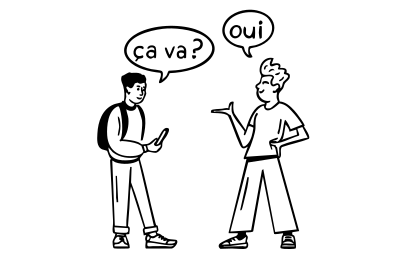
- Me and te are used frequently in dialogue between two people.
Keywords
Indirect object pronoun - replaces the person or thing that the verb action is done to, when the action is 'to me' or 'for you'.
Me, (m') - me, to me
Te, (t') - you, to you
Common misconception
In French, 'to you' is translated literally from English e.g. I say to you 'je dis à toi'.
In French indirect object pronouns to me and to you are translated by single words: 'me' and 'te'. They go before the verb, not at the end of the sentence.
Teacher tip
Be ready to explain why me and to me, you and to you are the same word in French, in the same place in the sentence, and to explain further why the distinction is important.

Equipment
Mini whiteboard and pen

Licence

Lesson video
Loading...
Some of our videos, including non-English language videos, do not have captions.
Prior knowledge starter quiz
6 Questions
Q1.Match the French to the English.

Q2.What are the correct endings for regular er, ir and re verbs with 'je'?
Q3.What is the correct conjugation for the verb in brackets in this sentence? Nous (finir) les devoirs.
Q4.Which statement is true for direct object pronoun placement in French?
Q5.What is the conjugation of the verb 's'appeler' when translating 'is called Jennifer'?
Q6.Which is the correct French word order for this sentence? French helps me to communicate with my French teacher.
Assessment exit quiz
6 Questions
Q1.What is the French translation of these English verbs?
Q2.Which word correctly completes this sentence? La pollution est un problème ...
Q3.Which word completes each sentence?
Q4.Translate 'm'' in the sentence: 'ça m'aide à faire mes devoirs'.
Q5.Translate 'm'' in the sentence: 'Tu m'expliques pourquoi tu ne viens pas'.
Q6.Put the words in the right order to make the sentence: You say to me that Léa is pleased.
To help you plan your 10 French lesson on: Ça t'intéresse ? Direct and indirect pronouns me and te, download all teaching resources for free and adapt to suit your pupils' needs...
To help you plan your 10 French lesson on: Ça t'intéresse ? Direct and indirect pronouns me and te, download all teaching resources for free and adapt to suit your pupils' needs.
The starter quiz will activate and check your pupils' prior knowledge, with versions available both with and without answers in PDF format.
We use learning cycles to break down learning into key concepts or ideas linked to the learning outcome. Each learning cycle features explanations with checks for understanding and practice tasks with feedback. All of this is found in our slide decks, ready for you to download and edit. The practice tasks are also available as printable worksheets and some lessons have additional materials with extra material you might need for teaching the lesson.
The assessment exit quiz will test your pupils' understanding of the key learning points.
Our video is a tool for planning, showing how other teachers might teach the lesson, offering helpful tips, modelled explanations and inspiration for your own delivery in the classroom. Plus, you can set it as homework or revision for pupils and keep their learning on track by sharing an online pupil version of this lesson.
Explore more key stage 4 French lessons from the Lifestyle and wellbeing:Visites et rendez-vous unit, dive into the full secondary French curriculum, or learn more about lesson planning.