


Understanding small-scale ecosystems


Lesson details
Learning outcome
I can describe the natural processes that occur within a small-scale ecosystem in the UK.
Key learning points
- An ecosystem is a natural system in which plants, animals and their non-living environment interact.
- Living and non-living things interract within a small-scale ecosystem.
- Food webs help us understand the interrelationships in a small-scale ecosystem.
- Nutrient cycles show how nutrients transfer across different stores within an ecosystem.
Keywords
Ecosystem - a community of organisms (such as plants and animals) that interact with one another and their non-living (abiotic) environment
Producer - an organism that is able to absorb energy from the sun through photosynthesis
Consumer - an organism that gets its energy by feeding on other organisms (animals and/or plant matter)
Food chain - the connections between different organisms (plants and animals) that rely on one another for their source of food
Decomposer - an organism such as a bacterium or fungus that breaks down dead plant or animal tissue or waste
Common misconception
That ecosystems are made up of plants and animals only.
An ecosystem is a community of living things interacting with one another and with non-living components of their environment, such as soil and climate.
Teacher tip
Coordinate with science colleagues about what students should already know about this topic from KS3 and KS4.

Licence

Lesson video
Loading...
Prior knowledge starter quiz
6 Questions
Q1.Which of the following is not a process carried out by all living things?
Q2.An ecosystem is a community of __________ and their non-living environment.
Q3.What does the term photosynthesis mean?
Q4.What is the term for an animal that only eats other animals and not plants?
Q5.Which of the following organisms can make their own food using energy from the Sun?
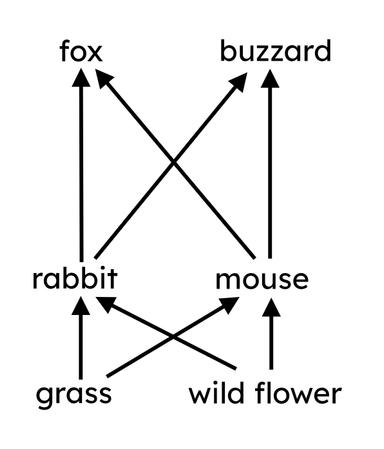
Q6.What is this type of diagram called?
Assessment exit quiz
6 Questions
Q1.A community of organisms that interact with one another and their non-living environment is called an .
Q2.Which of the following would be considered abiotic?
Q3.Put the following organisms in the correct food chain order, going from producer to quaternary (level four) consumer.
Q4.The cycling of nutrients within an ecosystem can be understood by considering transfers between three stores. Which of these are stores?
Q5.Identify the examples of inputs into an ecosystem.
Q6.Match the following keywords to the correct definitions.

To help you plan your 10 geography lesson on: Understanding small-scale ecosystems, download all teaching resources for free and adapt to suit your pupils' needs...
To help you plan your 10 geography lesson on: Understanding small-scale ecosystems, download all teaching resources for free and adapt to suit your pupils' needs.
The starter quiz will activate and check your pupils' prior knowledge, with versions available both with and without answers in PDF format.
We use learning cycles to break down learning into key concepts or ideas linked to the learning outcome. Each learning cycle features explanations with checks for understanding and practice tasks with feedback. All of this is found in our slide decks, ready for you to download and edit. The practice tasks are also available as printable worksheets and some lessons have additional materials with extra material you might need for teaching the lesson.
The assessment exit quiz will test your pupils' understanding of the key learning points.
Our video is a tool for planning, showing how other teachers might teach the lesson, offering helpful tips, modelled explanations and inspiration for your own delivery in the classroom. Plus, you can set it as homework or revision for pupils and keep their learning on track by sharing an online pupil version of this lesson.
Explore more key stage 4 geography lessons from the Ecosystems, biomes and the biosphere unit, dive into the full secondary geography curriculum, or learn more about lesson planning.