


Convert from smaller to larger units of measure


Lesson details
Learning outcome
I can apply known unit conversions to convert from smaller to larger units of measure.
Key learning points
- 1 m = 1,000 mm
- 1 kg = 1,000g
- 1 l = 1,000ml
- 1 km = 1,000m
Keywords
Equivalent - If two or more things have the same value, they are equivalent.
Convert - Convert means to change a value or expression from one form to another.
Common misconception
Pupils may not remember whether a certain larger unit is comprised of 10, 100 or 1,000 smaller units - all of these are explored at some point in this sequence of lessons.
Spend time discussing the etymology of the words, and have these displayed in your environment. The prefix 'kilo' means 'one thousand' while the prefix 'milli' means 'one thousandth'.
Teacher tip
Practical experience of these conversions will help pupils to avoid common errors in recalling the correct power of 10 for a given conversion. For example, they can walk 1 km with a trundle wheel to see that this distance is equal to more than 10 or 100 metres.

Licence

Lesson video
Loading...
Prior knowledge starter quiz
6 Questions
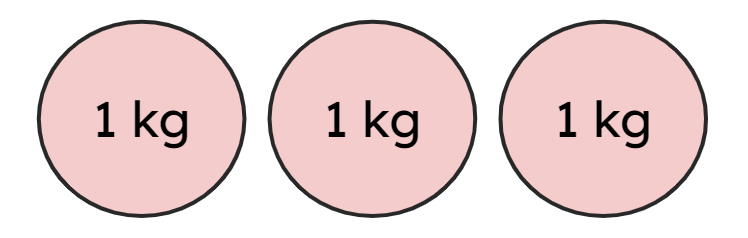
Q1.Convert these kilograms to grams. g

Q2.Convert 3 km to metres. m
Q3.Convert 8 m to milimetres.
Q4.Convert 7 litres to millilitres. ml
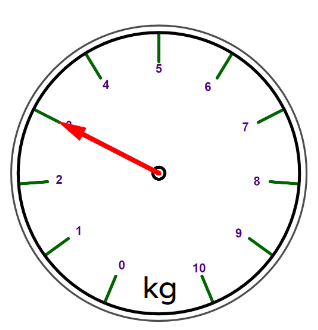
Q5.Subtract 1,000 g from this amount shown on the scale. g
Q6.Izzy has taken two parcels to the Post Office to be delivered. One has a mass of 3 kg. The other has a mass of 7 kg. What is their combined mass in grams? g
Assessment exit quiz
6 Questions
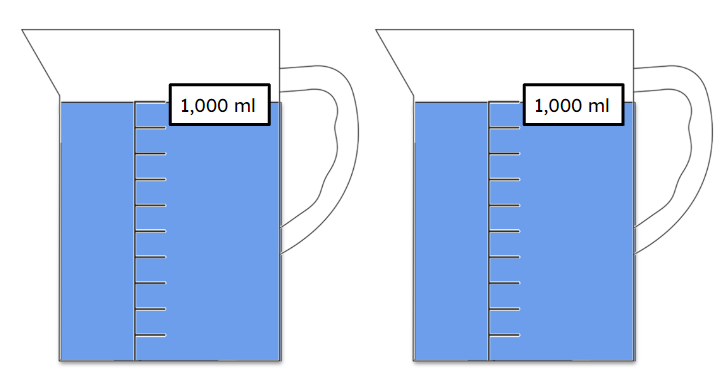
Q1.How many litres is equivalent to 2,000 ml?
Q2.3,000 mm = m
Q3.Convert 4,000 millilitres into litres. l
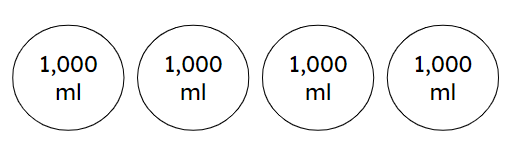
Q4.Convert 8,000 g into kilograms. kg
Q5.Order these distances from shortest to longest:
Q6.Oakley and Beau are dogs. Oakley has a mass of 7 kg and Beau has a mass of 5,000 g. What is the difference between their masses?
To help you plan your 5 maths lesson on: Convert from smaller to larger units of measure, download all teaching resources for free and adapt to suit your pupils' needs...
To help you plan your 5 maths lesson on: Convert from smaller to larger units of measure, download all teaching resources for free and adapt to suit your pupils' needs.
The starter quiz will activate and check your pupils' prior knowledge, with versions available both with and without answers in PDF format.
We use learning cycles to break down learning into key concepts or ideas linked to the learning outcome. Each learning cycle features explanations with checks for understanding and practice tasks with feedback. All of this is found in our slide decks, ready for you to download and edit. The practice tasks are also available as printable worksheets and some lessons have additional materials with extra material you might need for teaching the lesson.
The assessment exit quiz will test your pupils' understanding of the key learning points.
Our video is a tool for planning, showing how other teachers might teach the lesson, offering helpful tips, modelled explanations and inspiration for your own delivery in the classroom. Plus, you can set it as homework or revision for pupils and keep their learning on track by sharing an online pupil version of this lesson.
Explore more key stage 2 maths lessons from the Converting units unit, dive into the full primary maths curriculum, or learn more about lesson planning.