


Use knowledge of the composition of seven-digit numbers to solve problems


Lesson details
Learning outcome
I can use knowledge of the composition of seven-digit numbers to solve problems.
Key learning points
- The digits in a number indicate its structure so it can be decomposed.
- Numbers can be decomposed, or partitioned, according to the value of their digits.
- Missing parts can be determined by comparison of known parts to the whole.
Keywords
Partition - When we partition a value or object, we split it into smaller parts.
Common misconception
A child may give the incorrect value for a digit or struggle to see how to partition larger numbers in a non-standard way.
Use a place value chart or counters to prove the value of the digit and use a Gattegno chart to support partitioning.
Teacher tip
Children should use place value charts and Gattegno charts to support their learning. They need to be familiarised with recombining when counters are grouped or in a random arrangement. Give children the chance to play 'Zap the digit' in pairs.

Licence

Lesson video
Loading...
Prior knowledge starter quiz
6 Questions
Q1.Complete this equation to show partitioning of 5,603
5,603 = 5,000 + + 3

Q2.Complete this equation to show partitioning of 12,928
12,928 = 12,000 + + 8
Q3.In the number 1,503,924 the value of the digit five is __________.
Q4.In the number 1,503,924 the value of the digit three is __________.
Q5.In which of these numbers is the digit ‘6’ worth 60 thousand?
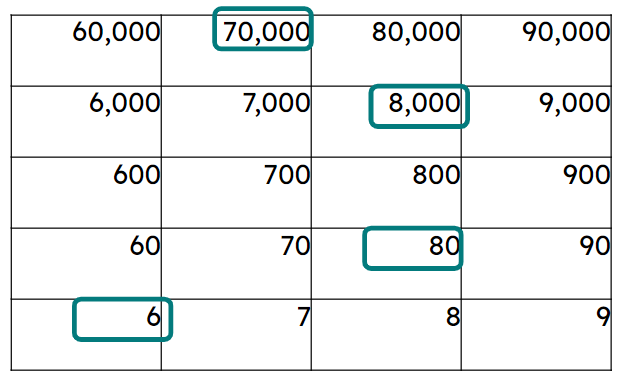
Q6.What number is represented in this part of a Gattegno chart? Write your answer as a numeral.
Assessment exit quiz
6 Questions
Q1.Complete the equation to show partitioning. 2,190,513 = 2,000,000 + 100,000 + + 500 + 10 + 3
Q2.Complete the equation to show partitioning. 5,901,142 = 5,000,000 + + 1,000 + 100 + 40 + 2
Q3.Complete the equation to show partitioning. 469,231 = + 200 + 31 + 1
Q4.Complete the equation to show partitioning. 2,031,450 = 2,000,000 + + 400 + 51
Q5.Complete this subtraction equation to ‘zap’ the digit 2 from the number 1,324,003 Remember this means subtract the value of the 2 in the number.
1,324,003 - = 1,304,003
Q6.Complete this subtraction equation to ‘zap’ the digits ‘94’ from the number 9,450,603 Remember this means subtract the value of the 94 in the number.
9,450,603 - = 50,603
To help you plan your 6 maths lesson on: Use knowledge of the composition of seven-digit numbers to solve problems, download all teaching resources for free and adapt to suit your pupils' needs...
To help you plan your 6 maths lesson on: Use knowledge of the composition of seven-digit numbers to solve problems, download all teaching resources for free and adapt to suit your pupils' needs.
The starter quiz will activate and check your pupils' prior knowledge, with versions available both with and without answers in PDF format.
We use learning cycles to break down learning into key concepts or ideas linked to the learning outcome. Each learning cycle features explanations with checks for understanding and practice tasks with feedback. All of this is found in our slide decks, ready for you to download and edit. The practice tasks are also available as printable worksheets and some lessons have additional materials with extra material you might need for teaching the lesson.
The assessment exit quiz will test your pupils' understanding of the key learning points.
Our video is a tool for planning, showing how other teachers might teach the lesson, offering helpful tips, modelled explanations and inspiration for your own delivery in the classroom. Plus, you can set it as homework or revision for pupils and keep their learning on track by sharing an online pupil version of this lesson.
Explore more key stage 2 maths lessons from the Order, compare and calculate with numbers up to 8 digits unit, dive into the full primary maths curriculum, or learn more about lesson planning.