Choose exam board for KS4 Computer Science (GCSE)
Choose exam board for KS4 English
Choose exam board for KS4 French
Choose exam board for KS4 Geography
Choose exam board for KS4 German
Choose exam board for KS4 History
Choose tier for KS4 Maths
Choose exam board for KS4 Music
Choose exam board for KS4 Physical education (GCSE)
Choose exam board for KS4 Religious education (GCSE)
Choose exam board for KS4 Spanish

Lesson details

Learning outcome

I can understand how maths is used by engineers.

Key learning points

  1. Fractions are more useful when dealing with imperial measurements
  2. Pythagoras' theorem is used when considering force diagrams
  3. Standard form is used when considering especially large or small forces

Keywords

  • Fractional form - A number is in fractional form when it is displayed as one integer divided by another integer.

Common misconception

Pupils mix-up the sides of the right-angled triangle when using Pythagoras' theorem.

Pupils may benefit from labelling the right-angled triangle so that the hypotenuse is clearly identified.

Teacher tip

If pupils want to learn more about how maths is used in engineering, you may want to consider a visit from Maths4Girls or look at the free 'Where maths meets... the world of work!' resources on the AMSP website.

Licence

This content is © Oak National Academy Limited (2025), licensed on Open Government Licence version 3.0 except where otherwise stated. See Oak's terms & conditions (Collection 2).

Lesson video

Loading...

Prior knowledge starter quiz

6 Questions

Q1.
A number is in form when it is displayed as one integer divided by another integer.

Correct Answer: fractional

Q2.
Which of the following are types of engineering?

Correct answer: Agricultural
Correct answer: Mechanical
Operational
Correct answer: Systems
Water

Q3.
states that the sum of the squares of the two shorter sides of a right-angled triangle is equal to the square of the hypotenuse.

Correct Answer: Pythagoras’ theorem, Pythagoras theorem

Q4.
If the two shorter sides in a right-angled triangle have lengths 3 cm and 4 cm, what is the length of the longest side?

Correct Answer: 5 cm

Q5.
If the two shorter sides in a right-angled triangle have lengths 5 cm and 12 cm, what is the length of the longest side?

Correct Answer: 13 cm

Q6.
If the longest side of a right-angled triangle is 29 cm in length, and one of the shorter sides has a length of 21 cm, what is the length of the third side?

Correct Answer: 20 cm

6 Questions

Q1.
Half of a half is a .

Correct answer: quarter
fifth
tenth
sixteenth

Q2.
The width of three adult human thumbs is approximately inches long.

2
Correct answer: 3
4
5
6

Q3.
How many inches are there in a foot?

5
10
Correct answer: 12
24

Q4.
A was often a five-foot folding rule.

Correct answer: Carpenter's Rule
Correct answer: Mason’s Rule
Plumber’s Rule
Workman's Rule

Q5.
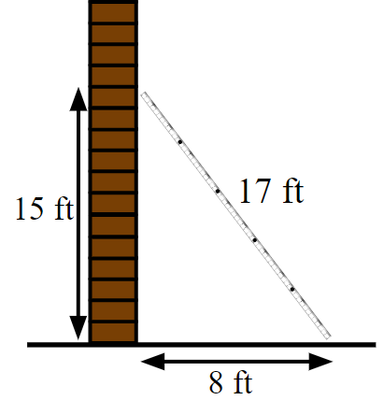
Is the wall upright?

An image in a quiz
No because $$15^2 + 8^2 eq 17^2$$
No because $$15^2 + 8^2 = 17^2$$
Yes because $$15^2 + 8^2 eq 17^2$$
Correct answer: Yes because $$15^2 + 8^2 = 17^2$$

Q6.
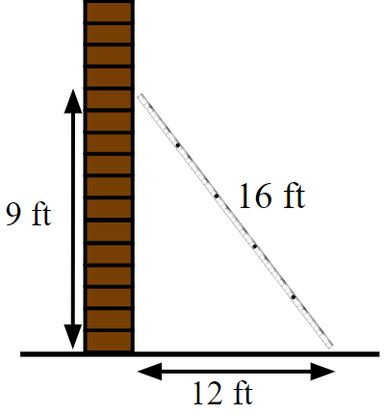
Is the wall upright?

An image in a quiz
Correct answer: No because $$9^2 + 12^2 eq 16^2$$
No because $$9^2 + 12^2 = 16^2$$
Yes because $$9^2 + 12^2 eq 16^2$$
Yes because $$9^2 + 12^2 = 16^2$$

To help you plan your 9 maths lesson on: Engineer, download all teaching resources for free and adapt to suit your pupils' needs...