Choose exam board for KS4 Computer Science (GCSE)
Choose exam board for KS4 English
Choose exam board for KS4 French
Choose exam board for KS4 Geography
Choose exam board for KS4 German
Choose exam board for KS4 History
Choose tier for KS4 Maths
Choose exam board for KS4 Music
Choose exam board for KS4 Physical education (GCSE)
Choose exam board for KS4 Religious education (GCSE)
Choose exam board for KS4 Spanish

      Lesson details

      Learning outcome

      I can critically analyse a graph.

      Key learning points

      1. Some graphs are drawn to mislead.
      2. Some graphs are drawn accurately, but interpreted incorrectly.
      3. Unfamiliar graphs need to be carefully checked to understand what they show.

      Keywords

      • Pie chart - A pie chart (pie graph) is a circular graph where sectors represent different groups proportionally.

      • Time series graph - Time series graphs show data over a time period. The time period is always shown on the x-axis. Data points are joined chronologically by line segments.

      • Scatter graph - A scatter graph is a visual representation for bivariate data. It can be useful when determining the nature of the relationship between the two variables.

      Common misconception

      Pupils may think that drawing a graph with a broken axis is incorrect.

      It is fine to do this (and is sometimes necessary) but it is important to acknowledge this when trying to draw conclusions from the graph.

      Teacher tip

      You may wish to ask your pupils to investigate graphs in the media and to bring examples of these graphs to the lesson where they can be discussed. Pupils could present on what the graph is showing and why it is misleading (or not).

      Licence

      This content is © Oak National Academy Limited (2025), licensed on Open Government Licence version 3.0
      except where otherwise stated. See Oak's terms & conditions
      (Collection 2).

      Lesson video

      Loading...

      Prior knowledge starter quiz

      6 Questions
      Q1.
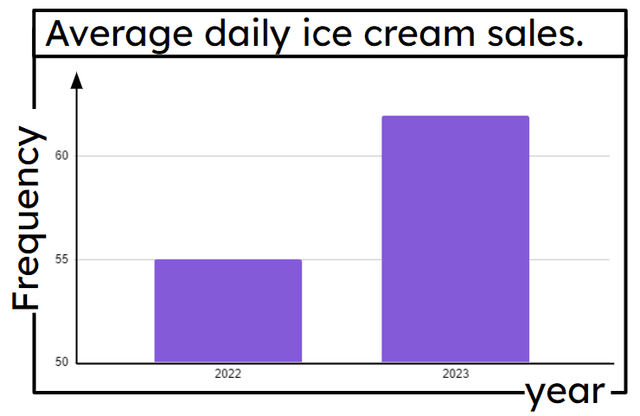
      What label is on the $$x$$ axis?

      An image in a quiz
      Average daily ice cream sales
      Frequency
      Correct answer: year

      Q2.
      What label is on the $$y$$ axis?

      An image in a quiz
      Average daily ice cream sales
      Correct answer: Frequency
      year

      Q3.
      What does this bar chart show?

      An image in a quiz
      The number of ice creams sold each year.
      The average number of ice creams sold each year.
      The number of ice creams sold each day for each year.
      Correct answer: The average number of ice creams sold each day for each year.

      Q4.
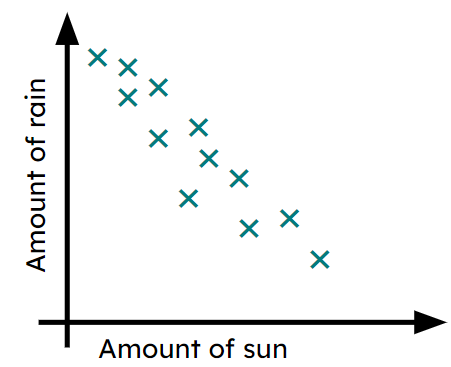
      What type of graph is this?

      An image in a quiz
      Bar graph
      Pictograph
      Pie graph
      Correct answer: Scatter graph

      Q5.
      What type of correlation (if any) is shown here?

      An image in a quiz
      Correct answer: Negative correlation
      No correlation
      Positive correlation

      Q6.
      Which statements best fit the graph?

      An image in a quiz
      As the amount of rain increases, the amount of sun also increases.
      As the amount of rain decreases, the amount of sun also decreases.
      Correct answer: As the amount of rain decreases, the amount of sun increases.
      Correct answer: The more rain we have, the less sun we have.

      6 Questions

      Q1.
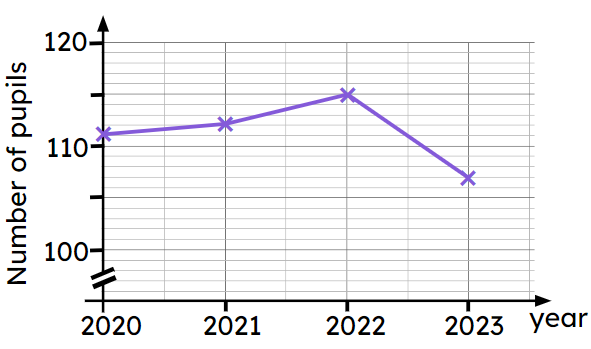
      'Local shops see devastating drop in the number of pupils visiting them in 2023.' What reason explains why the graph may not support the headline?

      An image in a quiz
      The year starts at 2020
      Correct answer: The $$y$$ axis has a broken scale.
      Not all shops have been surveyed.
      Not all pupils have been surveyed.

      Q2.
      What is the difference between the number of pupils in 2021 and 2022?

      An image in a quiz
      Correct Answer: 3, Three

      Q3.
      A pie chart (pie graph) is a graph where sectors represent different groups proportionally.

      Correct Answer: circular

      Q4.
      A scatter graph is a visual representation for data.

      Correct Answer: bivariate, two types of

      Q5.
      If two things are correlated then one must cause the other.

      True - positive correlation means as one variable increases, so does the other.
      Correct answer: False - there may be a third factor affecting both or coincidence.

      Q6.
      In what ways could a chart be manipulated to make one element appear significantly bigger than it really is?

      Correct answer: Draw a 3D pie chart, at an angle, with the sector for that element at the front.
      Correct answer: Draw a bar chart and leave numbers off the frequency axis.
      Draw a 2D pie chart, at an angle, with the sector for that element at the front.
      Draw a 3D bar chart with the bar for that element in the background.

      To help you plan your 9 maths lesson on: Misleading data, download all teaching resources for free and adapt to suit your pupils' needs...