


Constructing stem and leaf diagrams


Lesson details
Learning outcome
I can construct a stem and leaf diagram.
Key learning points
- The stem is made of all but the last digit of each value.
- The leaves are made from the last digit of each value.
- It is important that place value is preserved in the diagram through use of a key.
- A stem and leaf diagram can display data in strata.
Keywords
Stem and leaf diagram - A stem and leaf diagram is a systematic way to visually organise and represent numerical data.
Common misconception
That the stem always has to have the same number of digits.
Data with a range between 93 cm and 147 cm, draw the stem-and-leaf diagram but how do they write a key for it? Stress the leaf is the final single digit (all truncated so final digits have same place value), and all other digits form the stem.
Teacher tip
The "post it" activity can be a great way to introduce a real life data investigation into your classroom. Use data engaging to your pupils, e.g. their heights. Depending on group define accuracy of the measure or look at importance of truncation. Value what can be seen from distance/up close.

Licence

Lesson video
Loading...
Prior knowledge starter quiz
6 Questions
Q1.Starting with the smallest, put these numbers in ascending order.

Q2.Which of these numbers is not equivalent to the others?
Q3.The last digit in 13.8 represents __________.
Q4.Simplifying a number by 'cutting off' one or more of the digits and replacing them with zeros if necessary to preserve place value is known as __________.
Q5.23.6473 truncated to 2 decimal places is .
Q6.Here is a list of numbers: 56, 624, 40.6, 62, 668, 256, 60.06, 36, 0.66, 68, 62, 62.9. How many of the numbers have 6 tens?
Assessment exit quiz
6 Questions
Q1.What part of the stem and leaf diagram is highlighted?
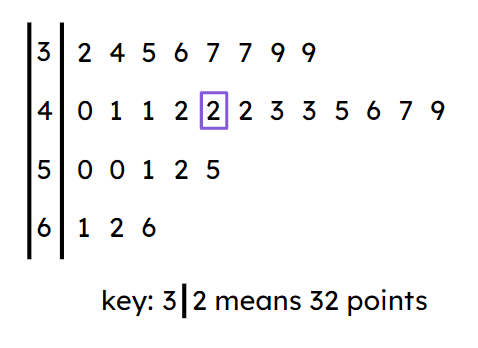
Q2.The value of the highlighted data point is cm.
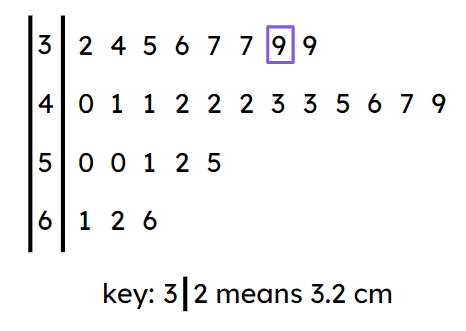
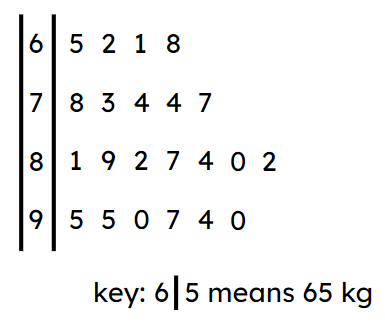
Q3.The value of the highlighted data point is kg.
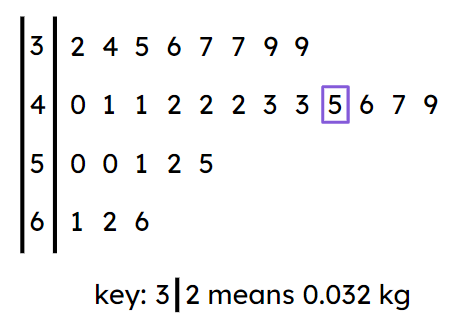
Q4.Sam draws this stem and leaf diagram. Is Sam's diagram complete?
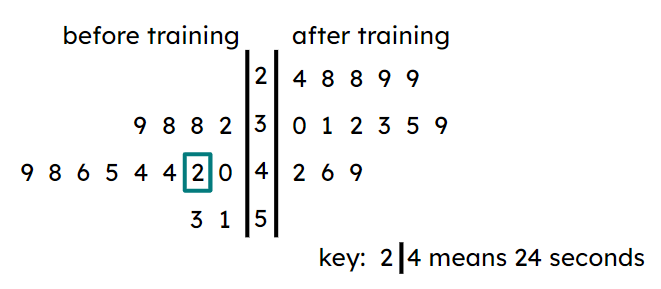
Q5.The highlighted leaf represents seconds.
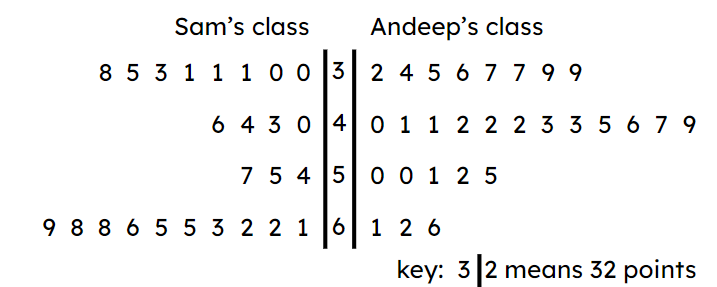
Q6.Sam and Andeep draw a back-to-back stem and leaf diagram to compare their classes' scores in a quiz. The lowest score in Andeep's class is more than the lowest score in Sam's class.
To help you plan your 10 maths lesson on: Constructing stem and leaf diagrams, download all teaching resources for free and adapt to suit your pupils' needs...
To help you plan your 10 maths lesson on: Constructing stem and leaf diagrams, download all teaching resources for free and adapt to suit your pupils' needs.
The starter quiz will activate and check your pupils' prior knowledge, with versions available both with and without answers in PDF format.
We use learning cycles to break down learning into key concepts or ideas linked to the learning outcome. Each learning cycle features explanations with checks for understanding and practice tasks with feedback. All of this is found in our slide decks, ready for you to download and edit. The practice tasks are also available as printable worksheets and some lessons have additional materials with extra material you might need for teaching the lesson.
The assessment exit quiz will test your pupils' understanding of the key learning points.
Our video is a tool for planning, showing how other teachers might teach the lesson, offering helpful tips, modelled explanations and inspiration for your own delivery in the classroom. Plus, you can set it as homework or revision for pupils and keep their learning on track by sharing an online pupil version of this lesson.
Explore more key stage 4 maths lessons from the Comparisons of numerical summaries of data unit, dive into the full secondary maths curriculum, or learn more about lesson planning.