Choose exam board for KS4 Computer Science (GCSE)
Choose exam board for KS4 English
Choose exam board for KS4 French
Choose exam board for KS4 Geography
Choose exam board for KS4 German
Choose exam board for KS4 History
Choose tier for KS4 Maths
Choose exam board for KS4 Music
Choose exam board for KS4 Physical education (GCSE)
Choose exam board for KS4 Religious education (GCSE)
Choose exam board for KS4 Spanish

      Conditional probability in a Venn diagram
      Lesson details

      Learning outcome

      I can calculate a conditional probability from a Venn diagram.

      Key learning points

      1. A Venn diagram can be used to calculate conditional probabilities
      2. A Venn diagram can be used to calculate conditional probabilities involving sets of events
      3. Venn diagrams allow us to identify which events are mutually exclusive
      4. Venn diagrams can be used to identify which events are independent

      Keywords

      • Venn diagram - Venn diagrams are a representation used to model statistical/probability questions. Commonly circles are used to represent events.

      • Probability - The probability that an event will occur is the proportion of times the event is expected to happen in a suitably large experiment.

      • Conditional probability - Conditional probability is the probability of an outcome occurring given that another event has occurred.

      • Independent events - Event A is independent of event B if the probability of event A occurring is not affected by whether or not event B occurs.

      • Mutually exclusive - Mutually exclusive events have no outcomes in common.

      Common misconception

      Pupils may confuse the probability of event A given B, P(A|B), with the probability of event A and B occurring.

      Use the context of the question to make a judgement about what probability is to be calculated. Try to avoid using, or draw attention to, potentially ambiguous language/notation. E.g. Is P(AB) referring to P(A given B) or P(B given A) or P(A and B)?

      Teacher tip

      Encourage pupils to draw/copy the Venn diagram and highlight or shade the regions that are needed for a given question.

      Licence

      This content is © Oak National Academy Limited (2025), licensed on Open Government Licence version 3.0
      except where otherwise stated. See Oak's terms & conditions
      (Collection 2).

      Lesson video

      Loading...

      Prior knowledge starter quiz

      6 Questions

      Q1.
      Event A is of event B if the probability of event A occurring is not affected by whether or not event B occurs.

      Correct Answer: independent

      Q2.
      Select the example of events which are not independent.

      Rolling a die and then flipping a coin
      Flipping three coins together
      Rolling two dice together
      Taking a counter at random from a box, replacing it and then taking another
      Correct answer: Taking a counter at random from a box, keeping it and then taking another

      Q3.
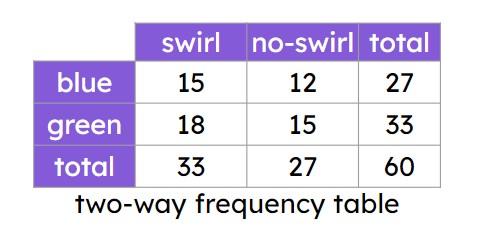
      The table shows the types of marble in a bag. Match each event to its probability.

      An image in a quiz
      Correct Answer:P(blue),$$27\over 60$$

      $$27\over 60$$

      Correct Answer:P(green),$$33\over 60$$

      $$33\over 60$$

      Correct Answer:P(blue and has no swirl), $$12\over 60$$

      $$12\over 60$$

      Correct Answer:P(blue given it has no swirl),$$12\over 27$$

      $$12\over 27$$

      Correct Answer:P(green and has a swirl),$$18\over60$$

      $$18\over60$$

      Correct Answer:P(green given it has swirl),$$18\over 33$$

      $$18\over 33$$

      Q4.
      A marble is taken at random from a box of marbles. Alex works out that P(swirl given it is blue) = P(swirl). This shows the event 'has a swirl' is __________ of the event 'blue marble'.

      conditional
      exhaustive
      Correct answer: independent
      mutually exclusive

      Q5.
      A 10-sided die with integers from 1 to 10 written on it is rolled once. Select the pair of mutually exclusive events.

      Correct answer: A factor of 9
      A factor of 10
      Correct answer: Even number
      Odd number
      Prime number

      Q6.
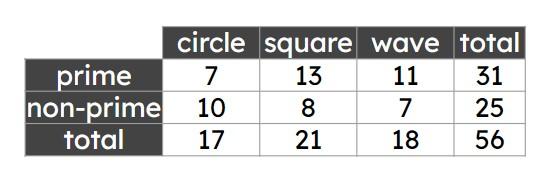
      A deck of cards has a number on it (either prime or non-prime), and a symbol (a circle, square, or wave). A card is selected at random from the deck. Find P(non-prime | wave).

      An image in a quiz
      Correct answer: $$7\over18$$
      $$7\over25$$
      $$7\over56$$
      $$25\over56$$
      $$18\over56$$

      6 Questions

      Q1.
      Event A and event B are mutually exclusive events. Which of these statements are correct?

      Correct answer: P(A and B) = 0
      P(A or B) = 0
      Correct answer: P(B | A) = 0
      Correct answer: P(A | B) = 0
      P(A) + P(B) = 0

      Q2.
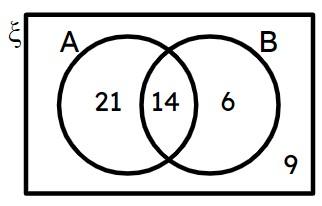
      From the frequency Venn diagram, P(A | B) = . Give your answer as a decimal.

      An image in a quiz
      Correct Answer: 0.7

      Q3.
      From the frequency Venn diagram, P(A | B') = . Give your answer as a decimal.

      An image in a quiz
      Correct Answer: 0.7

      Q4.
      The diagram shows the number of outcomes for two events A and B. The values of P(A | B) and P(A | B') show that events A and B are events.

      An image in a quiz
      Correct Answer: independent

      Q5.
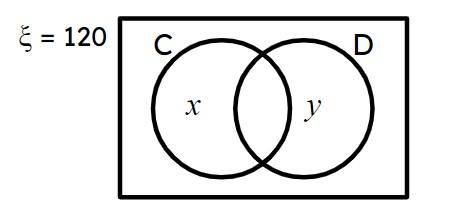
      Here is an incomplete frequency Venn diagram. P(C) = $$1\over3$$, P(D') = $$1\over6$$, P(C ∩ D) = $$1 \over 4$$ and P(C | D) = $$3 \over 10$$. The value of $$x$$ is .

      An image in a quiz
      Correct Answer: 10

      Q6.
      Here is an incomplete frequency Venn diagram. P(C) = $$1\over3$$, P(D') = $$1\over6$$, P(C ∩ D) = $$1 \over 4$$ and P(C | D) = $$3 \over 10$$. The value of $$y$$ is .

      An image in a quiz
      Correct Answer: 70

      To help you plan your 11 maths lesson on: Conditional probability in a Venn diagram, download all teaching resources for free and adapt to suit your pupils' needs...