Choose exam board for KS4 Computer Science (GCSE)
Choose exam board for KS4 English
Choose exam board for KS4 French
Choose exam board for KS4 Geography
Choose exam board for KS4 German
Choose exam board for KS4 History
Choose tier for KS4 Maths
Choose exam board for KS4 Music
Choose exam board for KS4 Physical education (GCSE)
Choose exam board for KS4 Religious education (GCSE)
Choose exam board for KS4 Spanish

      Arithmetic sequences and their graphs
      Lesson details

      Learning outcome

      I can recognise that an arithmetic sequence can be shown graphically and how this relates to the equation of a linear graph and use this to find the n^th term formula.

      Key learning points

      1. The n^th term rule can be generated from the sequence.
      2. The n^th term rule can be generated from the graph.
      3. The n^th term rule is the equation of the line.

      Keywords

      • Arithmetic sequence - An arithmetic (or linear) sequence is a sequence where the difference between successive terms is a constant.

      • N^th term - The n^th term of a sequence is the position of a term in a sequence where n stands for the term number.

      Common misconception

      When plotting a sequence you should always connect the points with a line.

      Only the (term number, term value) should be plotted. Points should not be joined as these are discrete values.

      Teacher tip

      Knowing the shape of the graph for arithmetic sequences means pupils have a way of checking any terms generated as the values should align.

      Licence

      This content is © Oak National Academy Limited (2025), licensed on Open Government Licence version 3.0
      except where otherwise stated. See Oak's terms & conditions
      (Collection 2).

      Lesson video

      Loading...

      Prior knowledge starter quiz

      6 Questions

      Q1.
      Arithmetic sequences have a __________ difference between successive terms.

      positive
      negative
      Correct answer: constant
      variable

      Q2.
      Which of these will be amongst the first five terms of the arithmetic sequence $$3n-2$$?

      $$-2$$
      Correct answer: $$1$$
      $$3$$
      Correct answer: $$4$$
      $$5$$

      Q3.
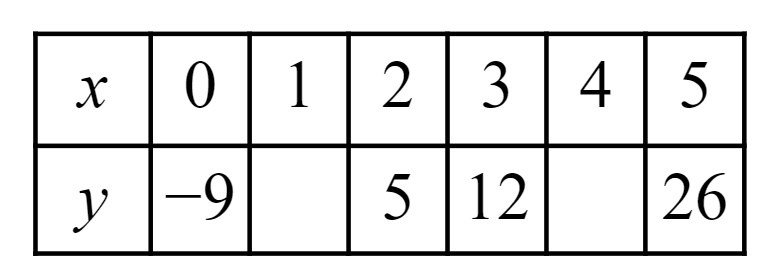
      Which values are missing from this table for the linear equation $$y=7x-9$$?

      An image in a quiz
      Correct answer: $$-2$$
      $$-1$$
      $$2$$
      $$17$$
      Correct answer: $$19$$

      Q4.
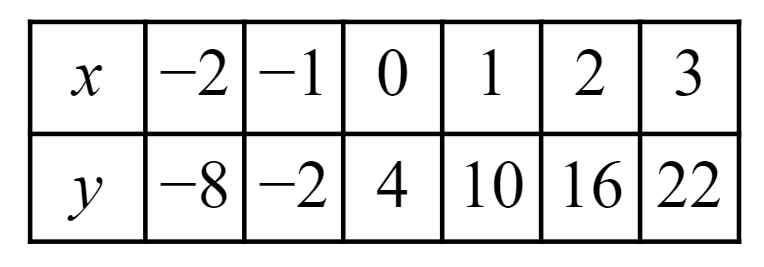
      Here is a table of values for the linear equation $$y=6x-4$$ When graphing this equation which coordinate pairs would you plot?

      An image in a quiz
      $$(-2,-1)$$
      $$(-8,-2)$$
      $$(22,3)$$
      Correct answer: $$(-1,-2)$$
      Correct answer: $$(3,22)$$

      Q5.
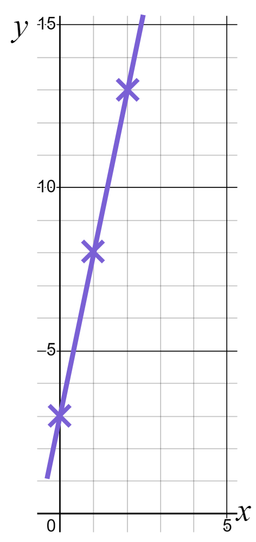
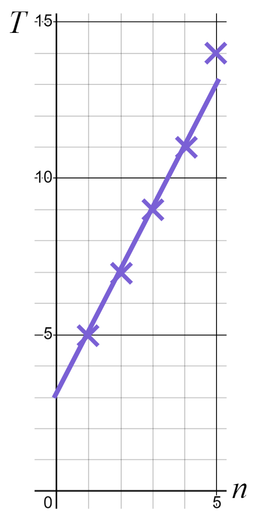
      What is the gradient of the line?

      An image in a quiz
      $$+3$$
      Correct answer: $$+5$$
      $$+8$$
      $$-5$$
      $$-3$$

      Q6.
      What is the equation of this line?

      An image in a quiz
      $$y=x+3$$
      $$y=x+5$$
      $$y=3x+5$$
      Correct answer: $$y=5x+3$$
      $$y=5(x+3)$$

      6 Questions

      Q1.
      Arithmetic sequences like this one are also called ________ because they increase or decrease in a straight line.

      An image in a quiz
      line sequences
      line segments
      line graphs
      Correct answer: linear sequences

      Q2.
      Which term does not belong in this arithmetic sequence?

      An image in a quiz
      $$7$$
      $$11$$
      $$5$$
      Correct answer: $$14$$

      Q3.
      What is the constant additive difference in this linear sequence?

      An image in a quiz
      $$-5$$
      $$-4$$
      $$+2$$
      Correct answer: $$+4$$
      $$+7$$

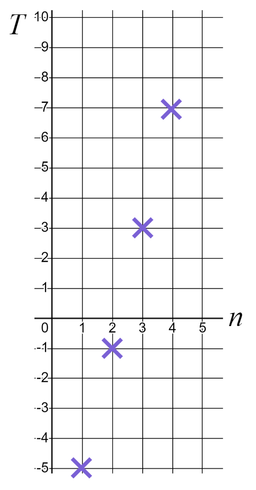
      Q4.
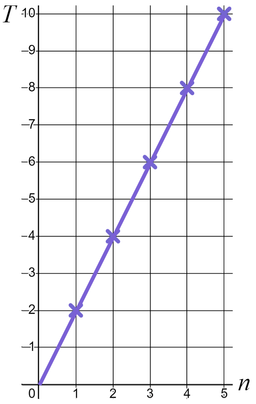
      What is the next coordinate pair we would plot when graphing this arithmetic sequence?

      An image in a quiz
      $$(4,-4)$$
      $$(-4,4)$$
      Correct answer: $$(4,-3)$$
      $$(-3,4)$$
      $$(5,-7)$$

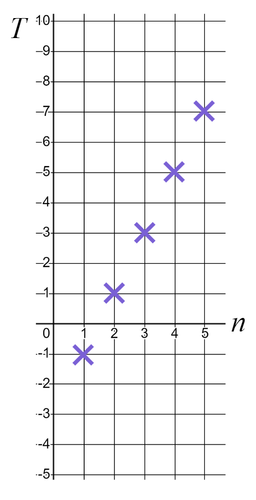
      Q5.
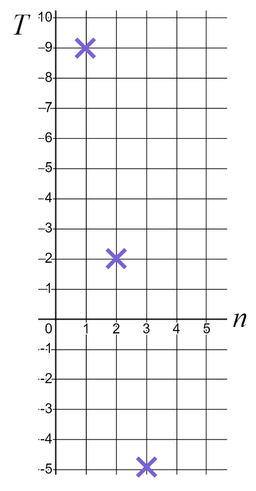
      What is the $$n^\text{th}$$ term of the arithmetic sequence graphed here?

      An image in a quiz
      Correct answer: $$2n-3$$
      $$2n-1$$
      $$-1n+2$$
      $$n+2$$
      $$3n-2$$

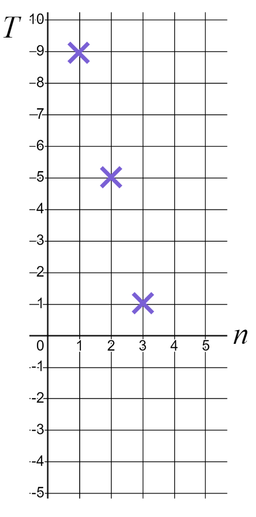
      Q6.
      What is the $$n^\text{th}$$ term of the arithmetic sequence graphed here?

      An image in a quiz
      $$9-7n$$
      $$7-9n$$
      Correct answer: $$16-7n$$
      $$7n+16$$

      To help you plan your 11 maths lesson on: Arithmetic sequences and their graphs, download all teaching resources for free and adapt to suit your pupils' needs...