Choose exam board for KS4 Computer Science (GCSE)
Choose exam board for KS4 English
Choose exam board for KS4 French
Choose exam board for KS4 Geography
Choose exam board for KS4 German
Choose exam board for KS4 History
Choose tier for KS4 Maths
Choose exam board for KS4 Music
Choose exam board for KS4 Physical education (GCSE)
Choose exam board for KS4 Religious education (GCSE)
Choose exam board for KS4 Spanish

Checking and securing understanding of nets of solids
Lesson details

Learning outcome

I can relate a solid to its net, draw a solid from its net and draw a net from its solid.

Key learning points

  1. A net is composed of polygons.
  2. Folding a net along certain edges and joining others, produces a solid.
  3. By studying the polygons in the net, you can deduce what solid is made.
  4. By studying the solid, you can draw the net.

Keywords

  • Net - The net of a 3D object is a 2D representation of its surfaces that can be folded up into the 3D object.

Common misconception

Pupils may misconfigure the net, believing that as long as the shapes of the faces are correct, the net will fold to be the desired 3D shape.

Have pupils mark/label/colour the edges that will join upon folding the net, this will ensure they are the correct length.

Teacher tip

Some pupils will struggle with visualising a net folding to make the solid. Videos, interactivities, 3D shapes and tiles can support them to physically see the net folding and unfolding.

Licence

This content is © Oak National Academy Limited (2025), licensed on Open Government Licence version 3.0
except where otherwise stated. See Oak's terms & conditions
(Collection 2).

Lesson video

Loading...

Prior knowledge starter quiz

6 Questions

Q1.
A is a flat (2D), closed figure made up of straight line segments.

Correct Answer: polygon

Q2.
A __________ is any polygon that has four straight sides.

kite
Correct answer: quadrilateral
rectangle
rhombus
square

Q3.
Select the properties of a regular $$n$$-sided polygon.

Correct answer: $$n$$ equal angles
$$(n-1)$$ equal angles
Correct answer: $$n$$ equal side lengths
Correct answer: Rotational symmetry of degree $$n$$
$$(n-1)$$ lines of symmetry

Q4.
Select the 3D shapes.

Correct answer: cone
Correct answer: cuboid
dodecagon
Correct answer: prism
trapezium

Q5.
A cuboid has faces.

Correct Answer: 6, six

Q6.
A triangular prism has faces.

Correct Answer: 5, five

6 Questions

Q1.
The of a 3D object is a 2D representation of its surfaces that can be folded up into the 3D object.

Correct Answer: net

Q2.
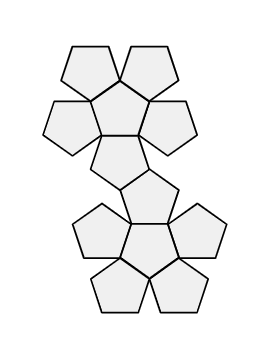
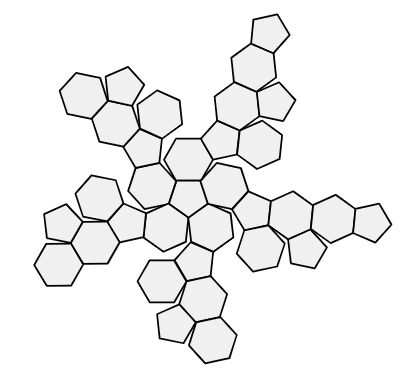
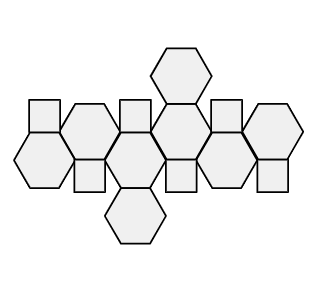
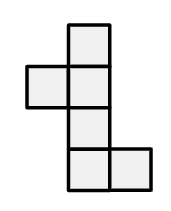
A solid is created from regular quadrilaterals and regular hexagons only. Which of these nets could be for the solid?

An image in a quiz
An image in a quiz
An image in a quiz
Correct Answer: An image in a quiz
An image in a quiz

Q3.
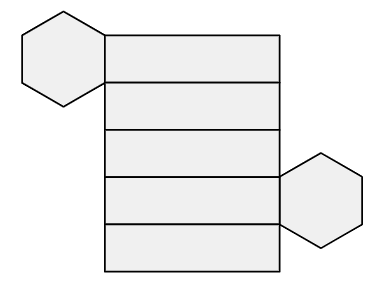
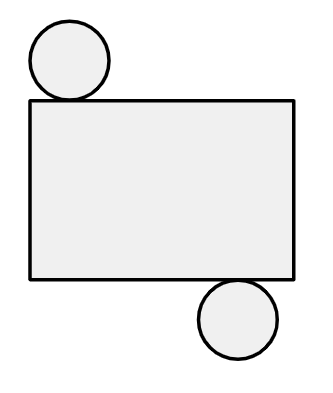
The diagram shows a net of a .

An image in a quiz
Correct Answer: cylinder

Q4.
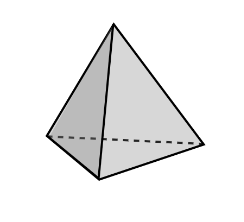
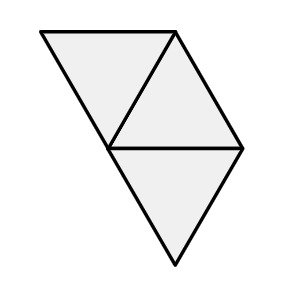
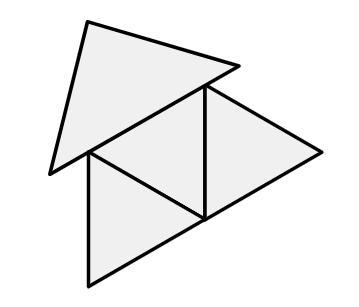
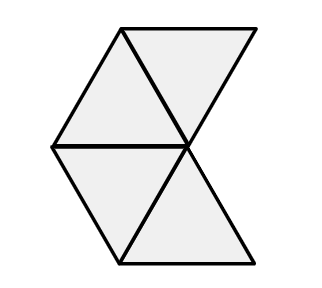
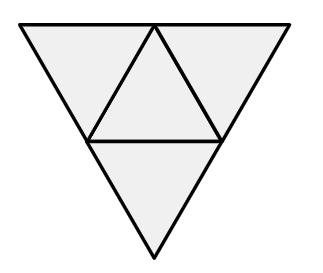
Which of these diagrams shows a net for a tetrahedron?

An image in a quiz
An image in a quiz
An image in a quiz
An image in a quiz
Correct Answer: An image in a quiz
An image in a quiz

Q5.
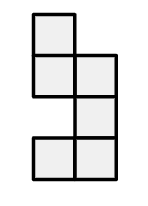
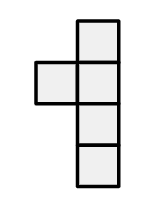
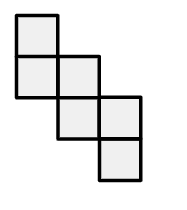
Which of these diagrams show a net of a cube?

An image in a quiz
An image in a quiz
Correct Answer: An image in a quiz
An image in a quiz
Correct Answer: An image in a quiz
An image in a quiz

Q6.
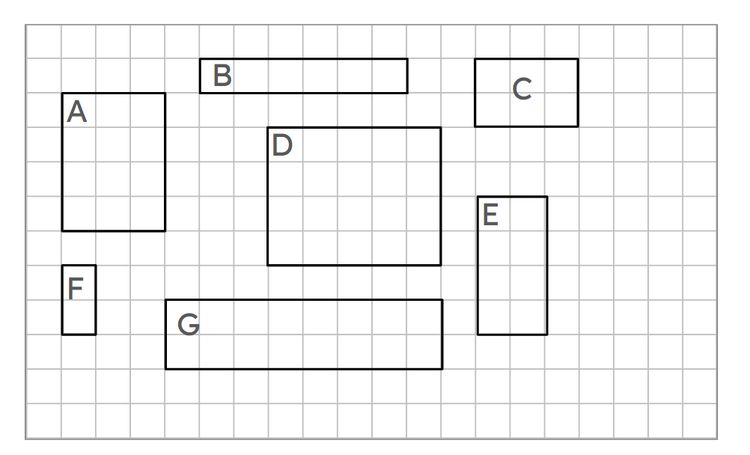
Which of the following rectangles can be used to create the net of a cuboid?

An image in a quiz
A, C and G
Correct answer: A, C and E
B, F and G
C, E and F
D, E and F

To help you plan your 11 maths lesson on: Checking and securing understanding of nets of solids, download all teaching resources for free and adapt to suit your pupils' needs...