Myths about teaching can hold you back
- Year 11•
- Higher
Probabilities in three event Venn diagrams
I can use a three event Venn diagram to calculate probabilities (including conditional).
- Year 11•
- Higher
Probabilities in three event Venn diagrams
I can use a three event Venn diagram to calculate probabilities (including conditional).
Lesson details
Key learning points
- A three event Venn diagram can be used to calculate probabilities
- Three event Venn diagrams can be used to calculate the probability of a subset of events occurring
- A three event Venn diagram can be used to calculate conditional probabilities
- Three event Venn diagrams can be used to calculate conditional probabilities involving sets of events
Keywords
Venn diagrams - Venn diagrams are a representation used to model statistical/probability questions. Commonly circles are used to represent events.
Mutually exclusive - Mutually exclusive events have no outcomes in common.
Conditional probability - Conditional probability is the probability of an outcome occurring given that another event has occurred.
Common misconception
Pupils may give the probability as a fraction with the wrong denominator.
Check that pupils understand the difference between the probability of event A given B, P(A|B), and the probability of event A and B occurring.
To help you plan your year 11 maths lesson on: Probabilities in three event Venn diagrams, download all teaching resources for free and adapt to suit your pupils' needs...
To help you plan your year 11 maths lesson on: Probabilities in three event Venn diagrams, download all teaching resources for free and adapt to suit your pupils' needs.
The starter quiz will activate and check your pupils' prior knowledge, with versions available both with and without answers in PDF format.
We use learning cycles to break down learning into key concepts or ideas linked to the learning outcome. Each learning cycle features explanations with checks for understanding and practice tasks with feedback. All of this is found in our slide decks, ready for you to download and edit. The practice tasks are also available as printable worksheets and some lessons have additional materials with extra material you might need for teaching the lesson.
The assessment exit quiz will test your pupils' understanding of the key learning points.
Our video is a tool for planning, showing how other teachers might teach the lesson, offering helpful tips, modelled explanations and inspiration for your own delivery in the classroom. Plus, you can set it as homework or revision for pupils and keep their learning on track by sharing an online pupil version of this lesson.
Explore more key stage 4 maths lessons from the Conditional probability unit, dive into the full secondary maths curriculum, or learn more about lesson planning.
Licence
Lesson video
Loading...
Prior knowledge starter quiz
6 Questions
Q1.An is a result of a trial in a probability experiment.
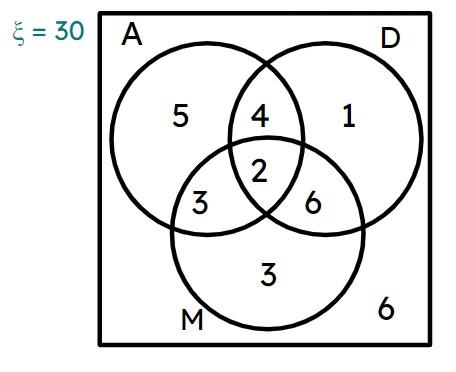
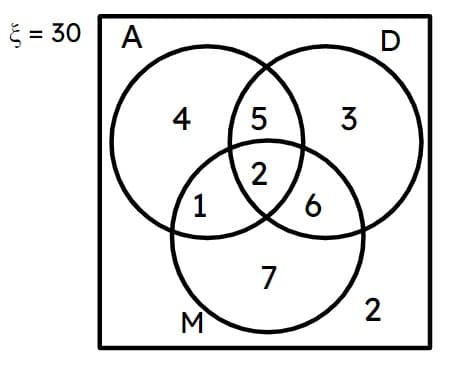
Q2.Izzy asks 30 pupils if they take GCSE Art (A), GCSE Drama (D) or GCSE Music (M). The frequencies are shown in the Venn diagram. pupils take drama but not music.

Q3.Izzy asks 30 pupils if they take GCSE Art (A), GCSE Drama (D) or GCSE Music (M). The frequencies are shown in the Venn diagram. pupils do not take music.

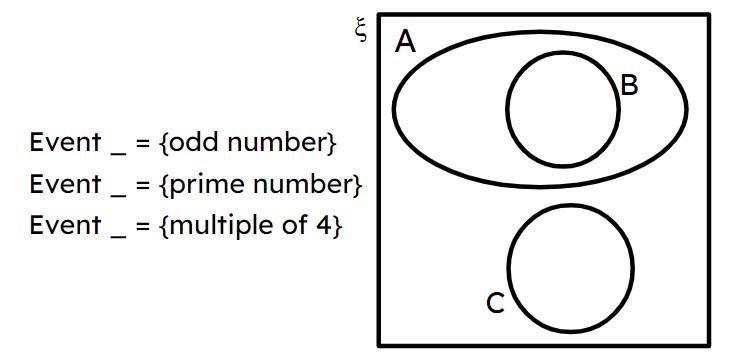
Q4.A spinner is numbered with the integers from 80 to 89. The incomplete outcome Venn diagram is used to display 3 events. Select the correct statements.

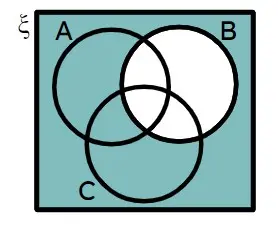
Q5.What region is shown shaded in this Venn diagram?

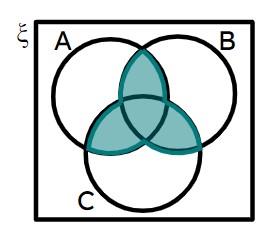
Q6.What region is shown shaded in this Venn diagram?

Assessment exit quiz
6 Questions
Q1.Venn diagrams are a representation used to model statistical and probability questions. Commonly circles are used to represent...
Q2.Sam asks 30 pupils if they take GCSE Art (A), GCSE Drama (D) or GCSE Music (M). The frequencies are shown in the Venn diagram. Find P(A ∩ D).

Q3.Sam asks 30 pupils if they take GCSE Art (A), GCSE Drama (D) or GCSE Music (M). The frequencies are shown in the Venn diagram. Find P(A ⋃ D′).

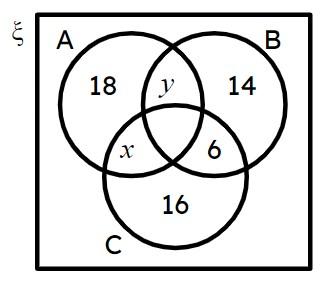
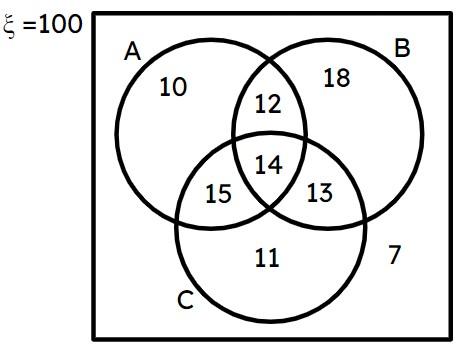
Q4.Here is a frequency Venn diagram. P(A ∩ B ∩ C) = . Give your answer as a decimal.

Q5.Here is a frequency Venn diagram. P(A′ ⋃ B' ⋃ C) = . Give your answer as a decimal.

Q6.This frequency Venn diagram has 80 outcomes altogether. P(A ∩ B ∩ C) = $$\frac{1}{20}$$, P(A | B) = $$\frac{1}{3}$$ and P(A ⋃ B) = 0.7. $$x$$ = .