Choose exam board for KS4 Computer Science (GCSE)
Choose exam board for KS4 English
Choose exam board for KS4 French
Choose exam board for KS4 Geography
Choose exam board for KS4 German
Choose exam board for KS4 History
Choose tier for KS4 Maths
Choose exam board for KS4 Music
Choose exam board for KS4 Physical education (GCSE)
Choose exam board for KS4 Religious education (GCSE)
Choose exam board for KS4 Spanish

      Identifying multiple transformations
      Lesson details

      Learning outcome

      I can identify what transformations have taken place.

      Key learning points

      1. More than one transformation may have taken place.
      2. If the size has changed, one shape may be an enlargement of the other.
      3. If the orientation has changed, one shape may be a rotation of the other.
      4. If the shapes are mirrored, one shape may be a reflection of the other.
      5. If the shapes look identical but are in different places, one may be a translation of the other.

      Keywords

      • Object - The object is the starting figure before a transformation has been applied.

      • Image - The image is the resulting figure after a transformation has been applied.

      • Vector - A vector can be used to describe a translation.

      • Invariant - A property of a shape is invariant if that property has not changed after the shape is transformed.

      Common misconception

      There is only one way to describe what has happened to an object to create its image.

      Learning cycle 1 explores how different transformations can produce the same image. This is a good way of demonstrating that there is more than one possible description.

      Teacher tip

      Some pupils may benefit from having the slides printed out so that they can check the transformations using tracing paper.

      Licence

      This content is © Oak National Academy Limited (2025), licensed on Open Government Licence version 3.0
      except where otherwise stated. See Oak's terms & conditions
      (Collection 2).

      Lesson video

      Loading...

      Prior knowledge starter quiz

      6 Questions

      Q1.
      A vector can be used to describe a __________.

      enlargement
      reflection
      rotation
      Correct answer: translation

      Q2.
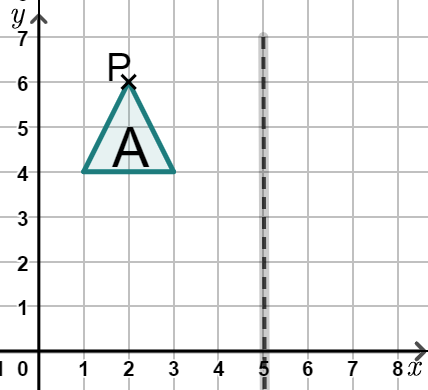
      Andeep reflects shape A in the line $$x=4$$ to A'. He then reflects A' in the line $$y=4$$ to A''. Select the coordinates of P' and P''.

      An image in a quiz
      P'(2, 2)
      Correct answer: P'(6, 6)
      Correct answer: P''(6, 2)
      P''(6, 6)
      P''(2, 2)

      Q3.
      Sofia translates shape A by $$\begin{pmatrix} 1 \\ -3 \\ \end{pmatrix}$$ to A'. She then reflects A' in the line $$x=5$$ to A''. Select the coordinates of P' and P''.

      An image in a quiz
      P'(4, 3)
      Correct answer: P'(3, 3)
      P''(5, 3)
      P''(6, 3)
      Correct answer: P''(7, 3)

      Q4.
      Laura is using technology to transform some shapes. She wants to use Desmos to rotate a shape 45° clockwise. Which of these angles should Laura type into Desmos?

      -315°
      Correct answer: -45°
      45°
      Correct answer: 315°

      Q5.
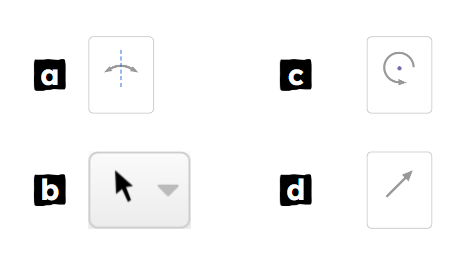
      Here are some buttons that you can use in Desmos for transformations. Match each button to its function.

      An image in a quiz
      Correct Answer:Button a,reflects object
      Correct Answer:Button b,selects object
      Correct Answer:Button c,rotates object
      Correct Answer:Button d,translates object

      Q6.
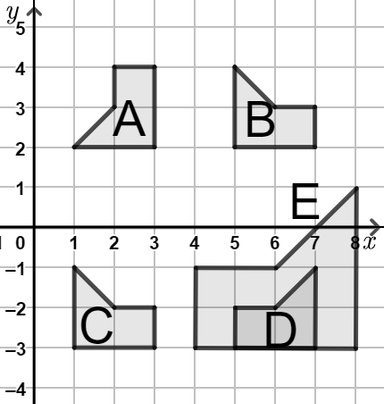
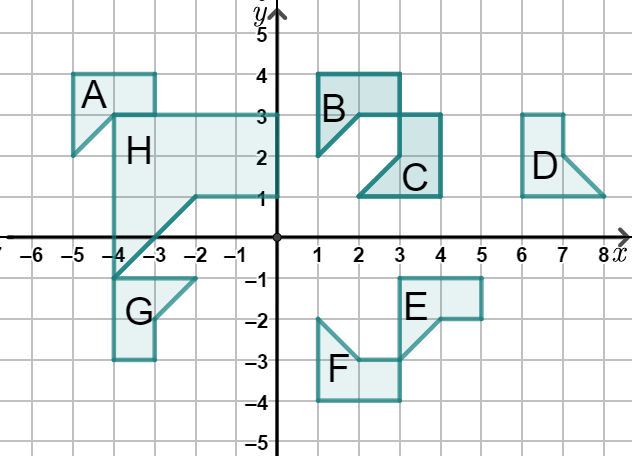
      Match each transformation to its description.

      An image in a quiz
      Correct Answer:Shape E to shape D,Enlargement, scale factor $$\frac{1}{2}$$, about $$(6,-3)$$
      Correct Answer:Shape D to shape C,Reflection in the line $$x=4$$
      Correct Answer:Shape C to shape B,Translation by $$\begin{pmatrix} 4 \\ 5 \\ \end{pmatrix}$$
      Correct Answer:Shape B to shape A,Rotation $$90$$° anticlockwise about $$(4, 1)$$

      6 Questions

      Q1.
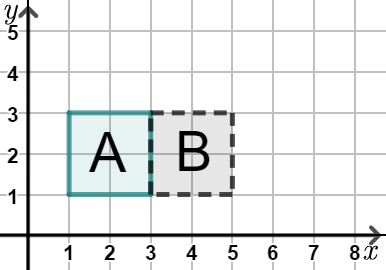
      A point on a shape is __________ if that point has not changed location after the shape is transformed.

      centre
      constant
      Correct answer: invariant
      variable

      Q2.
      Select the information you should give to fully describe a rotation.

      Correct answer: angle
      Correct answer: centre
      Correct answer: direction
      scale factor
      vector

      Q3.
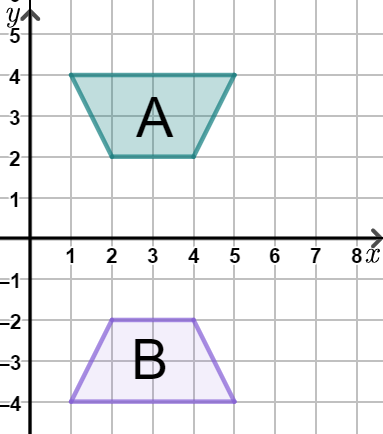
      What type of transformation maps shape A onto shape B?

      An image in a quiz
      A translation
      Correct answer: A rotation
      Correct answer: A reflection

      Q4.
      Describe one possible transformation from A to B that has zero invariant points.

      An image in a quiz
      Correct answer: A translation by the vector $$\begin{pmatrix} 2 \\ 0 \\ \end{pmatrix}$$
      A rotation of $$180$$° about $$(3, 2)$$
      A reflection in the line $$x=3$$
      An enlargement scale factor -1 about $$(3, 2)$$

      Q5.
      Describe the transformation that maps shape A onto shape E.

      An image in a quiz
      a reflection
      Correct answer: a translation
      in the line $$y=x$$
      Correct answer: by the vector $$\begin{pmatrix} 8 \\ -5 \\ \end{pmatrix}$$
      by the vector $$\begin{pmatrix} 8 \\ 5 \\ \end{pmatrix}$$

      Q6.
      Select the two transformations needed to map shape A onto shape C.

      An image in a quiz
      Correct answer: A translation by the vector $$\begin{pmatrix} 6 \\ 0 \\ \end{pmatrix}$$
      A translation by the vector $$\begin{pmatrix} 0 \\ 6 \\ \end{pmatrix}$$
      Correct answer: followed by a reflection in the line $$y=x$$
      followed by a rotation of $$90$$° about $$(3, 3)$$

      To help you plan your 10 maths lesson on: Identifying multiple transformations, download all teaching resources for free and adapt to suit your pupils' needs...