Choose exam board for KS4 Computer Science (GCSE)
Choose exam board for KS4 English
Choose exam board for KS4 French
Choose exam board for KS4 Geography
Choose exam board for KS4 German
Choose exam board for KS4 History
Choose tier for KS4 Maths
Choose exam board for KS4 Music
Choose exam board for KS4 Physical education (GCSE)
Choose exam board for KS4 Religious education (GCSE)
Choose exam board for KS4 Spanish

      The effect of enlargement on the volume of a 3D shape
      Lesson details

      Learning outcome

      I can understand the effect of an enlargement on the volume of a 3D shape.

      Key learning points

      1. An enlargement means the object and image are similar.
      2. All lengths in the object have been multiplied by the scale factor.
      3. Using index laws, this means the volume has been multiplied by the scale factor cubed.

      Keywords

      • Similar - Two shapes are similar if the only difference between them is their size. Their side lengths are in the same proportions.

      • Invariant - A property of a shape is invariant if that property has not changed after the shape is transformed.

      • Enlargement - Enlargement is a transformation that causes a change of size.

      • Scale factor - A scale factor is the multiplier between similar shapes that describes how large one shape is compared to the other.

      • Volume - Volume is the amount of space occupied by a closed 3D shape.

      Common misconception

      I will get different linear scale factors if a measure corresponding lengths in cm vs inches.

      Scale factors do not have dimensions, and aren't linked to specific units. If one length is 23 cm (9 inches), and a corresponding length is 69 cm (27 inches), then the scale factor between them is 3, regardless of whether we measured in cm or inches.

      Teacher tip

      Task B, question 2 can be more easily answered by calculating the maximum possible volume scale factor from the scale model to the real car, then cube rooting the volume scale factor to find the maximum possible linear scale factor. This method will be explicitly covered in lesson 6 of this unit.

      Licence

      This content is © Oak National Academy Limited (2026), licensed on Open Government Licence version 3.0
      except where otherwise stated. See Oak's terms & conditions
      (Collection 2).

      Lesson video

      Loading...

      Prior knowledge starter quiz

      6 Questions

      Q1.
      The transformation that causes a change in of the object is enlargement.

      Correct Answer: size

      Q2.
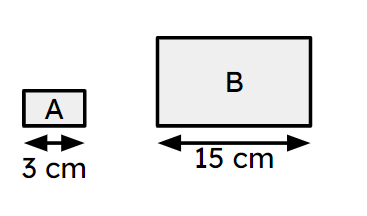
      Rectangles A and B are similar. What is the area scale factor from A to B?

      An image in a quiz
      $$\frac{1}{25}$$
      $$\frac{1}{5}$$
      5
      Correct answer: 25
      125

      Q3.
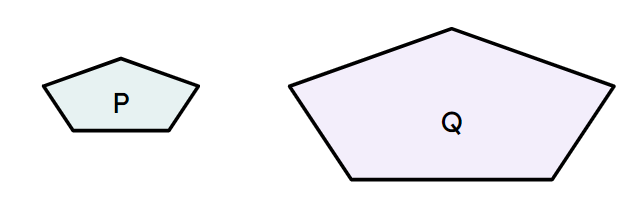
      Shapes P and Q are similar. The perimeter of shape P is 18 cm and the perimeter of shape Q is 72 cm. The area scale factor from P to Q is .

      An image in a quiz
      Correct Answer: 16

      Q4.
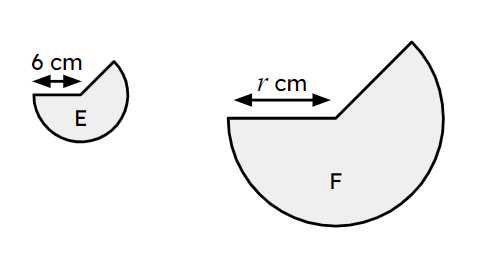
      Sectors E and F are similar. The area of sector E is 30π cm². What is the area of sector F?

      An image in a quiz
      36π cm²
      42π cm²
      60π cm²
      90π cm²
      Correct answer: 120π cm²

      Q5.
      Sectors E and F are similar. The area of shape E is 24π cm² and the area of sector F is 150π cm². The radius of sector F is cm.

      An image in a quiz
      Correct Answer: 15, 15 cm

      Q6.
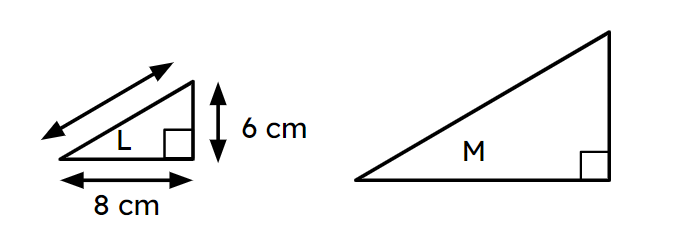
      Triangles L and M are similar. The area of triangle M is 54 cm². What is the perimeter of triangle M?

      An image in a quiz
      30 cm
      33 cm
      Correct answer: 36 cm
      42 cm
      48 cm

      6 Questions

      Q1.
      __________ is the amount of space occupied by a closed 3D shape.

      area
      perimeter
      Correct answer: volume

      Q2.
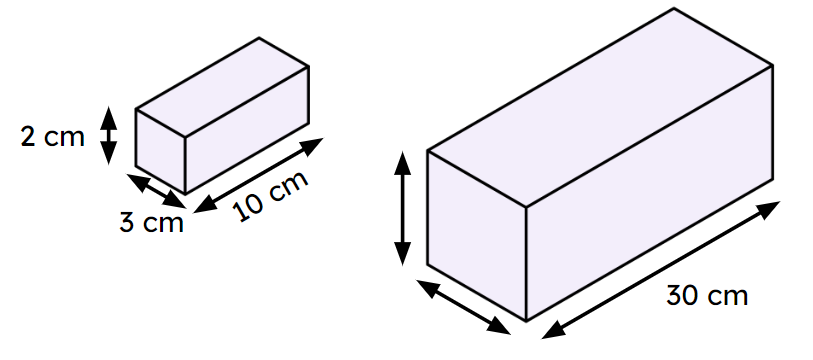
      A cuboid of dimensions 2 cm by 3 cm by 10 cm is enlarged by a scale factor of 3. Work out the volume of the enlarged cuboid.

      An image in a quiz
      480 cm³
      540 cm³
      1080 cm³
      Correct answer: 1620 cm³

      Q3.
      Shape A is a 3D shape. Shape A is enlarged by scale factor 3 to give shape B. What is the volume scale factor from A to B?

      $$\sqrt 3$$
      $$3$$
      $$6$$
      $$9$$
      Correct answer: $$27$$

      Q4.
      Match each linear scale factor to correct the volume scale factor.

      Correct Answer:Linear scale factor: $$2$$,Volume scale factor: $$8$$

      Volume scale factor: $$8$$

      Correct Answer:Linear scale factor: $$4$$,Volume scale factor: $$64$$

      Volume scale factor: $$64$$

      Correct Answer:Linear scale factor: $$5$$,Volume scale factor: $$125$$

      Volume scale factor: $$125$$

      Correct Answer:Linear scale factor: $$10$$,Linear scale factor: $$1000$$

      Linear scale factor: $$1000$$

      Q5.
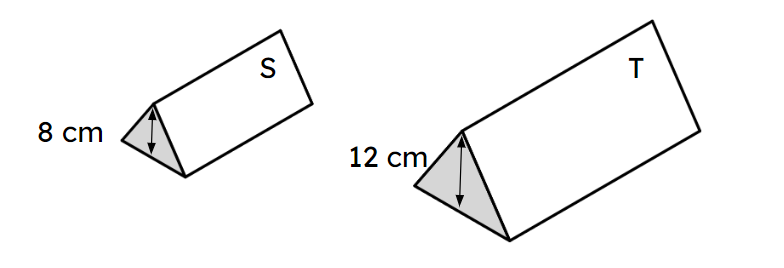
      Prism S and prism T are similar. What is the scale factor of enlargement from prism S to prism T?

      An image in a quiz
      $$\frac {3}{2}$$
      $$\frac {9}{4}$$
      $$\frac {4}{9}$$
      $$\frac {8}{27}$$
      Correct answer: $$\frac {27}{8}$$

      Q6.
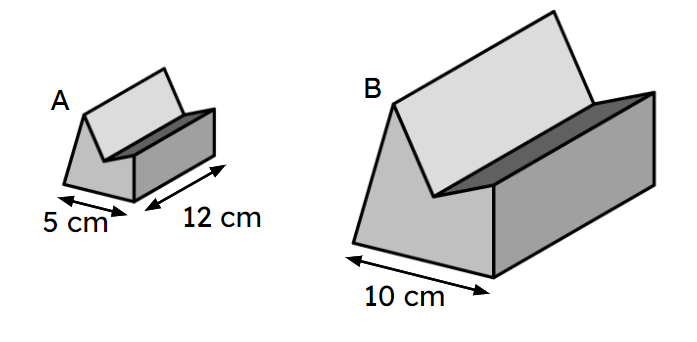
      Prism A and prism B are similar. The end face of prism A has an area of 15 cm². The volume of prism B is cm³.

      An image in a quiz
      Correct Answer: 1440, 1,440

      To help you plan your 10 maths lesson on: The effect of enlargement on the volume of a 3D shape, download all teaching resources for free and adapt to suit your pupils' needs...