Choose exam board for KS4 Computer Science (GCSE)
Choose exam board for KS4 English
Choose exam board for KS4 French
Choose exam board for KS4 Geography
Choose exam board for KS4 German
Choose exam board for KS4 History
Choose tier for KS4 Maths
Choose exam board for KS4 Music
Choose exam board for KS4 Physical education (GCSE)
Choose exam board for KS4 Religious education (GCSE)
Choose exam board for KS4 Spanish

      Transforming graphs: combinations of transformations
      Lesson details

      Learning outcome

      I can recognise the effect of applying a combination of transformations to a function.

      Key learning points

      1. Desmos is an effective tool for showing the effects of this transformation
      2. The actual function itself does not need to be known
      3. The order of transformations is defined by the priority of operations

      Keywords

      • Transformation - A transformation is a process that may change the size, orientation or position of a shape or graph.

      Common misconception

      For the combined transformation $$3$$f$$(x-2)$$ order does not matter so pupils may assume that order never matters.

      For $$3$$f$$(x-2)$$ the $$3$$ affects the output, the $$y$$ value, and the $$-2$$ affects the input, the $$x$$ value. Model to show that these can happen in either order. Then point out that $$3$$f$$(x)-2$$ is two effects on the output.

      Teacher tip

      Spend some time checking that pupils understand the transformations f$$(x)+a$$, f$$(x+a)$$, $$-$$f$$(x)$$, f$$(-x)$$, $$a$$f$$(x)$$ and f$$(ax)$$ before embarking on this lesson.

      Licence

      This content is © Oak National Academy Limited (2025), licensed on Open Government Licence version 3.0
      except where otherwise stated. See Oak's terms & conditions
      (Collection 2).

      Lesson video

      Loading...

      Prior knowledge starter quiz

      6 Questions

      Q1.
      $$y=\text{f}(x)+a$$, $$y=\text{f}(x+a)$$, $$y={a}\text{f}(x)$$, and $$y=\text{f}(ax)$$ are all of $$y=\text{f}(x)$$.

      Correct Answer: transformations

      Q2.
      Match the notation to its transformation.

      Correct Answer:$$y=\text{f}(x)+a$$,Translation by $$a$$ in the $$y$$-direction.

      Translation by $$a$$ in the $$y$$-direction.

      Correct Answer:$$y=\text{f}(x+a)$$,Translation by $$-a$$ in the $$x$$-direction.

      Translation by $$-a$$ in the $$x$$-direction.

      Correct Answer:$$y=-\text{f}(x)$$,Reflection in the $$x$$-axis.

      Reflection in the $$x$$-axis.

      Correct Answer:$$y=\text{f}(-x)$$,Reflection in the $$y$$-axis.

      Reflection in the $$y$$-axis.

      Correct Answer:$$y={a}\text{f}(x)$$,Stretch by scale factor $$a$$ in the $$y$$-direction.

      Stretch by scale factor $$a$$ in the $$y$$-direction.

      Correct Answer:$$y=\text{f}(ax)$$,Stretch by scale factor $$1\over{a}$$ in the $$x$$-direction.

      Stretch by scale factor $$1\over{a}$$ in the $$x$$-direction.

      Q3.
      Match each piece of function notation to a description.

      Correct Answer:$$2\text{f}(x)+3$$,Output of $$\text{f}(x)$$ is multiplied by $$2$$ then $$3$$ is added.

      Output of $$\text{f}(x)$$ is multiplied by $$2$$ then $$3$$ is added.

      Correct Answer:$$3\text{f}(x)+2$$,Output of $$\text{f}(x)$$ is multiplied by $$3$$ then $$2$$ is added.

      Output of $$\text{f}(x)$$ is multiplied by $$3$$ then $$2$$ is added.

      Correct Answer:$$3\text{f}(x+2)$$,Input has $$2$$ added before output is multiplied by $$3$$

      Input has $$2$$ added before output is multiplied by $$3$$

      Correct Answer:$$2\text{f}(x+3)$$,Input has $$3$$ added before output is multiplied by $$2$$

      Input has $$3$$ added before output is multiplied by $$2$$

      Correct Answer:$$2\text{f}(3x)$$,Input is multiplied by $$3$$ before output is multiplied by $$2$$

      Input is multiplied by $$3$$ before output is multiplied by $$2$$

      Correct Answer:$$-2\text{f}(x)$$,Output of $$\text{f}(x)$$ is multiplied by $$-2$$

      Output of $$\text{f}(x)$$ is multiplied by $$-2$$

      Q4.
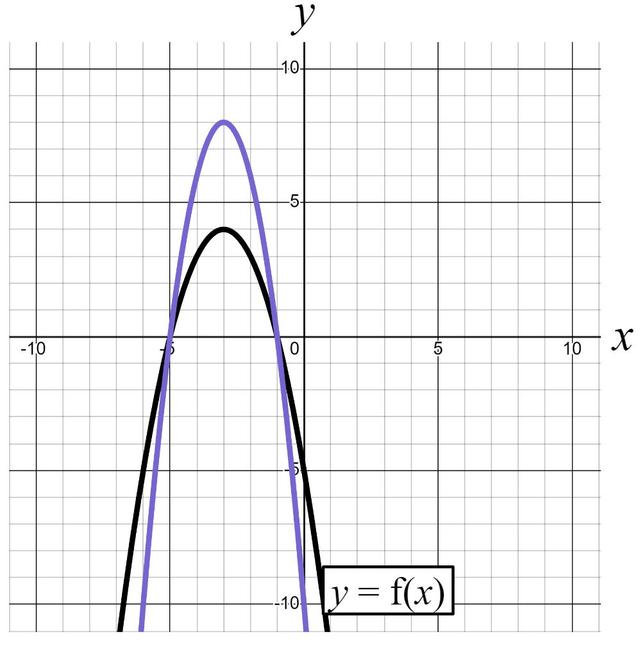
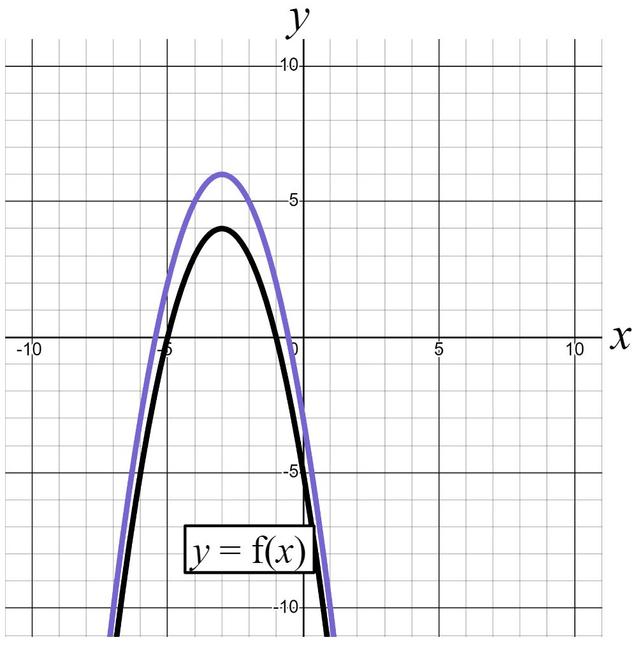
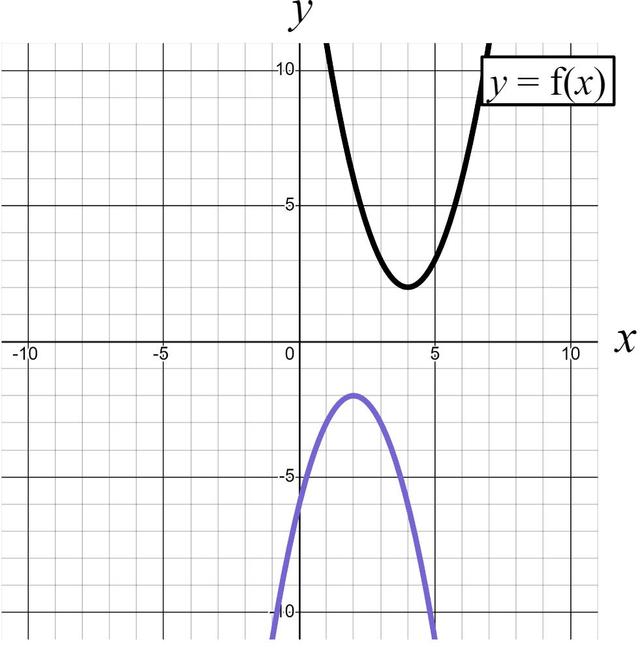
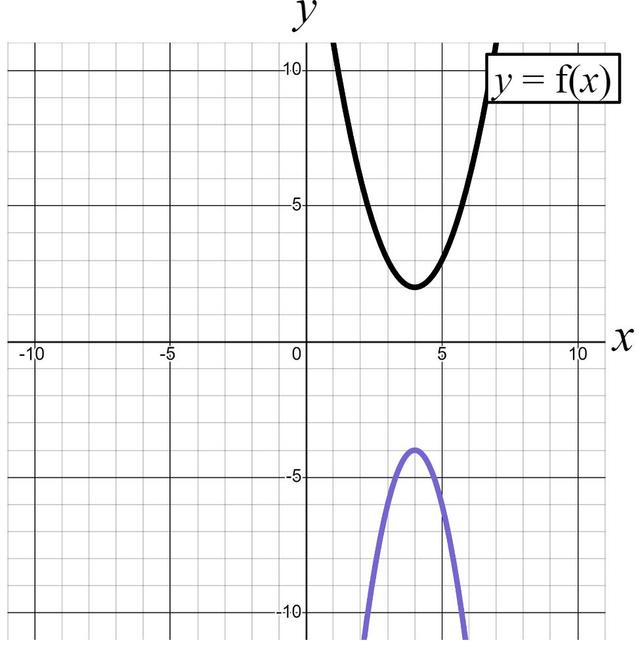
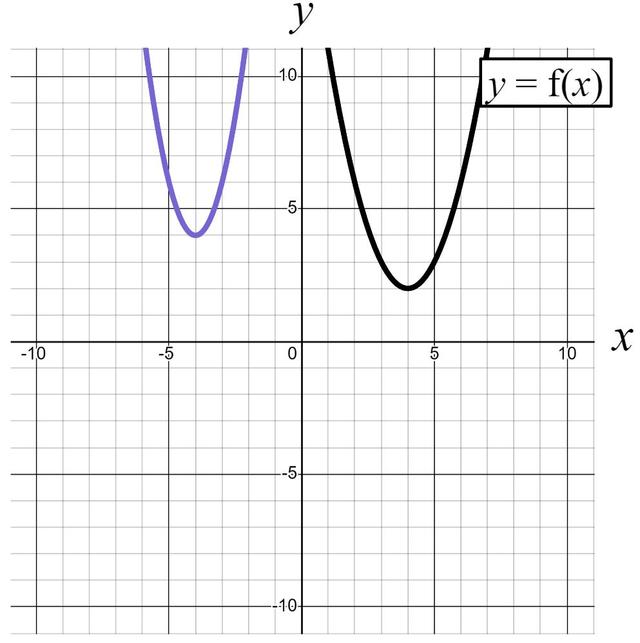
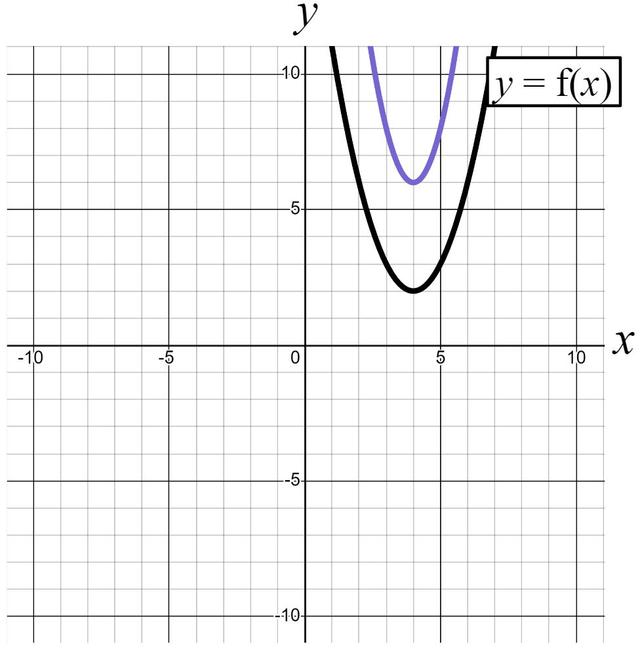
      $$y=\text{f}(x)$$ is graphed. Which of these images shows the transformation $$y=2\text{f}(x)$$?

      Correct Answer: An image in a quiz
      An image in a quiz
      An image in a quiz
      An image in a quiz
      An image in a quiz

      Q5.
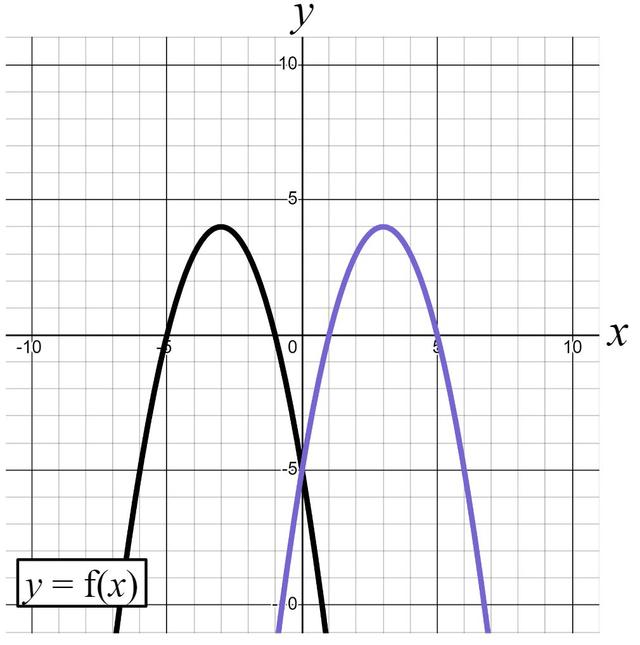
      $$y=\text{f}(x)$$ is graphed. Which of these images shows the transformation $$y=\text{f}(x-6)$$?

      An image in a quiz
      An image in a quiz
      Correct Answer: An image in a quiz
      An image in a quiz
      An image in a quiz

      Q6.
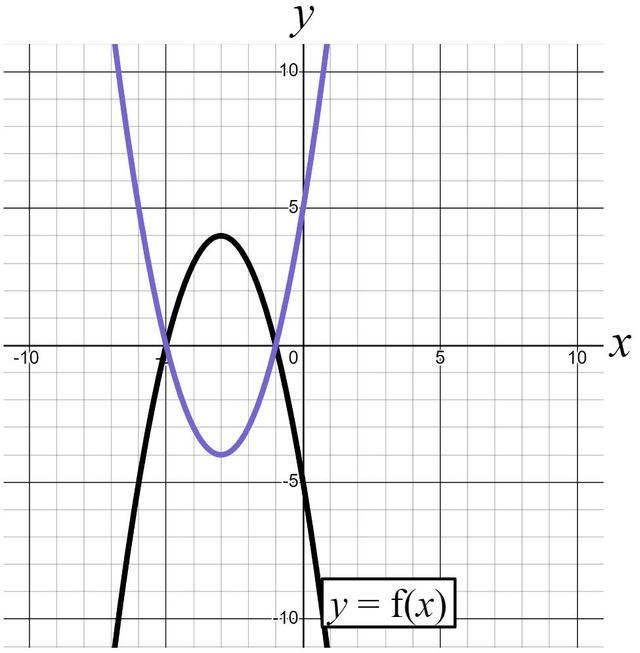
      $$y=\text{f}(x)$$ is graphed. Which of these images shows the transformation $$y=-\text{f}(x)$$?

      An image in a quiz
      Correct Answer: An image in a quiz
      An image in a quiz
      An image in a quiz
      An image in a quiz

      6 Questions

      Q1.
      $$-\text{f}(-x)$$ will transform $$\text{f}(x)$$ by two __________.

      translations
      rotations
      enlargements
      Correct answer: reflections

      Q2.
      $$y=\text{f}(x)$$ is graphed. Which of these images shows the transformation $$y=-2\text{f}(x)$$?

      An image in a quiz
      Correct Answer: An image in a quiz
      An image in a quiz
      An image in a quiz
      An image in a quiz

      Q3.
      $$y=\text{f}(x)$$ is graphed. Which of these images shows the transformation $$y=2\text{f}(x)+2$$?

      An image in a quiz
      An image in a quiz
      An image in a quiz
      Correct Answer: An image in a quiz
      An image in a quiz

      Q4.
      $$y=\text{f}(x)$$ is graphed. Which of these images shows the transformation $$y=-\text{f}(x+2)$$?

      Correct Answer: An image in a quiz
      An image in a quiz
      An image in a quiz
      An image in a quiz
      An image in a quiz

      Q5.
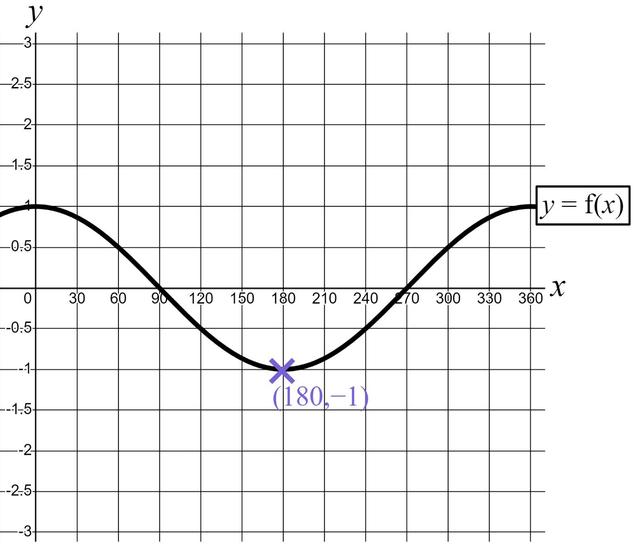
      $$\text{f}(x)=\text{cos}(x)$$. Where will the marked point be after the transformation $$y=3\text{f}(2x)$$?

      An image in a quiz
      Correct answer: $$(90,-3)$$
      $$(-90,-3)$$
      $$(-90,3)$$
      $$(360,3)$$
      $$(360,-3)$$

      Q6.
      $$\text{f}(x)=\text{cos}(x)$$. Where will the marked point be after the transformation $$y=-\text{f}\left({1\over2}x\right)+1$$? Give your answer in the form $$(x,y)$$

      An image in a quiz
      Correct Answer: (360, 2), (360,2)

      To help you plan your 11 maths lesson on: Transforming graphs: combinations of transformations, download all teaching resources for free and adapt to suit your pupils' needs...