Choose exam board for KS4 Computer Science (GCSE)
Choose exam board for KS4 English
Choose exam board for KS4 French
Choose exam board for KS4 Geography
Choose exam board for KS4 German
Choose exam board for KS4 History
Choose tier for KS4 Maths
Choose exam board for KS4 Music
Choose exam board for KS4 Physical education (GCSE)
Choose exam board for KS4 Religious education (GCSE)
Choose exam board for KS4 Spanish

      Lesson details

      Learning outcome

      I can explain why some nuclei are stable and why some are unstable.

      Key learning points

      1. Protons have a positive electric charge of +1 and a mass number of 1.
      2. Neutrons have no electric charge and have a mass number of 1.
      3. The atomic number of an element equals the number of protons in the nucleus of each atom of that element.
      4. The atomic number of an element equals the number of electrons in each atom of that element.
      5. Atoms of an element that have different numbers of neutrons in their nuclei are isotopes of the element.

      Keywords

      • Nucleus - the central part of an atom which contains protons and neutrons

      • Nucleon - the term for particles in a nucleus (protons and neutrons)

      • Atomic (proton) number - the number of protons within a particular nucleus

      • Mass (nucleon) number - the total number of nucleons within a particular nucleus (protons + neutrons)

      • Isotopes - atoms of the same element with differing numbers of neutrons

      Common misconception

      Many pupils are uncertain about the forces attracting or repelling particles inside an atom.

      Extend explanations to include electrostatic forces between protons in the nucleus and introduce the strong nuclear force to explain why nuclei do not self destruct.

      Teacher tip

      Ideas about strong nuclear force holding neutrons and protons together, and the instability of neutrons away from protons are essential to understanding radioactivity. An awareness of these ideas allows pupils to accept other ideas as rational and logical.

      Licence

      This content is © Oak National Academy Limited (2025), licensed on Open Government Licence version 3.0
      except where otherwise stated. See Oak's terms & conditions
      (Collection 2).

      Lesson video

      Loading...

      Prior knowledge starter quiz

      6 Questions

      Q1.
      Which of these are examples of natural sources of background radiation?

      Correct answer: cosmic rays
      nuclear fallout
      nuclear waste
      medical treatments
      Correct answer: granite rock

      Q2.
      Which of these devices is used to detect nuclear radiation?

      an ammeter
      a Van de Graaff generator
      Correct answer: a Geiger counter
      a voltmeter
      a joulemeter

      Q3.
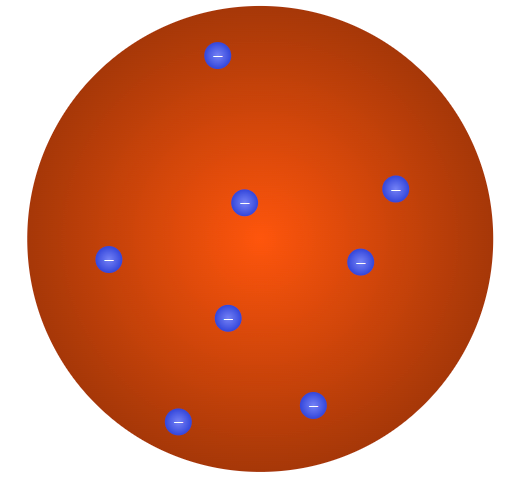
      The figure shows a model of the atom developed by JJ Thompson. It is the model of the atom.

      An image in a quiz
      Correct Answer: plum pudding, plum, plum-pudding

      Q4.
      Which particles did Rutherford use in his experiment which led to the development of the nuclear model of the atom?

      gamma particles
      beta particles
      Correct answer: alpha particles
      neutrons
      protons

      Q5.
      Which of these are conclusions from Rutherford’s scattering experiment?

      Correct answer: atoms are mostly empty space
      the nucleus contains protons
      the nucleus contains neutrons
      Correct answer: the nucleus has most of the mass of the atoms
      Correct answer: the nucleus is positively charged

      Q6.
      Which of these refinements of the nuclear model is Niels Bohr responsible for?

      the discovery of protons in the nucleus
      the discovery of electrons around the nucleus
      the discovery of neutrons in the nucleus
      Correct answer: the energy level (shell) structure of electrons in atoms
      background radiation

      6 Questions

      Q1.
      Match each key word or phrase to the correct definition.

      Correct Answer:nucleus,the central part of an atom that contains protons and neutrons

      the central part of an atom that contains protons and neutrons

      Correct Answer:nucleon,a proton or neutron in a nucleus

      a proton or neutron in a nucleus

      Correct Answer:atomic (proton) number,the number of protons within a particular nucleus

      the number of protons within a particular nucleus

      Correct Answer:mass (nucleon) number,the total number of protons + neutrons within a particular nucleus

      the total number of protons + neutrons within a particular nucleus

      Correct Answer:isotopes,atoms of the same element with differing numbers of neutrons

      atoms of the same element with differing numbers of neutrons

      Q2.
      Which of the following particles has the smallest mass?

      a neutron
      a helium atom
      a proton
      Correct answer: an electron
      a gold atom

      Q3.
      Nuclei can be represented by nuclear notation ($$^{\text{A}}_{\text{Z}}$$X). For example, $$^{21}_{10}$$Ne. Which of these statements about this notation are correct?

      Correct answer: Z shows the number of protons in the nucleus
      Z shows the number of neutrons in the nucleus
      A shows the number of protons in the nucleus
      A shows the number of neutrons in the nucleus
      Correct answer: A shows the total number of protons and neutrons in the nucleus

      Q4.
      A sulfur atom is represented by the symbol $$^{34}_{16}$$S. Which of these statements are correct?

      the atom contains 34 neutrons
      Correct answer: the atom contains 16 protons
      Correct answer: the atom contains 18 neutrons
      Correct answer: the atom contains 16 electrons
      the atom contains 34 protons

      Q5.
      Which of these statements about neutrons are correct?

      Neutrons are always stable particles
      Correct answer: Neutrons are more stable when close to a proton inside a nucleus.
      Neutrons are less stable when close to a proton inside a nucleus.
      Neutrons are much more massive than protons.
      Correct answer: Neutrons and protons have similar masses.

      Q6.
      There are 13 known isotopes of lithium. The most common is lithium-7, which can be represented as $$^{7}_{3}$$Li. Which of these statements about the nuclei of other isotopes of lithium are correct?

      Correct answer: They are all the same element.
      Correct answer: They all have 3 protons in their nucleus.
      They all have 4 neutrons in their nucleus.
      They all have the same mass.
      Correct answer: They all have the same number of electrons.

      To help you plan your 11 physics lesson on: Unstable nuclei, download all teaching resources for free and adapt to suit your pupils' needs...