


Moving electric charge


Lesson details
Learning outcome
I can explain how an electric field causes electric current to flow in a circuit.
Key learning points
- Two unlike electric charges attract each other.
- Two like electric charges repel each other.
- In an electric circuit, electrons are forced towards the positive terminal of a battery.
- Electric current is the amount of charge that passes a point in a circuit in each second.
- Current can be found using the equation: current = charge ÷ time.
Keywords
Van de Graaff generator - A device that produces electric charge and is used in electrostatic experiments.
Charge - An electrical property; it can either be positive or negative.
Electric field - The invisible field around a charged object that causes another charged object to experience a force.
Coulomb - The unit of electric charge.
Ampere - The unit of electric current.
Common misconception
Magnetic field effects are often mistaken for electric field effects.
Be explicit in teaching that electric charges and charged objects are not magnetic.
Teacher tip
For some classes, it may be helpful to investigate the attraction or repulsion between positively and negatively charged rods. The charge on the dome of a Van de Graaff generator will depend on the material the rollers are made of. This lesson assumes the charge on the dome is negative.

Equipment
Van de Graaff generator and discharge ball for demonstration.

Licence

Lesson video
Loading...
Prior knowledge starter quiz
6 Questions
Q1.An object becomes positively charged by friction. Which of the following explains how this happens?

Q2.How many of the following types of particle can an object gain or lose when it is rubbed against another object: electrons, protons, neutrons?
Q3.Which of the following statements about electric field lines are correct?
Q4.Which of the following statements about the arrows on electric field lines are correct?
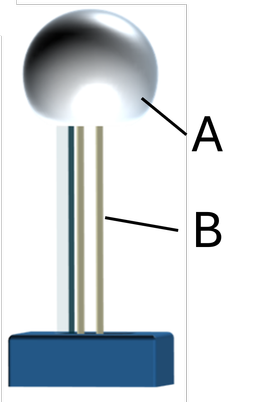
Q5.The diagram shows a Van de Graaff generator. After the generator is switched on, which of the following happen?
Q6.Speed, distance and time are related by the equation: speed = distance ÷ time. Which of the following are correct rearrangements of this equation?
Assessment exit quiz
6 Questions
Q1.Which of the following is a definition of electric current?
Q2.A battery makes a current flow in a circuit. Which of the following statements about the electric field in the circuit are correct?
Q3.Which of the following statements is correct?
Q4.If 12 coulombs (C) of charge flows in 2 seconds (s), the current is amps (A).
Q5.A current of 6 A flows in a circuit. The amount of charge that flows past in 3 s is C.
Q6.A current of 0.50 A flows in a circuit. The time taken for 12 C of charge to flow past a point in the circuit is s.
To help you plan your 10 physics lesson on: Moving electric charge, download all teaching resources for free and adapt to suit your pupils' needs...
To help you plan your 10 physics lesson on: Moving electric charge, download all teaching resources for free and adapt to suit your pupils' needs.
The starter quiz will activate and check your pupils' prior knowledge, with versions available both with and without answers in PDF format.
We use learning cycles to break down learning into key concepts or ideas linked to the learning outcome. Each learning cycle features explanations with checks for understanding and practice tasks with feedback. All of this is found in our slide decks, ready for you to download and edit. The practice tasks are also available as printable worksheets and some lessons have additional materials with extra material you might need for teaching the lesson.
The assessment exit quiz will test your pupils' understanding of the key learning points.
Our video is a tool for planning, showing how other teachers might teach the lesson, offering helpful tips, modelled explanations and inspiration for your own delivery in the classroom. Plus, you can set it as homework or revision for pupils and keep their learning on track by sharing an online pupil version of this lesson.
Explore more key stage 4 physics lessons from the Electric fields and circuit calculations unit, dive into the full secondary physics curriculum, or learn more about lesson planning.