Choose exam board for KS4 Computer Science (GCSE)
Choose exam board for KS4 English
Choose exam board for KS4 French
Choose exam board for KS4 Geography
Choose exam board for KS4 German
Choose exam board for KS4 History
Choose tier for KS4 Maths
Choose exam board for KS4 Music
Choose exam board for KS4 Physical education (GCSE)
Choose exam board for KS4 Religious education (GCSE)
Choose exam board for KS4 Spanish

      Lesson details

      Learning outcome

      I can use the equation F = m × a to determine and explain the motion of falling objects.

      Key learning points

      1. An object that is dropped experiences a constant gravitational force towards the centre of Earth.
      2. For a falling object, drag acts in the opposite direction to the gravitational force.
      3. As a falling object speeds up, the air resistance pushing up on it increases.
      4. When the resultant force on a falling object becomes zero, the object reaches terminal velocity.

      Keywords

      • Gravitational force - is a non–contact force that attracts objects with mass towards each other

      • Drag - is a force of a fluid on an object moving through it, in the opposite direction to the object’s motion

      • Resultant force - is the overall effect of the forces acting on an object

      • Terminal velocity - is the velocity of an object falling through a fluid, when there is zero resultant force

      Common misconception

      Pupils may believe that as air resistance increases, a falling object decelerates (slows down).

      Analyse footage of a falling object played back in slow motion, or frame–by–frame, to show that the speed of a falling object increases, up to a maximum speed, and at no time does it slow down.

      Teacher tip

      If time allows, the increase in terminal velocity with mass can be investigated by dropping paper bun–cases from about 2 m and measuring the average speed over the last 1 m of fall. Multiple bun cases stacked inside each other increase mass.

      Equipment

      See additional materials.

      Content guidance

      Risk assessment required - equipment

      Supervision

      Adult supervision required

      Licence

      This content is © Oak National Academy Limited (2026), licensed on Open Government Licence version 3.0
      except where otherwise stated. See Oak's terms & conditions
      (Collection 2).

      Lesson video

      Loading...

      Prior knowledge starter quiz

      6 Questions

      Q1.
      Which of the following forces acts on all objects near Earth surface?

      upthrust
      friction
      magnetic force
      drag
      Correct answer: gravitational force

      Q2.
      An aeroplane produces a horizontal forwards thrust of 3200 N and a drag force of 2400 N opposes the movement. What is the size of the resultant horizontal force acting on the aeroplane?

      5600 N forwards
      5600 N backwards
      Correct answer: 800 N forwards
      800 N backwards
      0 N

      Q3.
      Which of the following is a statement of Newton’s Second Law of motion, using standard symbols?

      $$v = x ÷ t$$
      $$a = (v – u) ÷ t$$
      Correct answer: $$F = m × a$$
      $$m = F × a$$
      $$a = F × m$$

      Q4.
      Five cars, A, B, C, D and E, travel along a straight road. There are three forces acting on each car, the values of which are listed below. Which of the cars are not accelerating?

      Correct answer: car A: driving force = 500 N, air resistance = 300 N, friction = 200 N
      car B: driving force = 600 N, air resistance = 300 N, friction = 200 N
      car C: driving force = 700 N, air resistance = 300 N, friction = 300 N
      car D: driving force = 800 N, air resistance = 300 N, friction = 400 N
      Correct answer: Car E: driving force = 900 N, air resistance = 450 N, friction = 450 N

      Q5.
      What sized resultant force is needed to cause a lorry of mass 3000 kg to accelerate at 0.3 m/s$$^2$$?

      0.3 N
      100 N
      Correct answer: 900 N
      1000 N
      10 000 N

      Q6.
      Calculate the acceleration of a skydiver of mass 70 kg with a weight of 700 N and a drag force of 490 N acting on them. You do not need to give the unit.

      Correct Answer: 3, 3.0, 3.00, 3 m/s$$^2$$, 3.0 m/s$$^2$$

      6 Questions

      Q1.
      Match the following key terms about terminal velocity to the correct description.

      Correct Answer:gravitational force,non–contact force that attracts objects with mass towards each other

      non–contact force that attracts objects with mass towards each other

      Correct Answer:drag,the force of a fluid acting on an object moving through it

      the force of a fluid acting on an object moving through it

      Correct Answer:resultant force,the overall effect of the forces acting on an object

      the overall effect of the forces acting on an object

      Correct Answer:terminal velocity,the velocity of a falling object when there is no resultant force

      the velocity of a falling object when there is no resultant force

      Q2.
      Which of the following statements about an object falling through the atmosphere are correct?

      the object will continue to accelerate as there is only one force acting on it
      Correct answer: the drag force increases as the speed of the falling object increases
      the weight of the object increases as the speed of the object increases
      Correct answer: at terminal velocity, the drag force is equal to the weight of the object
      at terminal velocity, the drag force is greater than the weight of the object

      Q3.
      Five objects, A, B, C, D and E, are falling towards Earth. There are two forces acting on each object, the values of which are listed below. Which of the objects are at terminal velocity?

      Object A: gravitational force = 40 N, drag force = 20 N
      Object B: gravitational force = 200 N, drag force = 400 N
      Correct answer: Object C: gravitational force = 200 N, drag force = 200 N
      Object D: gravitational force = 200 N, drag force = 190 N
      Correct answer: Object E: gravitational force = 0.4 N, drag force = 0.4 N

      Q4.
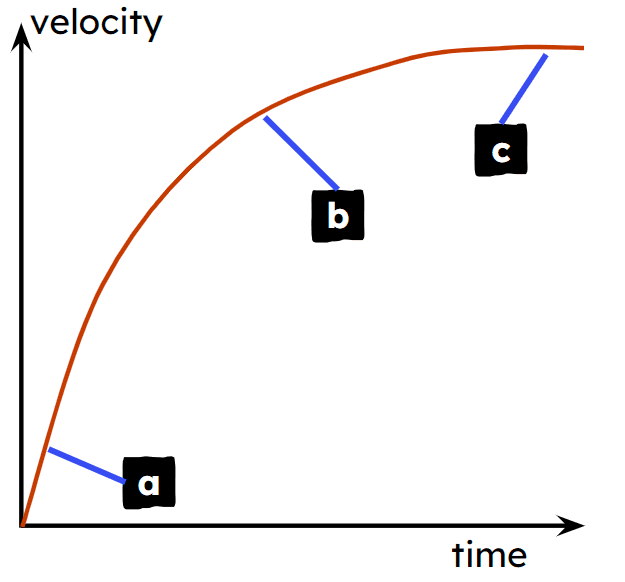
      A velocity–time graph for a falling object is shown. Match the labelled points to the correct descriptions.

      An image in a quiz
      Correct Answer:c,acceleration is zero: object has reached terminal velocity

      acceleration is zero: object has reached terminal velocity

      Correct Answer:a,acceleration is at its highest

      acceleration is at its highest

      Correct Answer:b,acceleration is at its lowest

      acceleration is at its lowest

      Q5.
      A stone of mass 0.5 kg is falling in water. Its weight is 5.0 N and a drag force of 4.5 N is acting. Calculate the acceleration of the stone. You do not need to give the unit.

      Correct Answer: 1, 1.0, 1.00, 1.0 m/s$$^2$$, 1 m/s$$^2$$

      Q6.
      Two balls, with the same diameter but different weights, are dropped from a height. Which two statements explain why the heavier ball reaches a higher terminal velocity then the lighter ball?

      the drag force on the balls will be equal at their terminal velocities
      Correct answer: the drag force increases with the speed of the falling objects
      Correct answer: terminal velocity is reached when the drag force equals the weight
      the weight of the balls changes as they fall
      the heavy ball has a larger drag when it is at the same speed as the light ball

      To help you plan your 11 physics lesson on: Terminal velocity, download all teaching resources for free and adapt to suit your pupils' needs...