


Looking after our teeth: review (non-statutory)


Lesson details
Learning outcome
I can present information about how sugar in drinks can damage teeth.
Key learning points
- Scientists make careful observations to investigate which drinks are harmful to teeth.
- Scientists review data collected from observations and write conclusions.
- In a conclusion, scientists often refer to earlier predictions of what they thought was going to happen.
- Too much sugar in food or drink can damage teeth. Information about sugar content in drinks can be found on packaging.
- Scientists often present data in a graph to help explain their conclusions to other people.
Keywords
Observations - We make observations when we look closely at something and use other senses too.
Data - Data is information collected during an investigation. It may be numbers, symbols, pictures or text.
Conclusion - In a conclusion, scientists explain what the results show or mean.
Sugar - Sugar is used to flavour food and drinks to give them a sweet taste.
Graph - A graph is a visual way to display results to make them easy to understand.
Common misconception
May believe diet drinks are good for teeth as they don't have sugar in them.
As children observe the eggshells left in different drinks, they will see that diet drinks can still cause tooth decay and discolouration.
Teacher tip
Need to have left the eggs in the liquids from the previous lesson for at least 5 days to see appropriate changes.

Equipment
Eggshells in different drinks from previous lesson's investigation.

Content guidance
Risk assessment required - equipment

Supervision
Adult supervision required

Licence

Lesson video
Loading...
Prior knowledge starter quiz
6 Questions
Q1.Food such as sweets, cakes and biscuits often contain lots of ...

Q2.Which of these things can build up on teeth if you eat lots of sugary food and drink lots of sugary drinks?
Q3.Which of these products help you look after your teeth?
Q4.Which teeth are your first set that you have as a child?
Q5.Animals have different shaped depending on what type of food they eat.
Q6.What type of investigation is it when scientists look carefully at changes that occur gradually?
Assessment exit quiz
6 Questions
Q1.Too much __________ can cause damage to teeth.
Q2.In a conclusion, scientists often refer to earlier of what they thought was going to happen.
Q3.What kind of data could you observe and collect when investigating which drinks cause the most damage to teeth?
Q4.Where can you find out about how much sugar a food or drink contains?
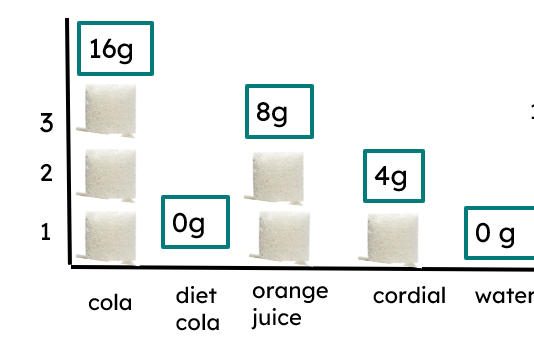
Q5.Using the graph below, put the drinks in order of highest sugar content to lowest sugar content.
Q6.When scientists have reviewed the data from an investigation, they write a to explain what their results show and mean.
To help you plan your 4 science lesson on: Looking after our teeth: review (non-statutory), download all teaching resources for free and adapt to suit your pupils' needs...
To help you plan your 4 science lesson on: Looking after our teeth: review (non-statutory), download all teaching resources for free and adapt to suit your pupils' needs.
The starter quiz will activate and check your pupils' prior knowledge, with versions available both with and without answers in PDF format.
We use learning cycles to break down learning into key concepts or ideas linked to the learning outcome. Each learning cycle features explanations with checks for understanding and practice tasks with feedback. All of this is found in our slide decks, ready for you to download and edit. The practice tasks are also available as printable worksheets and some lessons have additional materials with extra material you might need for teaching the lesson.
The assessment exit quiz will test your pupils' understanding of the key learning points.
Our video is a tool for planning, showing how other teachers might teach the lesson, offering helpful tips, modelled explanations and inspiration for your own delivery in the classroom. Plus, you can set it as homework or revision for pupils and keep their learning on track by sharing an online pupil version of this lesson.
Explore more key stage 2 science lessons from the Introduction to the human digestive system unit, dive into the full primary science curriculum, or learn more about lesson planning.