


Heart recovery time after exercise


Lesson details
Learning outcome
I can investigate the recovery time of my heart after exercise.
Key learning points
- Your pulse can be felt at the wrist and other places where an artery is close to the skin.
- A healthy resting heart rate for adults is between 50 and 90 beats per minute (bpm).
- Recovery time is the amount of time it takes your heart to return to its resting rate after being active.
- Regular exercise can improve recovery time and overall heart health.
Keywords
Exercise - Exercise means using a lot of effort to move our bodies so that they stay fit and healthy.
Heart rate - Heart rate is the number of times a heart beats each minute.
Pulse - Each time your heart beats it can be felt as a pulse in the arteries.
Arteries - Arteries are blood vessels that carry blood away from the heart.
Recovery time - Recovery time is the amount of time it takes your heart to return to its resting rate after being active.
Common misconception
Pupils may have a very narrow definition of exercise, limiting it to activities such as running or weightlifting and not including more ‘fun’ types of exercise such as dancing or trampolining.
Explain that any physical activity where we intentionally use a lot of effort to move our bodies is exercise, backing this up with all the examples in the slide deck.
Teacher tip
This lesson provides an opportunity for pupils to practise their maths skills; the data gathered on individual heart rate and recovery times could be used to calculate averages and create a line graph for the whole class.

Equipment
Stopwatches, clipboards. Pulse oximeters could also be provided if available but are not required.

Content guidance
Depiction or discussion of sensitive content
Risk assessment required - physical activity

Supervision
Adult supervision required

Licence

Lesson video
Loading...
Prior knowledge starter quiz
6 Questions
Q1.Which of these statements about the heart is correct?
Q2.Arteries are blood vessels that …
Q3.The number of times your heart beats in a minute is called your heart .
Q4.When you are exercising, your heart rate …
Q5.Match the heart rate to the activity.

Q6.What is carried to the muscles in our blood to help them keep working?
Assessment exit quiz
6 Questions
Q1.How can we improve our heart recovery time?
Q2.Between 50 – 90 bpm is considered a healthy heart rate for an adult.
Q3.What is heart recovery time?
Q4.At places where an is close to the skin, we can use two fingers to feel our pulse and check our heart rate.
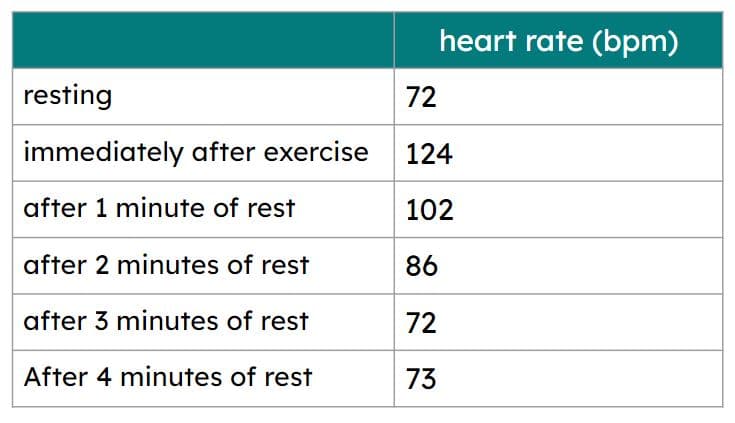
Q5.Aisha measured her heart rate, then did some exercise and measured her heart rate again at one-minute intervals.
Here are her results.
How long was Aisha’s recovery time?
Q6.Which type of diagram is best for recording changes to heart rate after exercise?
To help you plan your 6 science lesson on: Heart recovery time after exercise, download all teaching resources for free and adapt to suit your pupils' needs...
To help you plan your 6 science lesson on: Heart recovery time after exercise, download all teaching resources for free and adapt to suit your pupils' needs.
The starter quiz will activate and check your pupils' prior knowledge, with versions available both with and without answers in PDF format.
We use learning cycles to break down learning into key concepts or ideas linked to the learning outcome. Each learning cycle features explanations with checks for understanding and practice tasks with feedback. All of this is found in our slide decks, ready for you to download and edit. The practice tasks are also available as printable worksheets and some lessons have additional materials with extra material you might need for teaching the lesson.
The assessment exit quiz will test your pupils' understanding of the key learning points.
Our video is a tool for planning, showing how other teachers might teach the lesson, offering helpful tips, modelled explanations and inspiration for your own delivery in the classroom. Plus, you can set it as homework or revision for pupils and keep their learning on track by sharing an online pupil version of this lesson.
Explore more key stage 2 science lessons from the Keeping healthy unit, dive into the full primary science curriculum, or learn more about lesson planning.