


The force of a floor



Lesson details
Learning outcome
I can explain how a floor can support a range of objects with very different weights.
Key learning points
- More force is needed to hold up a bigger mass up in the air.
- The bigger the mass on a beam, the more the beam bends.
- The more a beam bends, the greater the force it pushes back with.
- The bigger the mass on a floor, the more particles in the floor are squashed together.
- The more particles in a floor are squashed together, the greater the force they push back with.
Keywords
Gravitational force - A gravitational force acts on any object inside a gravitational field.
Normal reaction force - When an object rests on a surface, there will be a normal reaction force acting on it.
Elastic - Materials are elastic if they return to their original shape when forces are removed from them.
Electrostatic force - The force between two electrically charged particles is an electrostatic force.
Common misconception
There is a downwards force on a surface, but no upward force, the surface just gets in the way.
Have pupils describe upward forces they need to exert whilst supporting different sized weights at arms length.
Teacher tip
Demonstrate the setup with a ruler and supports before pupils begin the activity. Ensure pupils place the 30 cm ruler behind the metre ruler accurately to measure the bend effectively. Highlight the importance of recording readings carefully as measurements could be as small as millimetres.

Content guidance
Risk assessment required - equipment

Supervision
Adult supervision required

Licence

Lesson video
Loading...
Prior knowledge starter quiz
6 Questions
Q1.Which word is used to describe the downwards force of an object on a surface it is resting on?
Q2.Which of the following affects the amount of weight of an object on a surface?
Q3.What word is used to describe a material that returns to its original shape when the forces acting on it are removed?
Q4.What type of electric charge do electrons carry?
Q5.What type of force acts between two objects that are electrically charged?
Q6.Which of the following correctly describe the structure of an atom?
Assessment exit quiz
6 Questions
Q1.Match the key words with the descriptions.

Q2.Izzy holds a mass stationary in her hand. Which statements are correct?
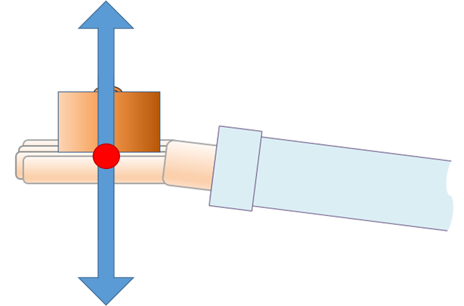
Q3.What happens to the size of the electrostatic forces between two surfaces when they are pushed closer together?
Q4.Some pupils use a plank of wood to build a bridge across a ditch. They walk across the plank one at a time to get to the other side. What happens to the wooden plank as they walk across?
Q5.How do the forces between atoms in solids operate?
Q6.A 5 kg mass is placed on a solid surface. What happens when a second identical mass is placed on top of the first?
To help you plan your 9 science lesson on: The force of a floor, download all teaching resources for free and adapt to suit your pupils' needs...
To help you plan your 9 science lesson on: The force of a floor, download all teaching resources for free and adapt to suit your pupils' needs.
The starter quiz will activate and check your pupils' prior knowledge, with versions available both with and without answers in PDF format.
We use learning cycles to break down learning into key concepts or ideas linked to the learning outcome. Each learning cycle features explanations with checks for understanding and practice tasks with feedback. All of this is found in our slide decks, ready for you to download and edit. The practice tasks are also available as printable worksheets and some lessons have additional materials with extra material you might need for teaching the lesson.
The assessment exit quiz will test your pupils' understanding of the key learning points.
Our video is a tool for planning, showing how other teachers might teach the lesson, offering helpful tips, modelled explanations and inspiration for your own delivery in the classroom. Plus, you can set it as homework or revision for pupils and keep their learning on track by sharing an online pupil version of this lesson.
Explore more key stage 3 science lessons from the Hidden forces unit, dive into the full secondary science curriculum, or learn more about lesson planning.