Add two 3-digit numbers using adjusting strategies
I can adjust a number to make an addition easier.


- Year 3
Add two 3-digit numbers using adjusting strategies
I can adjust a number to make an addition easier.
Lesson details
Key learning points
- If you adjust an addend you adjust the sum by the inverse.
- If you add 1 to an addend you must subtract 1 from the sum.
- If you subtract 1 from an addend you must add 1 to the sum.
- A number line can represent the adjusting strategy.
Keywords
Adjust - When you adjust you make a small change to a number. This is done to make a calculation easier to solve mentally.
Inverse - The inverse is the opposite or reverse operation. For example, subtraction is the inverse operation of addition.
Efficient - Working efficiently means finding a way to solve a problem quickly whilst also maintaining accuracy.
Common misconception
Many pupils will want to use a written method/algorithm immediately such as column method. This lesson is to support mental addition strategies.
Encourage the children to forget about using written procedures because they are inefficient when the addends are suited to adjustment. As class teacher, use adjustment and race the children desperate to use columns to see who is fastest!


Licence
Lesson video
Loading...
Prior knowledge starter quiz
6 Questions
Q1.Which of these numbers is closest to 10?
Q2.Which of these numbers is closest to a tens boundary?
Q3.Which of these numbers is closest to 100?
Q4.Which number is closest to a hundreds boundary?
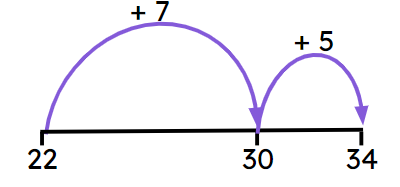
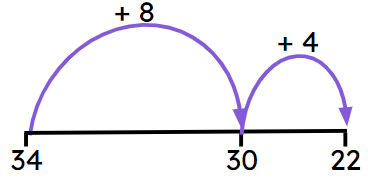
Q5.Which of these number lines accurately represents 22 + 12 = 34 using partitioning to bridge?
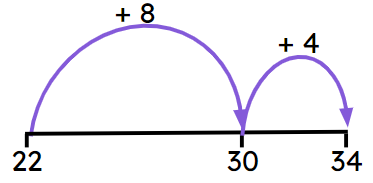
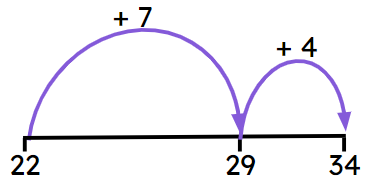
Q6.Match the complements to 100

Assessment exit quiz
6 Questions
Q1.What is the inverse of subtract 4?
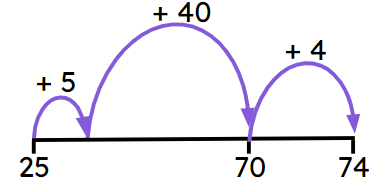
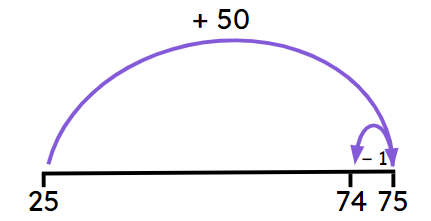
Q2.Which of these number lines represents using adjustment to find the total of 25 + 49?