


Air resistance: do and review
I can carry out an investigation into air resistance and evaluate results.


- Year 5
Air resistance: do and review
I can carry out an investigation into air resistance and evaluate results.


Lesson details
Key learning points
- Scientists often repeat tests in order to gather more information and make sure their results did not happen by chance.
- The findings from an investigation can be summarised in a conclusion.
- A greater surface area on a moving object can increase air resistance.
Keywords
Force - A force is a push or a pull. Forces can make objects move, change speed, change direction or change shape.
Air resistance - Air resistance is a type of frictional force that acts between the air and the surface of a moving object.
Fair test - A fair test is where only one thing is changed to see what effect that has on the results of the investigation.
Conclusion - In a conclusion, scientists explain what the results show or mean.
Common misconception
Air resistance does not exist or it only works vertically.
Explicit teaching including diagrams and examples of air resistance working in all directions.


Equipment
See additional materials for guidance.

Content guidance
- Risk assessment required - equipment

Supervision
Adult supervision required

Licence
Lesson video
Loading...
Prior knowledge starter quiz
6 Questions
Q1.Air resistance is a type of force.
Q2.Match the type of force to the example.

Q3.Scientists control all but variable in a fair test investigation.
Q4.What does air resistance do to moving objects?
Q5.Match whether engineers would want to maximise or minimise air resistance to the correct situation:
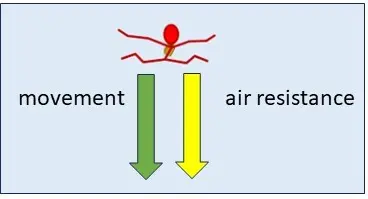
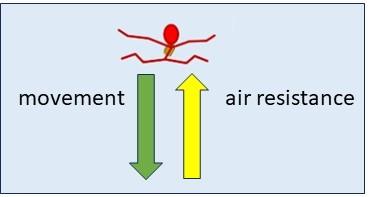
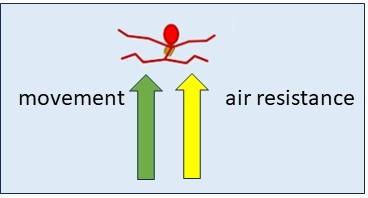
Q6.Which of these pictures shows the direction of air resistance correctly?
Assessment exit quiz
6 Questions
Q1.Which of these is not a reason that scientists repeat tests?
Q2.Match the part of the investigation write-up to the content you might find there.
