


Arithmetic sequences
I can appreciate the features of an arithmetic sequence and be able to recognise one.


- Year 8
Arithmetic sequences
I can appreciate the features of an arithmetic sequence and be able to recognise one.
Lesson details
Key learning points
- Finding the difference between each term can help you identify different types of sequence.
- Sequences with a constant difference are arithmetic sequences.
- Arithmetic sequences can be uniquely described with an initial term and a common difference.
- It is possible to identify which sequences are arithmetic.
Keywords
Arithmetic sequence - An arithmetic (or linear) sequence is a sequence where the difference between successive terms is a constant.
Common misconception
Sequences such as triangular numbers which have a linear sequence in their differences are linear.
Terms in an arithmetic sequence have to have a common first difference.


Licence
Lesson video
Loading...
Prior knowledge starter quiz
6 Questions
Q1.Which sequences have a constant additive pattern?

Q2.Which sequences have a constant multiplicative pattern?
Q3.Calculate the perimeter of this rectangle.
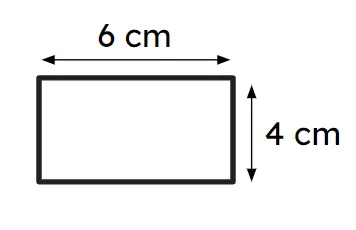
Q4.Which of these is the area of this rectangle?
Q5.What is the term-to-term rule for a sequence with a constant additive pattern which has first term = 23 and 4th term = 41.
Q6.What is the value of $${6\over 7} - 2{1\over2}$$
Assessment exit quiz
6 Questions
Q1.Match the keyword to its definition.
arithmetic sequence - a sequence that increases or decreases by the same step
common difference - the constant additive rule from one term to the next
initial term - the first term in a sequence
successive terms - terms that are next to each other in a sequence
Q2.Match the arithmetic sequences with their descriptions.
7, 5, 3, 1, ... - initial term $$7$$ and common difference $$-2$$
7, 9, 11, 13, ... - initial term $$7$$ and common difference $$2$$
-1.6, -1.3, -1, -0.7, ... - initial term $$-1.6$$ and common difference $$0.3$$
-1.6, -1.9, -2.2, -2.5, ... - initial term $$-1.6$$ and common difference $$-0.3$$
-2, 3, 8, 13, ... - fifth term $$18$$ and common difference $$5$$
38, 33, 28, 23, ... - ninth term $$-2$$ and common difference $$-5$$
Q3.Which of these sequences are arithmetic?
Q4.In which of these sequences do the number of shaded squares in each term form a linear sequence?
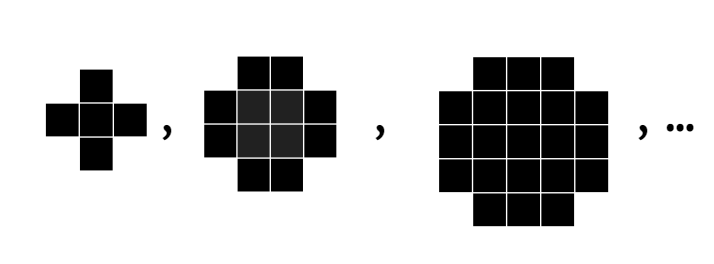
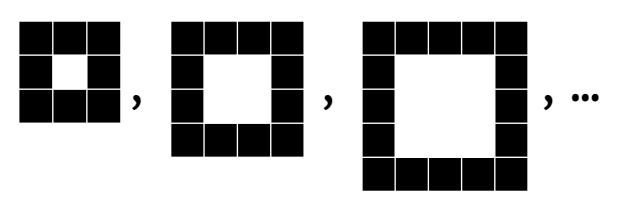
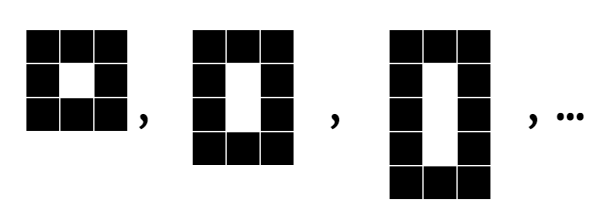
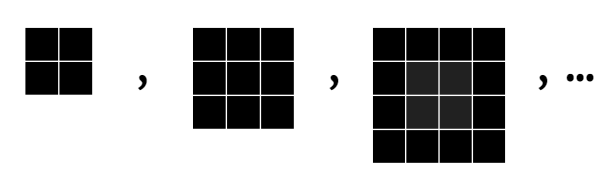
Q5.An arithmetic sequence has 3rd term = 41 and 7th term = 65. What is the initial term?
Q6.Which of these sequences are arithmetic?
